Key Takeaways
- The Scalper’s Paradox: High frequency often leads to negative PnL due to transaction costs and emotional fatigue; true profitability stems from surgical precision, not volume.
- Minimalism as an Edge: By focusing on "A+" setups and ignoring market noise, traders reduce cognitive load and preserve capital.
- Friction is the Enemy: Understanding the impact of the bid-ask spread and slippage is essential for maintaining a sustainable risk-to-reward ratio.
- Process over Prediction: Success is built on a 3-step framework: identifying liquidity targets, waiting for momentum confirmation, and executing with strict risk parameters (0.5%–1% per trade).
The Paradox of Crypto Scalping: Why More Trades Equal Less Profit
If you have ever spent twelve hours glued to a monitor, executed fifty trades, and ended the day with a 70% win rate yet a negative account balance, you have experienced the "Scalper’s Paradox." It is the most common pitfall for intermediate traders: the belief that the best scalping strategy for crypto is defined by the volume of activity rather than the quality of execution. In reality, the crypto market is a high-friction environment where your greatest enemy isn't necessarily a bad price prediction—it is the erosion of your capital through transaction costs and emotional fatigue.
The Math of "Busy but Broke"
Most traders treat scalping as a game of rapid-fire clicks, attempting to catch small bursts of market liquidity or minor shifts in price action. However, they often ignore the silent killers: the bid-ask spread and exchange fees. When you trade with high frequency, you aren't just fighting the market; you are fighting the house.
- Fee Erosion: In crypto, "taker" fees can quickly eat 0.05% to 0.1% per trade. If you are scalping for a 0.2% move, half of your profit is gone before you even exit.
- The Leverage Trap: While scalpers often use leverage to amplify small moves, overcommitting on a single losing trade can wipe out dozens of incremental gains. High-leverage strategies often lead to "chasing" larger profits, which negates hours of disciplined work.
- Negative Risk-to-Reward Ratio: Many scalpers fall into the habit of cutting winners short and letting losers run. They bank small profits to maintain a high win rate but allow one "stop-loss hunt" to devastate their equity.
💡 Manic Reality Check: You are not a high-frequency trading bot. You are a human with limited dopamine. Stop spamming the buy button. Learn how to trade like a sniper, not a machine gunner, in Visualizing Velocity: Why Most Indicators Are Just Noise.
What is Minimalist Scalping? Quality Over Quantity
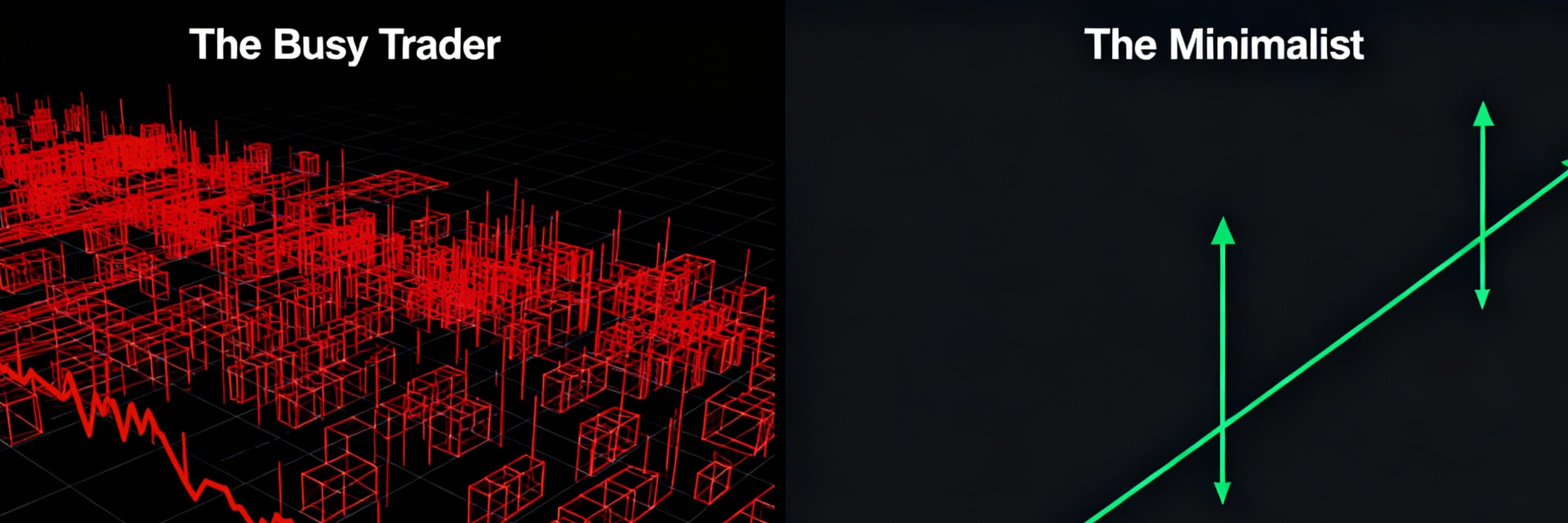
In the high-octane world of digital assets, traditional scalping is often portrayed as a frantic race against the clock. Standard definitions describe it as a strategy where traders execute dozens of trades per day to capture tiny price fluctuations. However, for the intermediate trader, this approach often leads to a "busy but broke" reality.
Minimalist scalping redefines this intensity by shifting the focus from frequency to precision. It is the "Zen" of the market—a philosophy that suggests the best scalping strategy for crypto isn't about chasing every 1-minute candle, but about waiting for the rare moments where liquidity and price action align perfectly.
Indicator-free trading relies on pure price action patterns. Engulfing candlesticks at key levels provide clearer reversal signals than any RSI divergence or MACD cross, with zero lag.
The Core Pillars of the Minimalist Approach
To transition from a frantic scalper to a minimalist one, you must adopt a framework that prioritizes mental clarity over raw trade volume:
- Selective Participation: This adheres to the principle of being patient and looking only for opportunities that meet strict strategic criteria. If the market is choppy, the minimalist choice is to stay in cash.
- Reduced Cognitive Load: By ignoring the "micro-noise" and focusing on significant order flow imbalances, you preserve your emotional capital.
- Precision over Probability: Rather than relying on the law of large numbers, minimalist scalping utilizes highly accurate price action patterns—such as flags or pennants—that signal immediate momentum.
⚔️ The Tale of Two Traders
| Metric | The "Grinder" (High Frequency) | The Minimalist (Sniper) |
|---|---|---|
| Trades per Day | 50 | 3 |
| Win Rate | 60% | 66% |
| Fees Paid | $$$ (Massive Erosion) | $ (Negligible) |
| Mental State | Exhausted / Anxious | Calm / Focused |
| Net Result | Loss (Death by Fees) | Profit (Clean Alpha) |
The Hidden Killers: Slippage and Bid-Ask Spreads in Scalping
In the pursuit of the best scalping strategy for crypto, many traders fall into the trap of focusing solely on entries. However, the technical reality of the market—specifically market liquidity and execution costs—acts as a silent drain on capital.
The Mathematics of the Bid-Ask Spread
At its core, scalping is a style where a speculator attempts to exploit small price gaps created by the bid-ask spread. In the crypto market, this spread represents the difference between the highest price a buyer is willing to pay and the lowest price a seller is willing to accept. If you are aiming for a 0.5% gain but the spread accounts for 0.1%, you are effectively starting every trade with a 20% "tax" on your potential profit.
The Liquidity Trap: Timing and Volatility
Execution costs are not static. Just as forex traders face periods where liquidity dries up, crypto markets experience "thin" periods. To maintain a sustainable PnL, you must align your strategy with periods of high volume, such as the London-New York overlap, to ensure:
- Tighter Spreads: High competition among market makers reduces the gap between bid and ask.
- Reduced Slippage: Deep order books allow for larger entries without moving the price against yourself.
A Minimalist Toolkit: Only the Indicators You Actually Need
The "busy but broke" trader often suffers from "indicator soup"—a chart so cluttered with lagging overlays that the actual price action is invisible. To execute the best scalping strategy for crypto, you must realize that complexity is a liability.
The Foundation: Pure Price Action
Before looking at a single oscillator, you must master the building blocks of the market: Japanese Candlesticks. In a minimalist framework, you look for:
- Key Levels: Identifying where liquidity rests (support and resistance).
- Rejection Signals: Long wicks that indicate a sudden shift in sentiment.
- Market Structure: Higher highs or lower lows that dictate the immediate flow.
Moving from Commands to Flow: The MACD
Many traders fail because they treat technical indicators like a binary switch. As noted in explanations of the MACD, markets don't move in rigid steps; they flow. The MACD (Moving Average Convergence Divergence) is the only momentum tool a minimalist needs, provided you use it to read "market health" rather than as a simple signal generator.
The Essential Minimalist Checklist
To maintain a "zero-noise" workspace, your toolkit should be restricted to:
- Price Action & Volume: To confirm the validity of a breakout.
- MACD Flow: To gauge the strength of the move and avoid entering a "dying" trend.
- Risk-to-Reward Ratio (R:R): Ensuring every scalp is mathematically sound.
Minimalism isn't aesthetics—it's cognitive load science. Your brain can hold 4-7 chunks in working memory, and every unnecessary indicator steals capacity from actual decision-making.
The 3-Step Low-Drawdown Scalping Setup
To maintain a low-drawdown profile—essential for those aiming to pass prop firm challenges—you must shift your focus from "guessing direction" to "identifying institutional intent."
Step 1: Identify the Liquidity Target
Before entering, determine where the market is likely to head to find "fuel." In crypto, fuel is market liquidity—clusters of stop-losses sitting just above recent highs or below recent lows. Wait for a "liquidity sweep," where the market briefly breaks a key level to trigger stops before reversing direction.
Step 2: Wait for Momentum Confirmation
Entering exactly at the support line is a recipe for high drawdown. Wait for the market to prove its new direction. On a 1-minute or 5-minute chart, wait for a "displacement" move—a sharp candle in the opposite direction of the sweep.
Step 3: Execute with Strict Risk Parameters
Scalping success is a game of statistics. To protect your PnL, your execution must be clinical:
- The Non-Negotiable Stop-Loss: Place a protective stop-loss order immediately. Consistent stop-losses can improve long-term profitability significantly.
- Defined Exit Targets: Aim for a 1:2 or 1:3 risk-to-reward ratio. Capturing small, sustainable percentage moves is better than waiting for a massive breakout that may never come.
Risk Management for the Minimalist Trader
In the high-velocity world of digital assets, the best scalping strategy for crypto is not defined by how much you can win, but by how little you are willing to lose. Risk management is the "hidden skill" that separates professional consistency from amateur gambling.
The 0.5%–1% Rule: Protecting Your Capital
Minimalism starts with position sizing. To maintain a sustainable ratio, you must strictly define your maximum risk per trade. Limit your risk to 0.5% to 1% of your total account balance per position. If you have a $10,000 account, you should never lose more than $50 to $100 on a single trade. Never enter the market without a stop-loss; it is your non-negotiable exit strategy.
Winning the Inner War: Avoiding the Revenge Trade
The greatest threat to a scalper is the "inner war" of trading psychology. When a trade hits your stop-loss, the ego often demands a "revenge trade." To maintain control, implement these constraints:
- Daily Loss Limits: Establish a "circuit breaker." Once you reach a predetermined loss threshold, stop trading immediately.
- Partial Profit Taking: Reduce psychological pressure by securing "banked" profits early.
- Structure-Based Trailing: Move stops behind recent swing highs or lows to lock in profit while giving the trade room to breathe.
Mastering the Flow: From Over-Trading to Consistent Gains
The transition to a profitable professional is about shifting from a reactive state to a proactive one. Proactive traders understand that market liquidity dictates when a move is genuine. Instead of reacting to every minor tick, they wait for the market to come to their predefined levels.
Overcoming the Over-Trading Myth
Over-trading is often a symptom of a lack of detachment from the outcome. To achieve long-term sustainability, you must develop emotional detachment. In crypto, where volatility is the norm, the "minimalist" approach is your greatest edge.
To transition toward consistent gains, remember these foundational shifts:
- Prioritize Quality Over Frequency: One high-probability trade is worth more than ten low-conviction "scratches."
- Embrace the "Boring" Trade: The most effective setups often occur during quiet periods of consolidation.
- Protect Your Capital First: Shift your mindset from "how much can I make?" to "how much can I lose?"
🚀 Trade Clean, Trade Fast: Minimalist trading requires a minimalist platform. No pop-ups, no KYC delays, no "Trade Disabled" errors.Manic.Trade is built for pure execution. Just connect your wallet and trade the flow.
FAQ
What is the best timeframe for crypto scalping?
While many traders use the 1-minute chart, the "minimalist" approach often finds better success on the 5-minute or 15-minute timeframes. These higher timeframes filter out institutional "noise" and provide more reliable price action signals while still offering multiple opportunities per day.
How much capital do I need to start scalping crypto?
Because professional scalpers risk only 0.5% to 1% per trade, starting capital depends on your income goals. However, with the rise of funded account programs and low-fee exchanges, many traders start with as little as $1,000 to $5,000 to practice execution before scaling up.
Can I use trading bots for a minimalist scalping strategy?
Yes, crypto scalping bots can be effective for executing the "mechanical" parts of a strategy, such as placing stop-losses and taking partial profits. However, the "minimalist" philosophy still requires human oversight to identify high-quality market structures that algorithms might misinterpret.
Why is my win rate high but my profit negative?
This is usually due to the "Scalper’s Paradox." High transaction costs (fees and spreads) combined with a poor risk-to-reward ratio (letting losers run too long) can wipe out the gains from a high win rate. Shifting to fewer, higher-quality trades helps mitigate these costs.
Is leverage necessary for scalping?
Leverage is a tool used to amplify small price movements (e.g., a 0.5% move). While it is common in scalping, it must be used with extreme caution. The key is to ensure your "position size" is calculated based on your stop-loss distance, ensuring you never risk more than 1% of your total equity regardless of the leverage used.
Related Reading
This article is part of our comprehensive guide: Trading Psychology for High-Frequency Scalping: The Complete Mental Discipline Guide.
Discover why 90% of scalpers fail psychologically, the 5 core mental traps destroying traders, and the architectural solutions that eliminate discipline failure without relying on willpower.