Looking for Polymarket alternatives in 2026? The best option depends on what you were actually using Polymarket for. Some traders want another event market for politics, macro, or sports outcomes. Others are really looking for a better way to trade short-term crypto price direction.
Those are not the same use case, and most comparison guides mix them together. That is why many “Polymarket alternatives” roundups feel helpful at first but do not actually point you to the right platform.
This guide separates the main alternatives by category, compares where each one fits, and shows which options make sense for event bettors versus crypto traders.
What are the best Polymarket alternatives in 2026?The best Polymarket alternative depends on what you want to trade. Kalshi, Manifold, and Augur are alternatives for users who want event prediction markets. Manic.Trade is the better alternative for users who actually want to trade short-term crypto price direction instead of event outcomes.
In practical terms:
- Best for US-regulated event trading: Kalshi
- Best for free forecasting practice: Manifold
- Best for on-chain event-market purists: Augur
- Best for BTC/SOL/ETH price direction trading: Manic.Trade
Quick Takeaways
- Polymarket alternatives in 2026 fall into two different categories: event prediction platforms like Kalshi, Manifold, and Augur, and crypto price direction platforms built for short-term BTC, ETH, or SOL moves. The best alternative depends on whether you want to trade event outcomes or price movement.
- Most “Polymarket alternatives” articles blur those two use cases together, which is why many traders leave still feeling like none of the options actually fit. If you used Polymarket for elections, macro events, or sports outcomes, you need another event market. If you used Polymarket’s price-threshold contracts as a proxy for fast crypto speculation, you are solving a different problem entirely.
- In reviewing the way these platforms handle contract resolution, user onboarding, and time-to-settlement, the real divide is not decentralized vs regulated. It is event resolution vs execution-speed trading. That distinction is what this guide is built around.
- This guide compares the main Polymarket alternatives side by side, shows which one fits each user type, and explains why crypto price traders often need a category that standard prediction-market roundups leave out.
Direct Answer Block
What are the best Polymarket alternatives?
It depends on what you actually want to do:
- If you want to bet on events (elections, sports, macro outcomes): Kalshi (US-regulated), Manifold (free, play money), Augur (on-chain, complex)
- If you want to trade crypto price direction (will BTC go up or down in the next 30 seconds to 5 minutes): Manic.Trade (Solana, on-chain, $0 fees, no KYC)
Most comparison articles only cover the first category. This guide covers both.
What Polymarket Actually Is — And Why People Want to Leave
Polymarket is a decentralized prediction market built on Polygon. You deposit USDC and trade shares in binary outcomes: "Will X happen by Y date?" The price of a share reflects the market's collective probability assessment.
Why people search for alternatives:
The "People Also Ask" box on Google tells you everything. The top questions for "polymarket alternatives" are:
- Is trading on Polymarket illegal? — Polymarket settled with the CFTC in 2022 for $1.4M and blocked US users. Many people outside the US still use it, but the regulatory overhang creates uncertainty.
- Did Polymarket get shut down? — It didn't, but the CFTC action scared users into looking for alternatives.
- Who is Polymarket's biggest competitor? — Kalshi, per most SEO traffic. But this answer only holds if you're comparing event prediction markets.
What these search questions reveal: Users are leaving Polymarket primarily due to regulatory concerns and geographic restrictions — not because they hate the product category. A subset of them, though, were never event bettors to begin with. They were crypto traders who used Polymarket's price markets ("Will BTC be above $80K on March 1?") as a proxy for directional speculation. For that group, none of the standard alternatives work.
The Two Types of "Polymarket Alternative" Users
Before comparing platforms, you need to know which type of user you are.
| What you want to do | Platform you need |
|---|---|
| Bet on elections, macro events, "will X happen?" | → Section 2: Kalshi / Manifold / Augur |
| Trade BTC/SOL direction in the next 30 seconds to 5 minutes | → Section 3: Manic.Trade |
Type 1: The Event Bettor You loved Polymarket because you could bet on election outcomes, Fed rate decisions, whether a specific CEO would resign. You want regulated, trusted infrastructure. You care about long-form markets (days, weeks, months). You probably follow prediction market aggregators like Metaculus.
→ You want Kalshi or Manifold.
Type 2: The Price Direction Trader You used Polymarket's BTC/ETH price markets. You want to speculate on whether a crypto asset will be higher or lower in the next few minutes. You're closer to a scalper than a forecaster. You care about execution speed, not event research. You've probably been frustrated by every "alternatives" list because they keep recommending platforms that make you research elections.
→ You want Manic.Trade.
If you're evaluating Kalshi more broadly, the more useful next step is understanding whether you actually want an event market at all. Our guide to apps like Kalshi separates event-contract users from traders who are really looking for short-term crypto price exposure.
Section 2: Best Polymarket Alternatives for Event Bettors
Kalshi — The Regulated US Option
Kalshi is federally regulated by the CFTC, making it the only legally compliant prediction market for US users. It launched in 2021 after a multi-year regulatory approval process.
What makes Kalshi different from Polymarket:
| Feature | Polymarket | Kalshi |
|---|---|---|
| Regulatory status | Decentralized, blocked US users | CFTC-regulated, US-legal |
| Settlement currency | USDC (crypto) | USD (bank/card) |
| Market types | Politics, sports, crypto prices | Politics, economics, weather, sports |
| Custody | Non-custodial (user wallet) | Custodial (Kalshi holds funds) |
| KYC required | No | Yes |
| On-chain settlement | Yes (Polygon) | No (centralized) |
| Verdict | ⚠️ Regulatory uncertainty | ✅ US-legal, trusted |
Who Kalshi is for: US-based users who want to trade event outcomes legally. If you're betting on Fed rate decisions, election results, or economic indicators, Kalshi is currently the most legitimate option in the US market.
Kalshi's limitation: It's designed for macro event research, not fast crypto price execution. If you want to make a directional bet on BTC in the next 30 seconds, Kalshi's architecture isn't built for that.
For traders who want to compare the two dominant event platforms directly, our Polymarket vs Kalshi comparison breaks down the differences in market structure, contract resolution, and why neither platform was designed for fast crypto price direction trading.
Manifold — Free Play-Money Markets
Manifold lets anyone create prediction markets on anything, using a fictional currency called mana. There's no real money involved, which means no regulatory issues — but also no financial upside.
Best for: Calibration practice, group forecasting, internal company prediction markets, intellectual curiosity. Not for anyone who wants real stakes.
Augur vs Polymarket: The Original On-Chain Market vs the One That Won
Augur is the most instructive case study in prediction market history — not because it succeeded, but because its failure is the exact blueprint Polymarket used to succeed.
Understanding Augur vs Polymarket explains why the current prediction market landscape looks the way it does, and why most "decentralized alternatives" to Polymarket still repeat Augur's core mistakes.
What Augur actually is:
Augur launched in 2018 as the first major decentralized prediction market, built on Ethereum. The concept was genuinely innovative: a permissionless, on-chain prediction market where anyone could create markets on any topic, with outcomes resolved by a decentralized network of REP token holders rather than a central authority.
It raised $5.3M in one of the earliest token sales in crypto history. At peak, REP token hit a $1.35B market cap. The whitepaper was cited in every subsequent prediction market proposal for five years.
By 2021, Augur was functionally dead. Daily active users had collapsed to double digits. Volume was negligible.
Why Augur failed where Polymarket succeeded:
| Feature | Augur | Polymarket |
|---|---|---|
| Blockchain | Ethereum (L1) | Polygon (L2) |
| Gas fees | $5–50 per trade | Near zero |
| Resolution mechanism | REP token holders (complex) | UMA optimistic oracle (streamlined) |
| Market creation | Anyone (fragmented liquidity) | Curated (concentrated liquidity) |
| UX | Requires REP token, complex onboarding | USDC wallet, simple interface |
| Dispute window | 7 days minimum | 48 hours |
| Verdict | ❌ Economically unviable for small trades | ✅ Accessible for any position size |
The core problem was Ethereum gas fees. At $5–50 per trade, Augur made it economically impossible to place positions under a few hundred dollars. A $20 bet on a US election outcome would cost $30 in gas. The platform was self-defeating: the users who most wanted to use it couldn't afford to.
Polymarket solved this by moving to Polygon, reducing transaction costs to near zero. That single infrastructure decision unlocked the entire retail market that Augur could never reach.
The oracle problem:
Augur's second failure was its resolution mechanism. REP token holders were supposed to report event outcomes honestly, incentivized by the staking economics. In practice, the system was slow (7-day dispute windows), complex, and vulnerable to low-participation periods where a small number of REP holders could determine outcomes. For time-sensitive events, waiting a week for resolution destroyed the product's utility.
Polymarket's UMA optimistic oracle reduced this to 48 hours with cleaner dispute mechanics. Not perfect — the Iran attack oracle disputes in 2024 showed the system still struggles with ambiguous geopolitical events — but structurally far faster than Augur's REP-based resolution.
What Augur got right (that everyone forgets):
Augur's architecture proved several things that now define the entire prediction market space:
- On-chain settlement is possible at scale
- Non-custodial markets remove counterparty risk
- Permissionless market creation enables markets traditional platforms won't list
- Decentralized oracles can replace centralized resolution
Every platform that came after Augur — including Polymarket — built on these foundations. Augur demonstrated the potential of crypto-native innovation, but exposed the gap between concept and practical application. Polymarket took the concept and fixed the economics.
Should you use Augur today?
Decentralized prediction markets like Augur offer censorship resistance and no KYC, but liquidity is typically 10–100× lower than Polymarket or Kalshi, with spreads of 10–30% , making profitable trading difficult for most users.
Augur in 2026 is best for: DeFi purists who prioritize maximum decentralization, traders who want to create markets that centralized platforms won't list, or users in jurisdictions where Polymarket and Kalshi are inaccessible.
For everyone else: Polymarket has better liquidity, lower effective costs, and a far simpler UX. Augur's ideological purity doesn't offset its practical disadvantages when a better-architected alternative exists.
The lesson for crypto price direction traders:
Neither Augur nor Polymarket solves the core problem for scalpers: both are event markets with multi-day resolution timelines. The "Augur vs Polymarket" question is relevant if you're choosing between event betting platforms. If you're trying to trade whether SOL goes up or down in the next 5 minutes, you're asking the wrong question entirely — which is exactly what our Section 3 covers.
For a full three-generation comparison — Augur's gas failure, Gnosis's
pivot to infrastructure, and how Polymarket inherited the CTF framework — see Polymarket vs Augur vs Gnosis (2026): Why All Three Got the Architecture Wrong for Crypto Price Traders.
The Honest Event-Betting Verdict
| Platform | Best For | US Legal | On-Chain | Fees | Speed |
|---|---|---|---|---|---|
| Kalshi | Regulated event trading | ✅ Yes | ❌ No | Low | Medium |
| Manifold | Play-money practice | ✅ Yes | ❌ No | Free | Fast |
| Augur | Decentralized events | ✅ Yes | ✅ Yes | High (ETH gas) | Slow |
| Polymarket | Broad event markets | ❌ Blocked US | ✅ Yes (Polygon) | Low | Medium |
If you're an event bettor, stop here. Kalshi is your answer if you're in the US. Polymarket is your answer if you're outside the US and comfortable with the regulatory ambiguity.
If you're a price direction trader, keep reading.
Other Platforms Frequently Compared to Polymarket
These platforms appear in most "Polymarket alternatives" lists. Here's a one-line honest assessment of each — and why none of them address the crypto price direction use case:
| Platform | What It Actually Is | Why It Doesn't Replace Polymarket for Price Traders |
|---|---|---|
| Myriad | Social prediction market on BNB Chain/Linea, YES/NO event contracts, virtual points for beginners | Event-betting framework — no crypto price direction markets, no sub-5min resolution |
| PredictIt | US-regulated political prediction market, max $3,500 per contract, 5% deposit + 10% commission on wins | Politics-only, high fees, US-restricted, no crypto markets |
| Predict.fun | Decentralized prediction exchange on BNB Chain/Blast, AMM-style, $267M 30-day volume | Event markets (politics, sports, crypto price thresholds with multi-day resolution), not short-timeframe execution |
| Manifold | Play-money forecasting platform, virtual currency (mana), no real stakes | No financial upside — useful for calibration practice, not trading |
| Augur (2026) | Ethereum-based, decentralized, REP token oracle — see full analysis above | High gas fees, 7-day dispute windows, low liquidity vs Polymarket |
| Metaculus | Aggregation platform for long-form forecasting, no financial markets | Research tool, not a trading platform |
The pattern: Every platform on this list is built around the question "will X event happen?" Not one of them asks "will BTC be higher or lower in the next 30 seconds?" That's not a gap they're trying to fill. It's a different product category entirely.
The 2026 Regulatory Problem: Why Even "Safe" Alternatives Have New Risk
The standard recommendation — "use Kalshi if you're in the US, Polymarket if you're outside" — has developed a significant crack in 2026 that most comparison articles haven't updated for.
The full legal timeline — Nevada cease-and-desist, 9th Circuit ruling, Polymarket remand, and what 24 simultaneous state lawsuits mean for platform stability — is covered in our [Kalshi vs Polymarket Regulation: What the 2026 Rulings Mean for Crypto Price Traders]
What happened to Kalshi:
In February 2026, the 9th Circuit Court of Appeals upheld Nevada's right to block Kalshi from offering sports event contracts in the state. Nevada's Gaming Control Board filed a civil enforcement action, arguing Kalshi's sports contracts constitute unlicensed wagering under state law — a position the court backed. The ruling dissolved an earlier injunction that had allowed Kalshi to continue operating in Nevada.
The implication isn't just Nevada. Legal analysts have warned this creates a "domino effect": once Kalshi has to geofence one state, its argument that geofencing creates irreparable harm collapses in every other state lawsuit. Nearly two dozen states have filed similar challenges. If courts in other jurisdictions follow Nevada's lead, Kalshi's "100% legal in all 50 states" claim becomes structurally untenable.
What happened to Polymarket:
On the same day as the Nevada-Kalshi ruling (March 3, 2026), a federal court also sent Nevada's case against Polymarket back to state court, rejecting Polymarket's bid to move the dispute to federal jurisdiction. Polymarket had argued it was "acting under" CFTC oversight and therefore exempt from state gaming law. The court disagreed. Polymarket has filed an emergency stay while it prepares an appeal.
What this means for traders choosing a "regulated" alternative:
| Platform | Current Regulatory Status (March 2026) |
|---|---|
| Kalshi | ✅ CFTC-regulated nationally, but ⚠️ Nevada sports contracts blocked; ~24 state lawsuits pending |
| Polymarket | ⚠️ Nevada case remanded to state court; US relaunch via QCEX still limited |
| Manifold | ✅ Play-money only — no regulatory exposure |
| Manic.Trade | ✅ On-chain DeFi — no geographic restrictions, no event contracts, no gaming law exposure |
The core issue: Kalshi and Polymarket's regulatory problems stem from offering event contracts that resemble sports betting. Manic.Trade has no sports contracts, no election markets, no event-based resolution. It trades crypto price direction — a fundamentally different product category that doesn't fall under state gaming law frameworks.
For traders who want legal certainty without waiting for Supreme Court resolution: the safest on-chain alternative isn't the most regulated event platform — it's the platform that never operated in the regulated event space to begin with.
Section 3: The Alternative Nobody Talks About — Price Direction Trading
Here's what's missing from every comparison article:
Polymarket had price markets. "Will SOL be above $150 on March 15?" These weren't event markets in the traditional sense — they were directional crypto bets with a binary outcome. For a subset of Polymarket users, these were the markets they actually used. Everything else was noise.
When those users search "Polymarket alternatives," they get sent to Kalshi — which doesn't have 30-second BTC price markets. They get sent to Manifold — which has no real stakes. They get sent to Augur — which has $20 gas fees per trade.
None of those answers are correct for a price direction trader.
The actual product that fills this gap is Manic.Trade.
What Manic.Trade Is
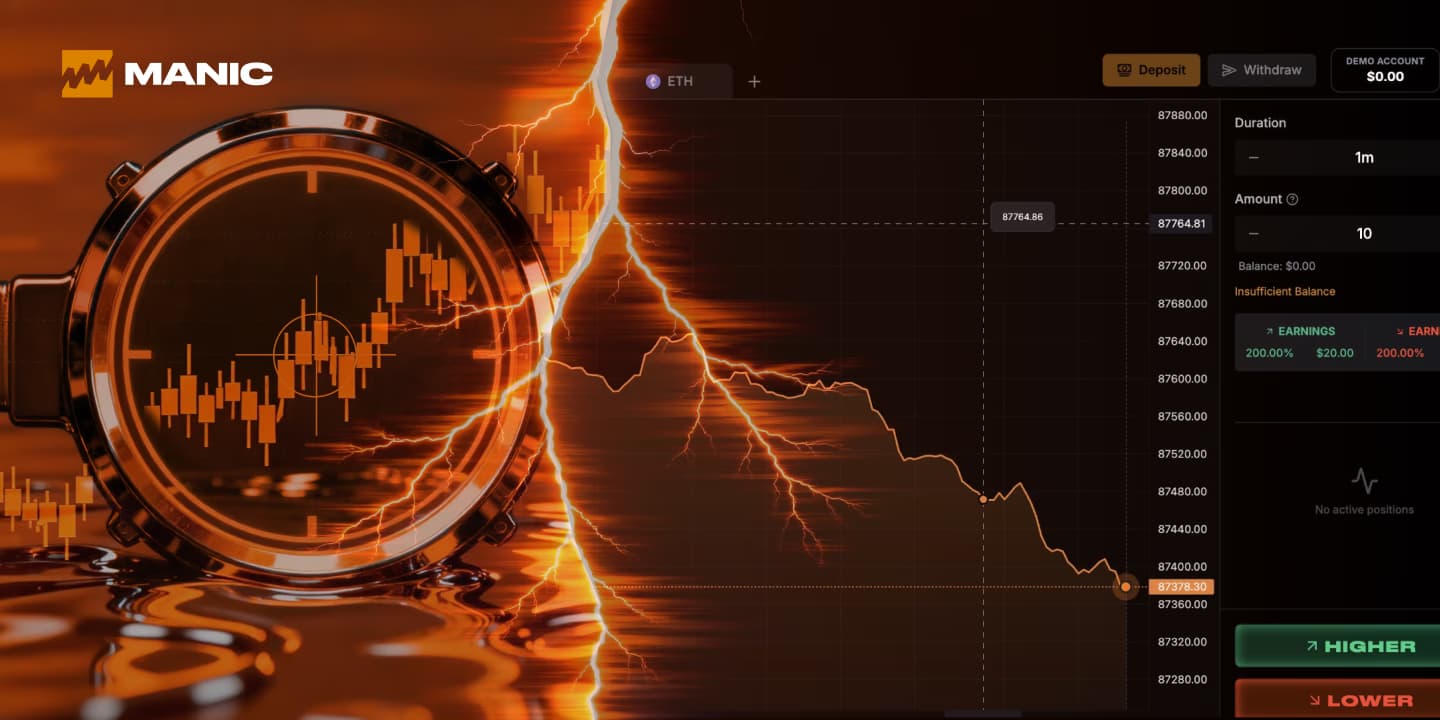
Manic is an on-chain binary direction trading platform built on Solana. The core mechanic is simple: you pick an asset (BTC, SOL, ETH), set a timeframe (30 seconds to 5 minutes), choose HIGHER or LOWER, and set your multiplier (3x conservative to 100x extreme). In 30 seconds to 5 minutes, you know the result.
This is not an event prediction market. There are no elections, no sports outcomes, no macroeconomic forecasts. It is purely: will this crypto asset be higher or lower than its current price when the timer expires?
The key differentiators from every other platform in this comparison:
Settlement speed: 400ms on Solana. Polymarket settles on Polygon (seconds). Ethereum-based platforms settle in 12-24 seconds. Manic settles in 400ms — the only platform where the infrastructure is fast enough to support 30-second trading windows without the settlement eating into your position time. For scalpers who understand the speed advantage in crypto execution, this is structural, not cosmetic.
$0 trading fees. Solana's transaction cost is $0.00025. Manic absorbs this. You pay nothing to trade. Ethereum-based platforms charge $5-50 in gas per trade — which makes sub-minute scalping economically impossible on those chains.
No KYC. Non-custodial. Connect your Solana wallet. Trade in 30 seconds. No email, no ID upload, no waiting. Your funds never leave your wallet until a trade opens. This is the DeFi-native approach that Polymarket users already understand — applied to price direction trading instead of event markets.
Pyth Network oracle. Manic's price feeds come from Pyth Network, a decentralized oracle. There is no centralized entity setting prices. Every outcome is mathematically verifiable on-chain. This eliminates the price manipulation risk that plagues offshore centralized options platforms.
Early exit capability. Most options platforms lock you in until expiry. Manic lets you exit early if you want to lock in a partial win or cut a loss. This changes the risk management calculus entirely.
On-chain transparency, Solana speed, zero fees, early exit. These four properties together don't exist on any other prediction/direction trading platform. If you need all four, Manic is currently the only option. Start trading on Manic.Trade →
The Full Platform Comparison
For Price Direction Traders
| Feature | Manic.Trade | Polymarket (Price Markets) | Kalshi | Augur |
|---|---|---|---|---|
| Asset type | Crypto prices | Crypto prices + events | Events only | Events only |
| Timeframe | 30s – 5min | Days to months | Days to months | Days to months |
| Settlement speed | 400ms (Solana) | Seconds (Polygon) | Off-chain | 12-24s (Ethereum) |
| Gas fees | $0 | Low (USDC) | None (USD) | $5-50 (ETH) |
| KYC | No | No | Yes (US regulated) | No |
| Custody | Non-custodial | Non-custodial | Custodial | Non-custodial |
| Price feed | Pyth (decentralized) | Centralized | Centralized | Centralized |
| Early exit | Yes | No | No | No |
| US legal | ⚠️ (DeFi, no geo-block) | ❌ Blocked US | ✅ CFTC regulated | ✅ |
| Multiplier control | 3x – 100x | Fixed odds | Fixed odds | Fixed odds |
| Verdict | ✅ Price traders | ⚠️ Geo-restricted | ❌ Events only | ❌ Events only |
The Psychology of Choosing the Wrong Platform
Why do traders end up on the wrong platform?
The standard mental model collapses "prediction" into one category. But prediction markets and price direction trading attract fundamentally different psychological profiles. Understanding cognitive load in trading decisions explains why: event prediction requires research, context accumulation, and probabilistic reasoning across weeks of information. Price direction trading requires pattern recognition, speed, and the ability to execute a decision in under 3 seconds without second-guessing.
These are not the same skill. Most traders who gravitate toward Polymarket's price markets are momentum-oriented. They're reading charts, not reading news cycles. Sending them to Kalshi is like recommending a chess player try poker — both involve strategy, but the cognitive demand is entirely different.
The Manic user is: someone who has tried traditional options (too complex), tried Polymarket's price markets (loved it, now geo-restricted or regulatory-anxious), and wants the cleanest possible on-chain execution environment for directional crypto bets.
That mismatch makes more sense once you look at trading psychology for high-frequency scalping: event research rewards deliberation, while short-window crypto trading punishes hesitation.
How Manic Works: The 4-Parameter Model
No order books. No Greeks. No jargon.
1. ASSET     → Select BTC, SOL, ETH, or other supported pairs
2. DIRECTION → HIGHER or LOWER
3. TIMEFRAME → 30 seconds / 1 min / 2 min / 5 min
4. MULTIPLIER → 3x (conservative) / 20x (standard) / 100x (extreme)
After the timer expires, Pyth Network's price feed is queried. If you predicted correctly, you receive your stake multiplied by your selected multiplier. If not, you lose your stake. No liquidation, no margin calls, no complex position management. The maximum you can lose on any trade is what you put in — fixed risk, fixed outcome.
The early exit feature means you're never locked in. If the price moves strongly in your favor with 10 seconds remaining, you can exit early and capture most of the gain. If it moves against you, you can exit to recover a partial stake rather than riding to zero.
This is the cleanest version of directional crypto speculation that exists on-chain today.
Want to understand why execution infrastructure determines your edge before you even place a trade? The piece on how slippage actually works in crypto explains why most traders are optimizing the wrong variable.
Who Each Platform Is Actually For
| User Type | Best Platform | Why |
|---|---|---|
| US event bettor, wants legal compliance | Kalshi | CFTC-regulated, USD-denominated |
| Non-US event bettor | Polymarket | Broad markets, USDC, no KYC |
| Play-money forecaster | Manifold | Free, any topic, no stakes |
| DeFi purist, events | Augur | On-chain, but complex + high fees |
| Crypto price direction, sub-5min | Manic.Trade | 400ms, $0 fees, on-chain, early exit |
| Traditional options trader | Deribit / Binance | Greeks, liquidity, institutional tools |
Case Study: What Happens When You Trade the Wrong Platform
The event: February 2026, BTC volatile around $94K-$98K range.
Trader A (wrong platform): Spots a momentum pattern forming on the 1-minute BTC chart. Opens a Kalshi contract: "Will BTC be above $96K by end of day?" Goes to sleep. Wakes up. BTC spiked to $98K at 2 AM and dropped back to $95K. Contract expired at $95K. Lost. The pattern was right. The instrument was wrong — a day-long contract can't capture a 2-hour momentum move.
Trader B (right platform): Spots the same pattern. Opens Manic: BTC at $94,200, 5-minute window, HIGHER, 20x multiplier. Four minutes and 22 seconds later, BTC at $94,800. Contract settled on-chain at 400ms. Win.
The pattern recognition was identical. The infrastructure determined the outcome.
This is why matching the platform to your actual trading style isn't a preference decision — it's a structural one. Momentum trading requires momentum-optimized execution. The momentum trading framework explains why pattern timing matters more than pattern identification — and why the execution window is the variable most traders ignore.
How to Start on Manic.Trade
- Go to manic.trade
- Connect your Solana wallet (Phantom, Backpack, or any Solana-compatible wallet)
- Fund with SOL (no KYC, no email required)
- Select asset → direction → timeframe → multiplier
- Confirm trade. Timer starts. Pyth oracle settles at expiry.
Total time from landing on the site to first trade: under 30 seconds.
On-chain. Non-custodial. Zero fees. 400ms settlement. The only platform purpose-built for crypto price direction traders. Start trading on Manic.Trade → Follow the community on Twitter/X · Telegram
Conclusion: Stop Using Event Markets to Trade Price Direction
The "Polymarket alternatives" conversation has been dominated by event betting infrastructure. Kalshi vs. Polymarket vs. Manifold — all three platforms exist to answer "will X happen?" That's a legitimate product category. It's just not the only one.
If what you're actually trying to do is speculate on whether BTC moves higher or lower in the next few minutes — with on-chain transparency, zero fees, and the execution speed that Solana enables — you've been looking in the wrong section of the comparison guides.
Your three-step audit:
- Look at your last 10 prediction market trades. Were they event-based (outcome of an election, a specific date threshold) or price-based (direction of a crypto asset in a short window)?
- If more than half were price-based, you've been using a wrong-category tool.
- Try one Manic trade. 30-second window, 3x multiplier, minimum stake. See what execution without 12-second settlement lag feels like.
The market doesn't care which platform you chose because the comparison article said it was the "best Polymarket alternative." Infrastructure determines outcome. Match your tool to your actual trading style.
FAQ
Who is Polymarket's biggest competitor?
Kalshi is Polymarket's closest competitor in the event prediction market category — both platforms allow users to trade on the outcomes of real-world events. However, they serve different geographies: Kalshi is CFTC-regulated and available to US users, while Polymarket blocked US users after a 2022 regulatory settlement. If you're trading crypto price direction rather than event outcomes, neither platform is your primary competitor — Manic.Trade occupies a distinct category.
Is trading on Polymarket illegal?
Polymarket is not illegal, but it is unavailable to US users following a $1.4M settlement with the CFTC in 2022. Users in most other jurisdictions can access it without legal issue. The platform operates on Polygon and uses USDC. If you're a US-based user looking for a legal alternative, Kalshi is the only CFTC-regulated prediction market currently operating in the US.
Who is better, Polymarket or Kalshi?
Neither is universally better — they serve different needs. Kalshi is better if you're a US user who wants legal compliance and USD-denominated positions. Polymarket is better if you're outside the US and want access to broader market types with crypto settlement. If you're trying to trade crypto price direction on short timeframes, both are the wrong tool — see Manic.Trade.
Did Polymarket get shut down?
No. Polymarket is still operating. It settled with the CFTC in 2022 and subsequently blocked US-based users via IP and other geofencing measures. The platform continues to operate globally and saw significant volume growth around the 2024 US election cycle.
What is the difference between Polymarket and Kalshi?
Polymarket is decentralized, non-custodial, Polygon-based, and accepts USDC. It is unavailable to US users. Kalshi is centralized, CFTC-regulated, USD-denominated, and legally available to US users. Polymarket has broader market types (sports, pop culture, global politics). Kalshi has tighter regulatory compliance and institutional credibility. Both are event prediction markets — neither is designed for sub-minute crypto price direction trading.
What is Manic.Trade and how does it differ from Polymarket?
Manic.Trade is a price direction trading platform on Solana, not an event prediction market. Where Polymarket asks "will X happen?", Manic asks "will this asset be higher or lower in the next 30 seconds to 5 minutes?" Manic is non-custodial, requires no KYC, charges $0 trading fees, settles at 400ms via Pyth Network oracle, and includes an early exit feature. It is purpose-built for crypto scalpers and momentum traders, not event forecasters.
Related Reading
Explore the Prediction Trading Framework:
- The Speed Advantage: Why Sub-Second Execution Defines Winners in Crypto Scalping — Why 400ms vs 12-24s is a structural edge, not a cosmetic feature
- Slippage Control: The Architecture-First Approach to Crypto Execution — The hidden cost killing most short-term traders
- Low Latency Trading Crypto: Why 99% of Solutions Fix the Wrong Problem — What "speed" actually means in execution infrastructure
- Execution Trends in Speed Trading — Where the on-chain execution landscape is heading
- Trading Tools & Resources Hub — Complete toolkit for crypto traders
Cross-Pillar Connections:
- Momentum Trading Guide: How to Master Crypto Micro-Trends in 30 Seconds — The pattern recognition framework that feeds price direction decisions
- From Paralysis to Pattern Recognition: How Cognitive Load Determines Trading Success — Why event bettors and price traders need different cognitive systems
- Trading Psychology for High-Frequency Scalping — Mental discipline architecture for sub-minute trading
- Why 90% of Trading Psychology Advice Fails — And what the 10% who succeed do differently
- How to Reduce Execution Search Time by 80% — A practical technical guide for scalpers optimizing their setup