How do you improve trading reaction time in crypto? While you can train your brain to react faster, the biggest bottleneck is usually your interface. To achieve professional scalping speeds, you must eliminate “Mechanical Friction” — the physical steps required to enter a trade. The only way to match the speed of a volatile market like Solana is through One-Tap Execution, reducing the time gap between “thought” and “action” to under 0.5 seconds.
Imagine playing Call of Duty. You see an enemy. You aim. You pull the trigger. But instead of firing, a pop-up window appears on your screen: “Are you sure you want to shoot? Please confirm the bullet caliber.” By the time you click “Yes,” you are dead.
This sounds ridiculous in gaming, yet this is exactly how 99% of crypto exchanges (CEXs) are designed. They force you to navigate complex menus, type in numbers, and click “Confirm” buttons. In the slow world of investing, this is a safety feature. In the violent world of High-Velocity Scalping, this is a death sentence.
1. The Anatomy of a Missed Opportunity
Let’s break down the “Time-to-Execute” on a standard exchange like Binance or Bybit during a sudden price spike.
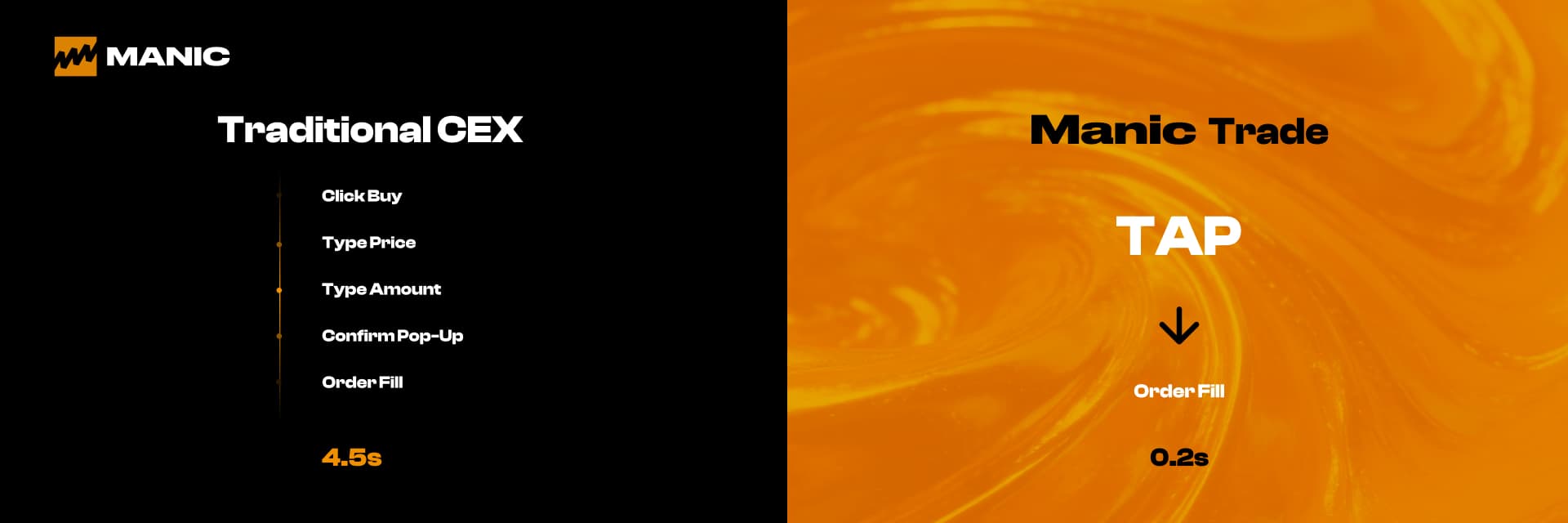
- Reaction: You see the breakout. (0.2s)
- Targeting: You move your mouse to the “Price” box. (0.5s)
- Input: You struggle to type the exact price or click “Market.” (1.0s)
- Sizing: You drag the slider to 50% or type an amount. (1.0s)
- Confirmation: You click “Buy.” A pop-up asks you to confirm. You click again. (1.0s)
Total Time: ~3.7 Seconds.
In [Surfing the Micro-Trend], we taught you that the best part of a move often lasts only 3 minutes. If you waste 4 seconds entering the trade, you have missed the “Ignition” phase. You are now buying the “Acceleration” phase at a worse price, drastically reducing your Risk/Reward ratio.
2. The 0.5 Second Rule
The 0.5 Second Rule is simple:
“The time between your brain deciding to trade and the network receiving the order must be less than 0.5 seconds.”
Any delay longer than this creates Cognitive Dissonance. Your brain is ready to move, but your hands are stuck doing administrative work (typing numbers). This disconnect breaks your focus.
Contextual Link: This is what we call “Friction.” Friction is the enemy of the “Zone.” To understand why seamless action is vital for your psychology, read [Entering the Flow State].
3. Why Manic Removed the “Confirm” Button
On Manic Trade, we made a radical design choice: We removed the safety rails. There is no “Confirm” pop-up. There is no typing. You preset your size (e.g., $50). You preset your direction. When you see the setup, you tap. Bang. You are in.
This enables “Reflexive Trading.” Just like an e-sports gamer reacts to visual stimuli without conscious thought, a Manic trader reacts to price action instantly.
- Eye sees: The Wick Betrayal.
- Finger taps: The Short button.
- Result: You catch the exact top of the candle.
4. Safety in Speed, Not in Pop-ups
Critics argue: “But what if I miss-click? Isn’t One-Tap dangerous?” In scalping, slowness is more dangerous than an accidental click. Being slow means you are constantly getting “front-run” by bots. Being slow means you are providing exit liquidity for faster traders.
Furthermore, Manic protects you with Fixed Risk. Because you define your bet size before you start trading (e.g., “Every trade is $20”), an accidental click can only lose you $20. On a traditional exchange, a “fat finger” error where you accidentally type “10 BTC” instead of “1 BTC” can bankrupt you. Paradoxically, One-Tap Execution combined with Fixed Risk is safer than a complex order form.
Contextual Link: Why is traditional execution so slow? Because it relies on outdated tech. Learn how indicators add even more delay in [Lag is Death].
Conclusion: Don’t Let the UI Beat You
The market is hard enough. You are fighting algorithms, market makers, and your own psychology. Don’t fight your keyboard too.
If you are serious about scalping, your interface needs to be an extension of your nervous system. If you have to “think” about how to place the order, you have already lost. Get a tool that moves as fast as you do.
Ready to feel the difference? Test your reaction time on the only platform built for 0.5-second execution.
🌐 Official Website: Manic.Trade
🐦 X (Twitter): @ManicTrade
🎮 Discord: Join the Server
✈️ Telegram: Official Channel
🤖 Glossary: Terms You Need to Know
Zero-Friction Execution
- Plain English: A user interface design that removes all unnecessary steps (clicks, pop-ups, typing) to make trading instant.
- Goal: To align the speed of execution with the speed of thought.
One-Tap Trading (1-Click)
- Plain English: A feature where a single click or tap immediately sends a buy or sell order to the market without asking for confirmation.
- Context: Essential for high-frequency strategies like scalping.
Mechanical Friction
- Plain English: The physical resistance caused by bad UI — mouse movements, keystrokes, and mental effort required to complete a task.
- Impact: High friction leads to slower reaction times and missed opportunities.
Reflexive Trading
- Plain English: Trading based on trained muscle memory and subconscious pattern recognition, rather than slow, deliberate analysis.
Related Reading
This article is part of our comprehensive guide: Momentum Trading Guide: How to Master Crypto Micro-Trends in 30 Seconds .
Discover the 3 types of momentum (news, breakout, continuation), 5 visual patterns with 60%+ win rates, and why Manic.Trade's forced exits capture more profit than "holding for more."
This article is part of our comprehensive guide: The Speed Advantage: Why Sub-Second Execution Defines Modern Crypto Trading as well
Discover the three layers of execution speed (hardware 15%, UI 50%, blockchain 35%), why Solana's 400ms confirmation beats Ethereum's 12 seconds, and how infrastructure advantage captures 3-5x more profit than skill alone.