Key Takeaways
- The Disconnect: CME gaps occur because the Chicago Mercantile Exchange closes on weekends while the crypto spot market trades 24/7.
- Technical Gravity: These gaps act as price magnets due to institutional liquidity needs and a widespread self-fulfilling prophecy among traders.
- Statistical Edge, Not Guarantee: While most gaps fill within days or weeks, "runaway gaps" can remain open for years during strong trends.
- Institutional Context: In 2025, gap trading is heavily influenced by Bitcoin ETF rebalancing and institutional "smart money" flows.
What is a CME Gap? Understanding the Friday-to-Sunday Disconnect
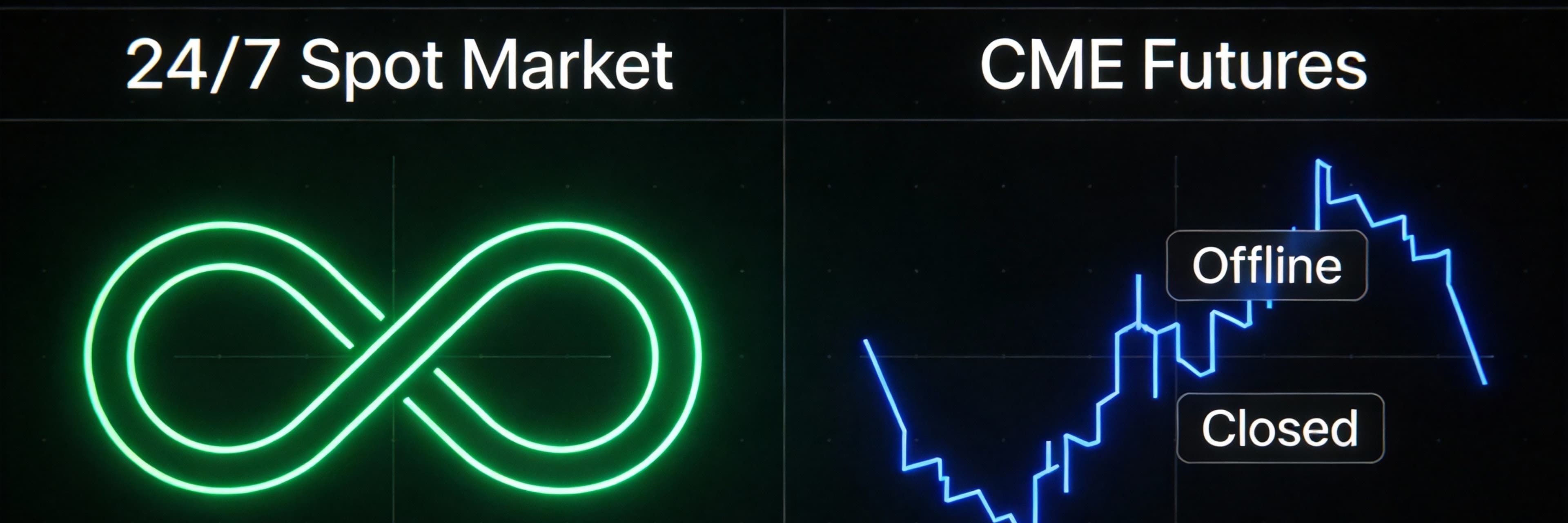
In the world of cryptocurrency trading, the term "CME gap" has evolved from a technical niche into a widely followed market narrative. To understand why these gaps occur, one must first recognize the fundamental friction between traditional financial infrastructure and the nascent digital asset market. While Bitcoin trades 24/7 across global spot exchanges, the Chicago Mercantile Exchange (CME)—the world’s largest financial derivatives platform—operates within a regulated, traditional framework with specific trading hours.
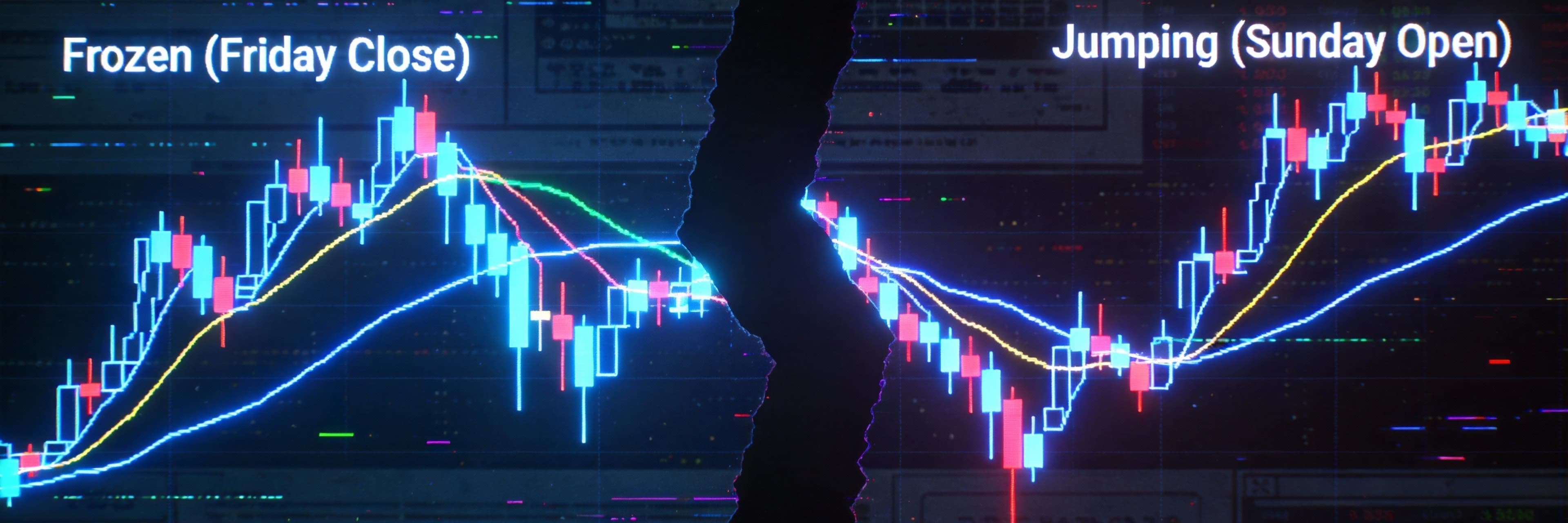
A CME gap is an empty space on a price chart where no trading activity took place on the CME Globex platform. These gaps primarily manifest during the weekend, specifically between the Friday close and the Sunday evening reopen. Because the Bitcoin futures market on the CME halts while the underlying spot market continues to trade, any significant price volatility during the weekend creates a "disconnect" or a void in the CME's price history.
The Mechanism: Regulated Hours vs. 24/7 Volatility
The core of the CME gap lies in the exchange's operational schedule. Unlike decentralized platforms, the CME Group maintains rigorous maintenance windows and weekend closures. According to official CME documentation, the exchange typically utilizes a Friday-to-Sunday maintenance window where trading is paused.
The process of gap formation generally follows this sequence:
- Friday Close: CME Bitcoin futures trading ceases (typically at 4:00 p.m. CT).
- Weekend Price Action: Global crypto spot markets remain active, driven by news or weekend price action.
- Sunday Open: When the futures market reopens at 5:00 p.m. CT, the opening price reflects the current spot value.
- The Gap: If the Sunday opening price is substantially different from Friday’s close, a visible "void" appears.
💡 Trader's Reality: While bankers sleep, we trade. This "friction" creates opportunity. But be careful—institutions use these gaps to trap retail traders. Learn how to spot their tracks in Smart Trade Login Issues? Why CEXs Block You & How DEXs Fix It.
The Psychology of the Fill: Why Do CME Gaps Get Filled?

The tendency for Bitcoin to retrace and trade through these empty price zones is not a matter of magic, but rather a result of converging technical and behavioral drivers. Understanding this "gravity" is essential for any CME gap trading strategy.
The Four Primary Drivers of the Gap Fill
- Market Efficiency and Liquidity Voids: Markets naturally seek to resolve inefficiencies. A gap represents a range where no institutional contracts were traded; prices often return to these levels to establish "fair value" across all venues.
- Institutional Rebalancing and ETF Dynamics: With the rise of Bitcoin ETFs, institutional liquidity flows have become dominant. Large-scale players often use CME futures to hedge. Significant gaps, such as those sliding toward $91,000, often coincide with ETF rebalancing cycles where institutions seek technical anchor points.
- Self-Fulfilling Prophecy: Because so many traders—from retail to hedge fund algos—expect a gap to fill, they place orders accordingly. This collective behavior creates a feedback loop where the market moves toward the gap simply because participants believe it must.
- Correction of Spot Market Divergence: Weekend retail-driven volatility can push prices to extremes. The fill often represents a return to a stable price floor, flushing out over-leveraged "weekend warriors."
Historical Probability: Do CME Gaps Always Fill?
Within the cryptocurrency community, there is a persistent narrative that "gaps must always fill." While historical data suggests a high correlation, treating this as a 100% certainty is a dangerous misconception.
Debunking the 100% Fill Myth
Statistically, a significant majority of CME Bitcoin futures gaps do eventually close. However, the "fill" is not a law of physics. As noted in quantitative crypto trading strategies, several factors can override the gap-fill tendency:
- Runaway Gaps: During periods of intense conviction or major news, the market may simply move away from the gap indefinitely.
- Macroeconomic Shifts: Significant changes in Fed policy or global liquidity can leave gaps open for months or even years.
Timeframes for a Fill
- Short-term (1–7 Days): The majority of weekend gaps are closed within the first week of trading.
- Medium-term (Weeks to Months): Some gaps remain open during a strong trend but are revisited during a standard market correction.
- The "Never" Fills: Historical instances exist where Bitcoin left gaps in the $9,000 or $11,000 regions from previous cycles that remain untouched. Relying on these to fill can lead to "bag-holding" against a dominant trend.
How to Trade CME Gaps: A Step-by-Step Strategy
Trading gaps requires a blend of patience and technical precision. Follow this practical framework to turn this structural inefficiency into a consistent edge.
Step 1: Identify the Gap on Sunday Open
Monitor the CME Bitcoin futures chart (Ticker: BTC1!) immediately upon the Sunday open.
- Gap Up: Sunday open > Friday close (Target: Downside fill).
- Gap Down: Sunday open < Friday close (Target: Upside fill).
Step 2: Set Your Entry Points
Do not jump in immediately. Low-liquidity moves can lead to "fake-outs." Wait for a reversal candle or a shift in momentum on lower timeframes (15m or 1h) toward the gap. The best entries often occur during the overlap of global trading sessions when volume and liquidity are highest.
Step 3: Determine Exit Targets and Stop Losses
- Take Profit (TP): Set your primary target exactly at the Friday closing price.
- Stop Loss (SL): Place your stop beyond the recent "swing high" or "swing low" established during the Sunday open.
- Use Bracket Orders: Automate your risk management to prevent emotional decision-making.
Step 4: Monitor Market Context
Be aware of the ETF influence on price action. If institutional vehicles like BlackRock’s IBIT show matching technical reference points, it adds further weight to your trade thesis.
🚀 Execution Speed: Identifying the gap is easy; trading it is hard. When the fill happens, it often happens fast. Ensure your execution speed is up to par with our guide: The 0.5 Second Rule: Why “One-Tap Execution” is the Holy Grail.
Risk Management: Why You Shouldn't Trade Gaps in Isolation
Treating every gap as a "guaranteed gift" is a recipe for disaster. Gaps are manifestations of institutional liquidity shifts, and trading them blindly during periods of extreme headline risk can be catastrophic.
The Danger of Event-Driven Volatility
Gaps often occur because the market is processing news while the CME is closed. Exercise caution during:
- Macroeconomic Announcements: CPI or FOMC decisions can create spot market divergence that overrides technical logic.
- Exhaustion Gaps: Late in a trend, a gap on massive volume may be a final gasp of retail FOMO rather than smart money.
Strategic Defensive Measures
- Position Sizing: Never size a trade so large that a sudden move against you ruins your month. Position sizing matters more than entry precision.
- Avoid "Overnight Risk": Gaps can bypass stop-loss orders. If the market opens significantly lower than your stop, you will be filled at the next available price, leading to slippage.
- Wait for Confirmation: Observing the initial reaction in the first hour of trading can help you distinguish between a quick fill and a "runaway gap."
Advanced Tools: Best Indicators for CME Gap Analysis
To refine your strategy, you must use tools that measure the conviction of market participants beyond simple price action.
🛠️ The Gap Trader's Toolkit
| Tool / Indicator | TradingView Ticker | Role in Gap Strategy |
|---|---|---|
| CME Bitcoin Futures | BTC1! | The Source: The only chart where the gap actually exists. |
| Volume Profile (VR) | VPVR | The Magnet: If a gap aligns with a high-volume node (POC), fill probability increases. |
| Open Interest (OI) | Open Interest | The Fuel: Rising OI near a gap suggests institutional positioning, not just retail noise. |
| Momentum (RSI) | RSI | The Trigger: Oversold RSI + Gap Zone = High Probability Reversal. |
Conclusion: Is the CME Gap Strategy Still Effective in 2025?
As we navigate 2025, the CME gap trading strategy remains a cornerstone of technical analysis, though it has evolved. The "normalization" of institutional participation means that CME gap fills are now influenced by deeper liquidity and multi-asset instruments like SOL and XRP futures.
The massive scaling of "cash-and-carry" arbitrage by hedge funds has tightened the link between the CME and spot markets, often leading to faster gap closures. To remain profitable, traders must combine traditional gap analysis with an understanding of institutional liquidity flows and the shifting dynamics of the spot ETF landscape.
The strategy is not a "guaranteed" price magnet, but rather a map of where "smart money" needs to re-enter the market to balance their books. In a volatile digital economy, these untraded zones remain one of the most reliable edges available to the disciplined trader.
FAQ
1. Why do CME gaps only happen on weekends?
CME gaps occur because the Chicago Mercantile Exchange operates on a traditional financial schedule, closing on Friday afternoon and reopening on Sunday evening. Since the Bitcoin spot market never stops trading, any price movement during the CME's downtime creates a gap when the futures market reopens.
2. Is it true that 100% of Bitcoin CME gaps get filled?
No. While a high percentage (often cited above 60-80% depending on the timeframe) eventually fill, some "runaway gaps" created during intense bull or bear markets can remain open for years. Trading based on a "guaranteed fill" is a high-risk strategy.
3. How long should I wait for a gap to fill?
Most gaps fill within 1 to 7 days. If a gap isn't filled within the first week of trading, it may become a medium-term target that only fills during a larger market correction weeks or months later.
4. Can I trade CME gaps on other cryptocurrencies?
Yes. With the expansion of the CME to include Ethereum (ETH) and recently other assets like Solana (SOL), the same gap-fill principles apply. However, Bitcoin remains the most liquid and reliable asset for this specific strategy.
5. What is the biggest risk of trading CME gaps?
The biggest risk is a "runaway gap" combined with leverage. If you enter a trade expecting a fill but the market continues to trend strongly in the opposite direction, you can face significant losses or liquidation, especially if the gap occurs during a major macroeconomic event.
Explore More Trading Resources
Solved your immediate problem? Go deeper:
- Trading Psychology Guide - Why discipline fails and how architecture solves it
- Momentum Trading Guide - Pattern recognition and execution frameworks
- Speed Advantage Guide - Infrastructure that multiplies edge
Browse all resources: Trading Tools & Resources Hub
Ready to trade with zero friction? → Start on Manic.Trade