
Why trust a centralized black box when you can trade directly on the blockchain? The war for liquidity is over.
Which is the best crypto DEX for scalpers? For high-frequency traders, the best platform is a Solana-based DEX (Decentralized Exchange) that offers low latency and direct on-chain settlement. Unlike CEXs (Centralized Exchanges) where you trade against an internal ledger, a Solana DEX allows you to trade directly against the blockchain's liquidity with Self-Custody, ensuring that you—not the exchange—own the assets at every millisecond of the trade.
For years, the argument was simple:
- CEX (Binance, Bybit): Fast, easy, but you don't own your keys.
- DEX (Uniswap, Raydium): Safe, private, but slow and clunky.
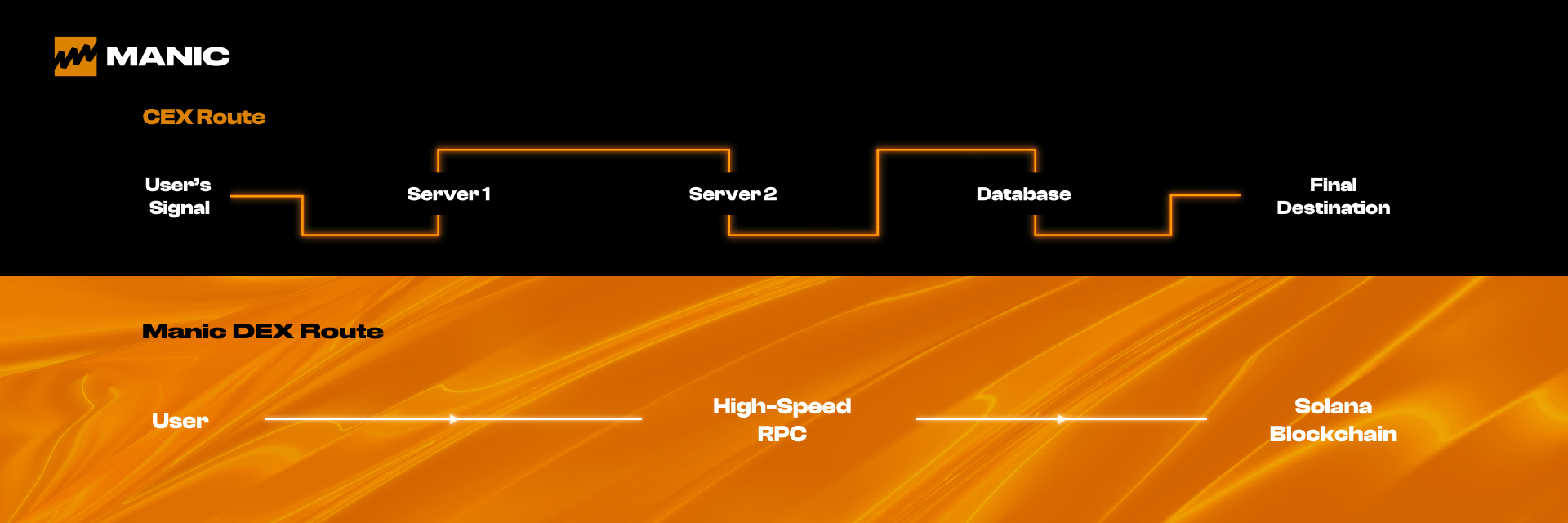
That argument is now dead. Solana killed it. With 400ms block times, Solana DEXs are now physically faster than the internal databases of many CEXs during peak traffic. If you are still scalping on a CEX, you are exposing yourself to "Counterparty Risk" for no reason.
Here is why the smart money is moving on-chain.
1. The CEX Illusion: Trading in a "Black Box"
When you buy Solana on a CEX, you aren't actually buying Solana on the blockchain. You are asking the exchange to update a number in their private Excel spreadsheet.
- They take your money.
- They give you an "IOU" (I Owe You).
- The real crypto sits in their cold wallet, not yours.
This works fine—until the market crashes. We have all seen it. Bitcoin drops 10%. You try to login to buy the dip. "System Overload. Please try again later." The CEX "pulls the plug" because their internal matching engine can't handle the volume (or worse, they are trading against you). In scalping, where every second counts, relying on a CEX means relying on a server that will fail exactly when you need it most.
2. The DEX Revolution: Direct-to-Chain
On a DEX like Manic Trade, there is no middleman database. When you click "Trade," you are signing a cryptographic transaction that goes straight to the Solana blockchain.
- No Login/KYC: You connect your wallet (Phantom/Solflare). You are the account.
- No Withdrawals: The profit lands directly in your wallet instantly. You never have to beg permission to withdraw your own money.
- 100% Uptime: As long as the Solana blockchain is running, you can trade. No CEO can turn off the buy button.
3. The Secret Weapon: RPC Node Speed
"But wait, aren't DEXs usually laggy?" They used to be. But the game changer is RPC (Remote Procedure Call) optimization. Think of the RPC Node as your internet cable to the blockchain.
- Standard DEX: Uses public, crowded RPC nodes. (Slow, congested).
- Manic Trade: Uses private, premium RPC clusters. (Fast, exclusive).
By optimizing the RPC layer, we ensure that your "One-Tap" signal bypasses the traffic jam and hits the validator first. This gives you the speed of a CEX with the security of a DEX.
Contextual Link: We optimized the interface with the "0.5 Second Rule," but the backend pipe matters just as much. See how we cut interface friction in [The 0.5 Second Rule].
4. Manic Trade Review: The Hybrid Approach
Manic Trade sits in a unique position. We are a DEX (you keep your keys). But we built the UI to feel like a gamified CEX. We stripped away the confusing "Swap" interfaces and "Slippage Settings" that confuse gamers. We replaced them with a clean, binary-style interface: Direction + Speed.
- Security: Non-custodial.
- Speed: Solana-native.
- Experience: Gamified Flow State.
It is the "Ultimate Battleground" because it removes the barriers. It is just you and the market.
Conclusion: Not Your Keys, Not Your Speed
The era of trusting centralized black boxes is ending. FTX taught us that "Not your keys, not your coins." But Solana taught us something new: "On-chain is faster."
Why trade on a CEX where you have to wait for a withdrawal email? Why trade on a slow DEX where you get front-run by bots? Find the middle ground. Find the speed.
Own your keys. Own your trade.
Ready to cut the middleman? Connect your wallet and trade directly on the fastest chain in the world. 🌐 Official Website: Manic.Trade 🐦 X (Twitter): @ManicTrade 🎮 Discord: Join the Server ✈️ Telegram: Official Channel
🤖 Glossary: Terms You Need to Know
- DEX (Decentralized Exchange)
- Plain English: A peer-to-peer marketplace where transactions happen directly between crypto traders without a middleman like a bank or broker.
- Benefit: You keep control of your money (Self-Custody).
- CEX (Centralized Exchange)
- Plain English: A company (like Binance or Coinbase) that holds your money and facilitates trades on their private internal system.
- Risk: If they go bankrupt (like FTX), you lose your money.
- RPC Node (Remote Procedure Call)
- Plain English: The server that acts as a gateway for your wallet to talk to the blockchain.
- Importance: A faster RPC node means your trade gets confirmed faster than other people using public nodes.
- Self-Custody
- Plain English: Holding your own private keys (in a wallet like Phantom). Nobody can freeze or steal your funds without your key.
Related Reading
This article is part of our comprehensive guide: The Speed Advantage: Why Sub-Second Execution Defines Modern Crypto Trading as well
Discover the three layers of execution speed (hardware 15%, UI 50%, blockchain 35%), why Solana's 400ms confirmation beats Ethereum's 12 seconds, and how infrastructure advantage captures 3-5x more profit than skill alone.