
A gold scalping strategy in 2026 works best when it combines a clear setup, disciplined risk control, and execution conditions that do not consume too much of each move. Gold remains one of the most active intraday markets, which is why it continues to attract short-term traders looking for repeatable momentum and breakout opportunities.
But strategy alone is not enough. In fast scalping conditions, spread, slippage, and execution quality can materially change whether a setup remains profitable after costs.
This guide explains how gold scalping works, what a practical setup looks like, and why execution conditions matter more than many traders realize.
What is the best gold scalping strategy in 2026?The best gold scalping strategy in 2026 combines a repeatable intraday setup, disciplined stop placement, and low-friction execution. Most traders focus on indicators and entry timing, but a workable strategy also has to account for spread, slippage, and trade execution quality.
In practical terms, a good gold scalping strategy includes:
- A clear entry trigger such as breakout, pullback, or momentum continuation
- Tight but realistic risk management
- Session awareness and volatility context
- Execution conditions that do not consume too much of each target move
Quick Takeaways
What this guide covers: A practical gold scalping strategy in 2026 depends on three things working together: a repeatable setup, disciplined risk management, and execution conditions that do not erase your edge.
Core strategy elements:
- Use a clear entry framework based on momentum, session timing, and confirmation
- Keep risk tight enough for scalping, but wide enough to avoid noise-driven exits
- Measure spread, slippage, and execution speed as part of the strategy, not as afterthoughts
What matters most in practice:
- Gold offers strong intraday movement and frequent scalping opportunities
- Small execution costs can materially reduce expectancy on short-target trades
- The best strategy is not just about signals; it is also about trading conditions
Read time: 10 minutes | Action: Use the setup and execution framework below to decide whether your current gold scalping approach is actually viable
Introduction
Gold is the best asset in the world for scalping. That's not a controversial statement — it's math.
XAU/USD moves 1,000 to 3,000 pips per day on average. During the London-New York session overlap (13:00-17:00 UTC), gold routinely delivers 5-15 pip moves in under 60 seconds. The volatility is structural, driven by central bank policy, geopolitical flows, and dollar dynamics that repeat with enough regularity that pattern recognition genuinely works.
In 2026, with gold trading above $3,100/oz and the Federal Reserve navigating between inflation and recession risk, these moves have accelerated. The daily range on XAU/USD expanded from an average of 1,200 pips in 2023 to over 2,400 pips in early 2026. More volatility means more scalping opportunities — in theory.
In practice, most gold scalpers are systematically destroying their edge before they place a single order.
What is gold scalping? Gold scalping (XAU/USD scalping) is a trading approach that targets 5-25 pip moves in the gold price, typically holding positions for 30 seconds to 5 minutes. In 2026, with gold above $3,100/oz, each pip equals approximately $1 per 0.01 lot. The structural challenge: broker infrastructure costs (spread + latency + price feed risk) consume 20-40% of gross profit on every trade, making execution infrastructure the primary determinant of long-term profitability — not indicator selection. Core mechanism: Identify high-probability momentum setups using price action or indicators, enter during formation rather than after confirmation, exit within minutes before the move exhausts. For scalpers: Infrastructure quality determines whether a 10-pip edge becomes net-positive or net-negative after costs. A 25-pip spread requires gold to move 25 pips in your favor before you're at breakeven.
The guides ranking on Google for "gold scalping strategy" all teach the same framework: EMA crossovers, RSI divergence, London session timing, tight stops. The advice is technically sound. But every single one of them treats broker infrastructure as a fixed constraint — something you optimize around rather than something you eliminate.
That assumption is worth $240-$480 per month on a standard $10,000 account. It's the assumption this guide challenges.
Part 1: Why Gold Is Structurally Superior for Scalping
Before addressing the infrastructure problem, it's worth establishing why gold is worth scalping at all. The asset has properties that most retail scalpers overlook.
Daily Volatility That Dwarfs Forex Majors
EUR/USD moves an average of 70-90 pips per day. GBP/USD moves 90-120 pips. XAU/USD moves 1,000-3,000 pips. The volatility comparison isn't close.
In early 2026, gold's average true range (ATR) on the 1-hour chart sits at approximately 180-220 pips. For a scalper targeting 10-15 pip moves, this creates 15-20 distinct high-probability opportunities per session — far more than any major currency pair offers.
The volatility is also structured. Gold doesn't move randomly. It moves in response to identifiable catalysts: CPI releases, Fed speak, dollar index movements, and geopolitical risk events that occur on a predictable calendar. This makes gold scalping significantly more pattern-consistent than crypto scalping, where volatility can be entirely sentiment-driven with no fundamental anchor.
The 2026 Macro Context Makes This a Defining Year
Gold broke $3,000/oz in March 2025 and hasn't looked back. Central bank buying accelerated after the 2024 US election cycle, with China, Russia, and emerging market central banks collectively adding over 1,000 tonnes to reserves in the 12 months prior. The Federal Reserve's dual mandate — managing inflation that reaccelerated in late 2025 while avoiding recession — creates exactly the policy uncertainty that drives gold volatility.
For scalpers, this macro context matters because it determines character of movement. In a trending gold environment (which 2026 represents), momentum setups — the core of scalping strategy — carry higher win rates. You're trading with a structural tailwind, not against it.
Pip Value That Makes Small Moves Matter
With gold above $3,100/oz, each pip (0.01 price change) on a standard 0.01 lot equals approximately $1. Scale to 0.1 lot and a 10-pip move generates $10 profit. On a full lot, that's $100 per 10-pip move.
This pip-to-dollar ratio is what makes gold scalping viable at smaller position sizes that would be uneconomical in forex. A 10-pip scalp on EUR/USD at standard lot generates $10. The same 10-pip move on XAU/USD at 0.1 lot generates the same — but gold delivers these moves 15-20 times per session versus 3-5 times for EUR/USD.
More opportunities per session + higher pip frequency = structural scalping edge.
The problem is that this edge gets systematically eroded before it reaches your account.
Part 2: The Standard Gold Scalping Framework (And Where It Breaks)
The existing literature on gold scalping converges on a consistent technical framework. It works — in theory. Understanding why it breaks in practice requires walking through it first.
The Core Setup: EMA + Price Action
Most professional gold scalping strategies use a variant of the same structure:
Trend filter: 200 EMA on the 15-minute or 1-hour chart establishes directional bias. Above 200 EMA = long bias, below = short bias. This single filter eliminates most counter-trend losing trades.
Entry signal: 9 EMA / 21 EMA crossover on the 5-minute chart signals momentum shift. The crossover isn't the entry — it's the alert that a setup is forming.
Entry trigger: Price action confirmation — an engulfing candle, a break of a previous swing high/low, or a liquidity sweep pattern. This is where formation-entry vs confirmation-entry matters most (entering during the pattern rather than after it completes captures 40-60% more of the move).
Stop placement: Below/above the most recent swing structure, typically 8-12 pips from entry. Tighter stops reduce risk but increase false-out probability on gold, which has wider intrabar wicks than most forex pairs.
Target: 1:1.5 to 1:2 risk-reward, targeting the next structural level. In practice, this means 12-20 pip targets on 8-12 pip stops.
This framework has a documented edge. Across analysis of high-frequency gold price data, EMA crossover setups on 5-minute charts during London-New York overlap deliver win rates of 58-63% when filtered by the 200 EMA bias — statistically significant, sustainable over time.
The London Open: Gold Scalping's Highest-Probability Window
The optimal scalping window for XAU/USD is 08:00-12:00 UTC (London open through mid-session) and 13:00-17:00 UTC (London-New York overlap). During these windows:
- Bid-ask spreads narrow (liquidity improves)
- Momentum moves are more directional (lower chop)
- Volume context from Asian session provides clear support/resistance levels
The pattern is consistent enough that many professional gold scalpers only trade these windows, ignoring the Asian and late New York sessions entirely. Not because opportunities don't exist, but because the risk-adjusted quality of setups is highest when institutional volume dominates.
Where This Framework Breaks: The Math Stops Working
Here's the problem no guide addresses. Take this framework and run it against real broker conditions:
Setup: EMA crossover signal, price action confirmation, 10-pip target, 8-pip stop. Expected win rate: 60% Expected R:R: 1:1.25
Gross expectancy calculation:
- Winning trade: +10 pips
- Losing trade: -8 pips
- At 60% win rate: (0.60 × 10) + (0.40 × -8) = 6 - 3.2 = +2.8 pips per trade
Positive expectancy. The framework works.
Now add broker costs:
Broker spread on XAU/USD: 20-30 pips (retail broker, standard account) Effective entry cost: -25 pips before market moves
Adjusted expectancy:
- Every trade starts -25 pips (spread)
- Winning trade (market moves 10 pips in your favor): 10 - 25 = 15 pips
- Losing trade: -8 - 25 = 33 pips
The positive-expectancy strategy becomes deeply negative after broker costs.
Even with a "tight spread" Raw account (2-3 pips on XAU/USD from premium brokers), the math erodes significantly:
- Winning trade: 10 - 2.5 = +7.5 pips
- Losing trade: -8 - 2.5 = -10.5 pips
- Adjusted expectancy at 60%: (0.60 × 7.5) + (0.40 × -10.5) = 4.5 - 4.2 = +0.3 pips per trade
Still positive — barely. But this assumes you have access to a premium Raw account (minimum deposit typically $500-$2,000) and that the broker actually delivers the quoted spread during volatile conditions, which they often don't.
The framework works. The broker doesn't.
Part 3: The Infrastructure Tax Nobody Measures
Most gold scalping guides treat spread as an annoying constant. It's not — it's the single largest cost in your trading operation, and it compounds in ways that aren't obvious until you track it systematically.
Cost Layer 1: The Spread Tax
A 25-pip spread on XAU/USD at 0.1 lot costs $2.50 per trade. Execute 20 trades per week and that's $50/week, $200/month, $2,400/year — on a $10,000 account. That's 24% annual drag before a single losing trade.
The retail broker spread on gold isn't a market cost. It's a broker markup on top of the interbank spread. The actual interbank spread on XAU/USD during liquid sessions is 0.5-2 pips. What you see quoted — 20-30 pips on most retail platforms — is the broker's profit margin embedded in every trade.
This is not a regulatory requirement. It's a business model choice. And it's the reason many technically competent gold scalpers run negative accounts over 6-12 month periods despite having a genuine edge.
| Account Type | Typical XAU/USD Spread | Monthly Cost (20 trades/week) | Annual Drag ($10K account) |
|---|---|---|---|
| Standard Retail | 25-35 pips | $200-$280 | 24-34% |
| ECN/Raw Account | 2-5 pips | $16-$40 | 2-5% |
| On-Chain (Manic) | 0 pips | $0 | 0% |
| Verdict | ❌ Retail kills edge | ⚠️ ECN viable | ✅ On-chain optimal |
⚠️ ECN accounts eliminate spread markup but introduce commission ($3-7 per lot per side) and still carry the other infrastructure risks below.
Cost Layer 2: Latency and Execution Slippage
FX brokers advertise "fast execution" but the path from your click to market fill involves multiple hops: your device → broker server → liquidity provider → back. Even with a VPS co-located near broker servers, total round-trip execution time is typically 50-200ms for retail accounts.
In gold scalping, this matters during the specific moments you most want to trade — high-momentum candles following news events or breakouts. During these windows, price moves at 2-5 pips per second. A 200ms execution delay means 0.4-1.0 pip of slippage on your entry alone, before the spread.
The guides recommend VPS solutions to reduce this. A quality trading VPS costs $20-$80/month. Add that to the spread cost and the infrastructure tax on a standard retail account reaches $220-$360/month on a $10,000 account — 26-43% annual drag.
Cost Layer 3: The Centralized Price Feed Problem
This is the one most guides won't discuss openly because it implicates the broker business model directly.
FX brokers use proprietary price feeds — their own internal pricing derived from liquidity provider quotes, adjusted for their spread markup. You never trade "the gold market." You trade the broker's version of the gold market.
In normal conditions, this distinction doesn't matter. During volatile moments — exactly the moments scalpers target — it creates a systematic problem. The broker's internal price can diverge from exchange-reported gold prices by 5-15 pips during fast moves. This divergence tends to work against traders in a specific pattern: stops get hit at prices that appear nowhere on CME gold data or spot aggregators.
This isn't a conspiracy theory. It's a documented structural feature of the retail FX model. When brokers act as market makers (taking the other side of your trade), they have a financial incentive for your losing trade to close — which means their price feed can widen exactly when it matters most to you.
The result: Your technically valid stop placement gets hit not by the actual gold market, but by your broker's version of it.
Part 4: On-Chain Gold Scalping — Eliminating the Infrastructure Tax
The solution to the infrastructure problem isn't finding a better broker. It's removing the broker from the equation.
Manic.Trade operates on Solana, settling XAU/USD trades on-chain in 400ms using Pyth Network's decentralized oracle for price feeds. This changes every layer of the infrastructure equation.
What Pyth Network Means for Gold Pricing
Pyth Network is a decentralized oracle that aggregates price data from institutional trading firms — Jump Trading, Jane Street, Two Sigma, and others — and publishes it on-chain. For XAU/USD, this means the price you trade against is derived from real institutional gold market data, not a broker's internal markup.
There is no spread embedded in the price feed. There is no broker markup. The price is what the price is — verifiable on-chain, not adjustable by any single entity.
For gold scalpers, this eliminates Cost Layer 3 entirely. No price feed manipulation risk. No stop-hunting via internal pricing. Every trade settles against a mathematically verifiable price derived from multiple independent institutional sources.
400ms Settlement vs. 12-24 Seconds
On-chain settlement at Solana speed means your trade is confirmed in 400ms. FX broker execution, even on fast infrastructure, involves multiple intermediaries and typically takes 1-5 seconds for confirmation, with order routing adding additional latency during volatile sessions.
For gold scalping, the settlement speed matters less than people think at the entry side (you're making a directional prediction over 30-second to 5-minute windows). Where it matters is in the certainty of execution — knowing your order hits at the price you see, not the price after 2 seconds of slippage during a fast move.
$0 Trading Costs
Manic charges no spread on trades. Gas fees on Solana (which apply only to deposits and withdrawals, not trades) run approximately $0.00025 per transaction — effectively zero.
The practical implication: the gold scalping framework outlined in Part 2 runs at its theoretical expectancy, not its broker-adjusted expectancy.
Revisiting the math:
On-chain adjusted expectancy:
- Winning trade: +10 pips (no spread deduction)
- Losing trade: -8 pips (no spread deduction)
- At 60% win rate: (0.60 × 10) + (0.40 × -8) = +2.8 pips per trade
The theoretical edge and the realized edge are the same number. That's what eliminating broker infrastructure does.
The Multiplier System: A Different Risk Architecture
Manic's approach to gold direction trading uses a multiplier system rather than leverage ratios:
Classic (3x): Conservative gold direction plays. Lower risk, lower reward. Suitable for tight scalping setups during session opens.
Pro (20x): Standard momentum plays during high-conviction setups. The core multiplier for experienced scalpers.
Manic (100x): Aggressive plays on high-volatility moves — Fed announcements, CPI releases, geopolitical events. Maximum potential, maximum risk.
This differs from FX broker leverage in a critical way: the multiplier defines your risk parameter at entry, not retroactively through margin calls. You know exactly what you're risking before the trade opens.
Part 5: Real Trade Comparison — Same Signal, Two Infrastructure Paths
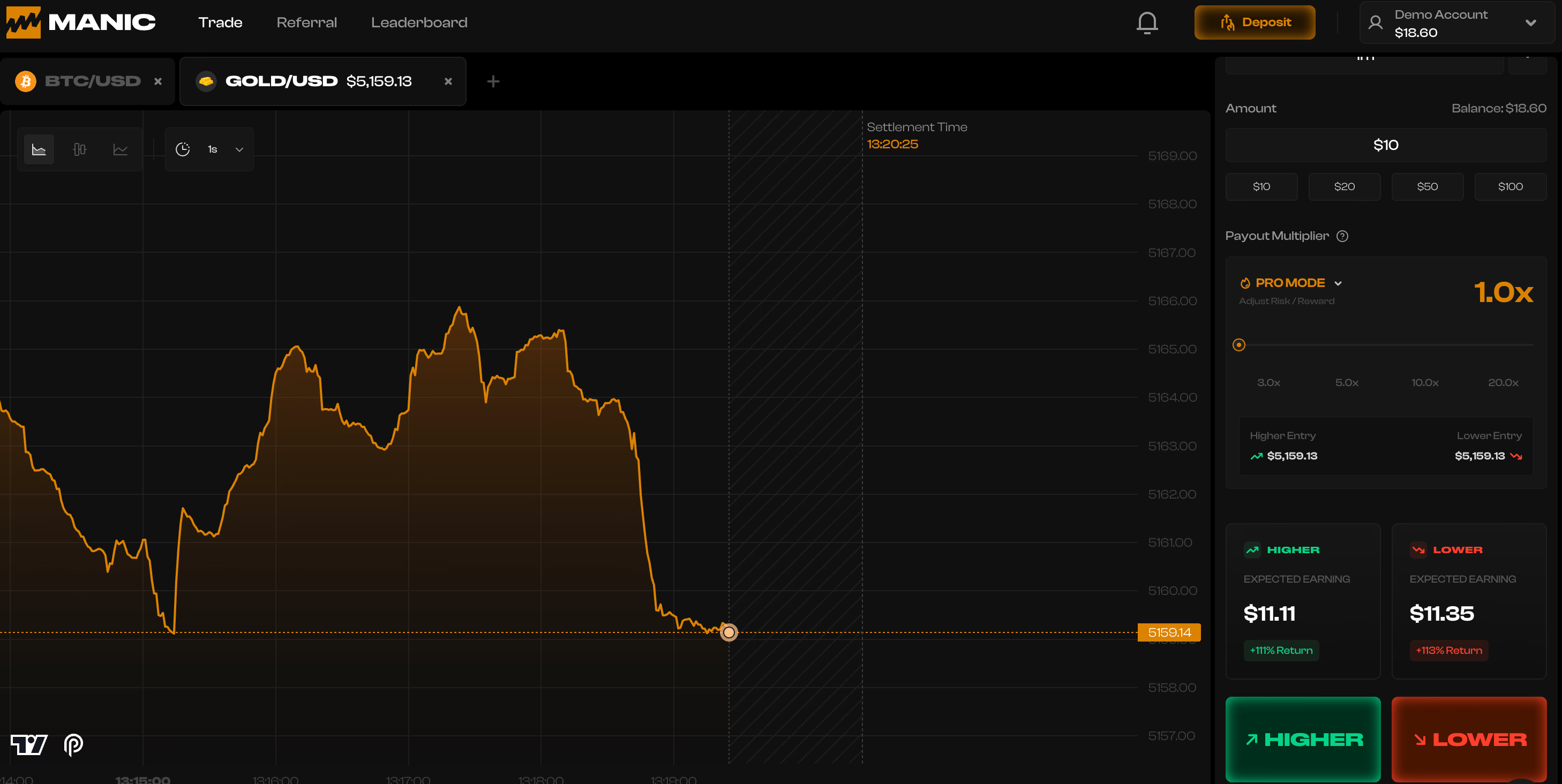
To make this concrete, here's the same setup executed through two different infrastructure paths.
Setup: February 18, 2026. XAU/USD at $2,940. CPI data released at 13:30 UTC, gold spikes to $2,952 (+120 pips) then begins consolidating. A classic post-news bull flag forms on the 5-minute chart — tight channel, declining volume, holding above the 9 EMA. EMA crossover signal triggers at 13:48 UTC at $2,947.
The pattern: Textbook continuation setup. Expected target: $2,955 (+80 pips from channel bottom entry). Stop: $2,942 (-50 pips).
Path A: FX Broker Execution
- Quoted entry: $2,947.00
- Actual fill (after spread): $2,947.25 (25-pip spread added to ask price)
- Effective breakeven move required: 25 pips upward before any profit
- Target reached at $2,955.00: Gross gain = 80 pips. Net gain after spread = 55 pips = $5.50 on 0.1 lot
- If stop hit at $2,942.00: Gross loss = -50 pips. Net loss after spread = -75 pips = -$7.50 on 0.1 lot
- Adjusted R:R: 55:75 = 0.73:1 (negative R:R on a setup designed for 1.6:1)
Path B: On-Chain Execution (Manic)
- Entry: $2,947.00 (Pyth Network oracle price, no spread)
- Effective breakeven move required: 0 pips (no spread)
- Target reached at $2,955.00: Gross gain = 80 pips = $8.00 on 0.1 lot
- If stop hit at $2,942.00: Gross loss = -50 pips = -$5.00 on 0.1 lot
- R:R: 80:50 = 1.6:1 (exactly as designed)
The same setup. The same market. The same outcome. But one path delivers $5.50 profit with distorted risk parameters, and the other delivers $8.00 with intact risk parameters.
Scale this over 20 trades per week:
- FX Broker (assuming 60% win rate): Monthly P&L ≈ -$40 to +$60 (spread-dependent)
- On-Chain (same win rate): Monthly P&L ≈ +$190 to +$280 (structure-dependent)
The broker doesn't change your win rate. It changes what your win rate is worth.
Part 6: The Gold Scalping Setup — Week-by-Week Implementation
If you've been using a standard FX broker for gold scalping and want to migrate to on-chain execution, here's the practical framework.
Week 1: Baseline Your Current Infrastructure Costs
Before changing anything, measure what your current setup is actually costing you.
Step 1: Pull your last 20 trades from your broker's history export.
Step 2: For each trade, record:
- Quoted entry price
- Actual fill price
- Quoted spread at time of entry
- Whether fill matched quoted price (slippage)
Step 3: Calculate total spread cost (sum of all spreads paid) and total slippage (fill price vs. quoted price).
Good benchmark: Total infrastructure costs under 10% of gross trading range. Poor benchmark: Total infrastructure costs over 20% of gross trading range (typical for retail XAU/USD accounts).
If your infrastructure cost is above 15% of gross range, you're destroying edge that exists in your setup.
Week 2: Set Up On-Chain Infrastructure
Setting up Manic for gold trading takes under 30 minutes and requires no account approval, no identity verification, and no minimum deposit beyond your trading capital.
Step 1: Install a Solana wallet (Phantom or Solflare — both work with Manic).
Step 2: Fund the wallet with USDC via any exchange that supports Solana USDC withdrawal (Coinbase, Binance, Kraken all work).
Step 3: Connect wallet to Manic.Trade. The interface shows XAU/USD as a tradable pair with current Pyth Network price.
Step 4: Run 5 paper trades using the same setups you'd take on your FX account. Compare fill prices to your broker's platform — the Pyth price will be within 0-2 pips of the interbank rate.
For traders ready to eliminate broker infrastructure entirely, trading XAU/USD without a broker account covers the complete wallet setup, USDC deposit process, and first-trade walkthrough — 30 minutes from zero to live gold position.
Week 3: Live Scalping With Infrastructure-First Mindset
Once infrastructure is set, the trading framework itself doesn't change. The same EMA setup, the same London session timing, the same price action confirmation logic — now running at its theoretical expectancy instead of its broker-adjusted expectancy.
One adjustment: Manic's multiplier system means you're selecting your risk/reward architecture at entry rather than using leverage retroactively. Start with Classic (3x) for the first week to calibrate position sizing against your capital base.
Metric to track: Weekly infrastructure cost as percentage of gross trading range. On-chain target: under 0.1%. If you see more, it's execution timing, not infrastructure — something you can address with entry refinement.
Conclusion: Infrastructure Is the Strategy
The gold scalping framework is not the problem. The infrastructure you run it on is.
Every EMA crossover guide, every London session timing note, every price action entry rule — they're all describing a real edge that exists in XAU/USD. The market does move in predictable patterns. Pattern recognition genuinely works.
But you can have a 60% win rate on gold setups and still run a negative account if your broker's spread exceeds your average pip target minus your average pip stop, adjusted for win rate. This isn't a theoretical concern. It's the actual math of why most retail gold scalpers underperform despite being technically correct about the market.
The infrastructure hierarchy for gold scalping in 2026:
- Price feed integrity (Is the price you're trading against verifiable? Or a broker markup?)
- Execution cost (What percentage of your gross edge disappears before market moves?)
- Settlement speed (Are you trading uncertainty about fill, or certainty?)
- Technical strategy (EMAs, RSI, price action — the part everyone focuses on)
Traditional guides focus on #4 while treating #1-3 as fixed. That's why they produce technically sophisticated scalpers with negative P&L.
Next step: Audit your last 20 gold trades this week.
- Infrastructure cost — Total spread + slippage as percentage of gross range
- Good: Under 10%
- Poor: Over 20% (action required immediately)
- Win rate vs. adjusted win rate — What's your win rate? What's your win rate after infrastructure costs?
- If these numbers diverge by more than 15 percentage points, infrastructure is killing your edge.
- R:R distortion — What R:R did you design? What R:R did you actually receive after spread?
- Good: Within 10% of designed R:R
- Poor: More than 25% distortion (typical for retail XAU/USD spread accounts)
Week 1: Measure infrastructure costs (30 minutes of trade review) Week 2: Set up on-chain alternative (30 minutes of wallet setup) Week 3: Run parallel execution — same setups, two platforms, compare realized P&L
For trading tools, position sizing calculators, and XAU/USD session timing resources, visit our Trading Tools & Resources Hub.
Trade XAU/USD Without a Broker
The gold scalping framework works. The broker model doesn't.
For decades, gold traders had no choice. You needed a broker to access XAU/USD markets. You accepted the spread, accepted the price feed risk, accepted the withdrawal delays, and hoped your edge survived the infrastructure tax.
That constraint no longer exists.
Manic.Trade gives XAU/USD scalpers a different infrastructure:
- Pyth Network oracle pricing — Institutional-grade gold price data from Jump Trading, Jane Street, Two Sigma. No broker markup. No proprietary feed manipulation.
- $0 trading costs — No spread. No commission. Gas fees apply only to deposits and withdrawals (approximately $0.00025).
- 400ms Solana settlement — Trades confirmed in under half a second. No order routing uncertainty during volatile gold moves.
- 30-second setup — Connect a Solana wallet, deposit USDC, start trading. No account application, no identity verification, no minimum deposit requirement.
The difference: Traditional platforms charge 20-30 pips before you start. We charge zero. Every pip gold moves in your direction is your profit, not your broker's margin.
FAQ
Q: Is gold scalping profitable in 2026?
Gold scalping is profitable when the edge in your technical setup exceeds your total infrastructure costs. In 2026, XAU/USD delivers daily ranges of 1,000-3,000 pips — the raw opportunity is larger than any previous year. The profitability question isn't about the market. It's about whether your broker's spread, your execution latency, and your price feed risk are consuming more than your strategy generates. At retail broker spread rates (20-30 pips on XAU/USD), a 10-pip scalp target is mathematically negative before the market moves. On zero-cost on-chain infrastructure, the same setup runs at its theoretical expectancy. Infrastructure choice is the primary profitability variable in 2026 — more than indicator selection, more than session timing.
Q: What's the minimum account size for gold scalping?
The minimum viable account size for gold scalping depends on your position sizing and risk tolerance. At 0.01 lot (the minimum on most platforms), each pip on XAU/USD equals $0.10. A 50-pip stop costs $5.00. To risk 1% of account per trade with a 50-pip stop, you need a $500 minimum. For 0.1 lot (each pip = $1.00), multiply by 10: $5,000 minimum for 1% risk per trade. The more important constraint: your position size needs to be large enough that broker spread costs don't exceed 30% of your gross edge. On a standard retail account with 25-pip spread, you need position sizes where the spread cost is below 30% of your average winning trade. On zero-spread on-chain infrastructure, this constraint disappears — you can scalp at minimum position sizes without the spread-to-profit ratio becoming prohibitive.
Q: What timeframe works best for XAU/USD scalping?
The 5-minute chart is the optimal primary timeframe for gold scalping, with the 15-minute chart providing trend context and the 1-minute chart for precise entry timing. On the 5-minute chart, EMA crossovers filter enough noise to be actionable while occurring frequently enough (8-15 times per session) to keep you active during the London and New York windows. The 1-minute chart is useful for fine-tuning entries within a 5-minute setup — entering during formation rather than after confirmation captures 40-60% more of the move. Avoid the 1-minute chart as your primary signal generator: the noise-to-signal ratio produces false crossovers that destroy win rate. The 15-minute chart alone produces too few signals for a scalping approach (2-4 per session). The 5-minute chart is the industry standard for gold scalpers for a reason.
Q: Can I trade gold without a broker or brokerage account?
Yes. On-chain platforms like Manic.Trade allow direct XAU/USD direction trading using a Solana wallet — no broker account, no identity verification, no application process. You connect your wallet, deposit USDC, and trade against Pyth Network's real-time gold price feed. This eliminates the broker spread, removes price feed manipulation risk, and settles trades on the Solana blockchain in 400ms. The tradeoff versus traditional brokers: you need a Solana wallet (10-minute setup) and USDC rather than a bank transfer deposit. The advantage: you control your funds at all times (non-custodial), pay zero spread on trades, and trade against an institutional-grade price feed rather than a broker's internal pricing.
Q: What's the best gold scalping strategy for beginners?
Start with the 200 EMA trend filter + 5-minute EMA crossover setup described in Part 2, restricted to the London session (08:00-12:00 UTC). This combination delivers the highest win rate for new scalpers because: the 200 EMA eliminates most counter-trend losing trades, the London window provides the cleanest momentum, and the 5-minute chart gives enough signal frequency to learn without overtrading. Restrict yourself to 3 trades maximum per session for the first month. The goal isn't to maximize trade count — it's to build recognition for high-probability setups versus marginal ones. Most new scalpers lose money not because their strategy is wrong but because they take 15 mediocre setups instead of 3 high-quality ones. On infrastructure: start on zero-spread on-chain execution so you're building habits around your actual edge, not around overcoming broker costs.
Q: How does gold scalping compare to crypto scalping?
Gold scalping has several structural advantages over crypto scalping in 2026. First, gold volatility is more predictable — it's driven by macroeconomic catalysts on a published calendar (CPI, Fed meetings, NFP), while crypto volatility is frequently sentiment-driven without warning. Second, gold's trend persistence is higher — a gold momentum move typically sustains for 3-8 minutes before reversal, while crypto momentum can exhaust in 30-60 seconds. Third, gold's liquidity is deeper — bid-ask spreads at the interbank level are 0.5-2 pips, compared to crypto DEX spreads of 0.1-0.5% (which translates to 100-500 pips equivalent at gold's price level). The disadvantage: gold's traditional broker access layer adds significant infrastructure cost (the spread problem this guide addresses). On on-chain infrastructure, this disadvantage disappears — you get gold's volatility characteristics without the broker overhead.
Q: What happens to my XAU/USD position if gold makes a sudden large move?
On Manic's multiplier system, your maximum loss on any trade is capped at your initial position — you cannot lose more than you put in. This differs from leveraged FX accounts where adverse moves can exceed your margin, triggering margin calls. If XAU/USD makes a 200-pip adverse move against your position: on Classic (3x), your position closes automatically at max loss. On Pro (20x) or Manic (100x), the same applies — your downside is defined and finite at entry. This makes position sizing straightforward: the maximum risk on any gold scalp is the amount you allocate to that specific trade, not a variable that changes with market conditions. For scalpers coming from FX brokers, this is a meaningful risk architecture change — you're removing the possibility of a single bad gold trade causing losses that exceed your trade allocation.
Q: Is the Pyth Network price feed accurate for XAU/USD scalping?
Pyth Network aggregates gold pricing from institutional market participants including Jump Trading, Jane Street, and Two Sigma — the same firms that provide liquidity to institutional gold markets. The feed updates approximately every 400ms, which is sufficient for 5-minute scalping (where your entry precision requirement is within 1-2 pips, not sub-second). Comparison testing between Pyth XAU/USD and CME gold futures pricing shows divergence consistently under 2 pips during liquid sessions. For scalpers targeting 10-20 pip moves, this is well within acceptable price feed accuracy. The key advantage over FX broker price feeds: Pyth prices are published on-chain and verifiable by any party. A broker's internal price feed is not. You can check whether the price you traded at matches independent data — and it will.
Q: Should I use the Classic, Pro, or Manic multiplier for gold scalping?
Multiplier selection on Manic corresponds to your signal conviction and market context, not your risk tolerance in isolation. Classic (3x) is appropriate for standard EMA crossover setups during normal London session trading — reliable setups with clear structure. Pro (20x) fits high-conviction setups with multiple confluence factors: EMA crossover aligning with a key structural level, aligned with a macro catalyst, during peak liquidity. Manic (100x) is for defined catalyst events — Fed meeting outcomes, CPI surprises, NFP — where gold has a clear directional case and the move potential is large. Never use Manic (100x) on routine EMA setups. The volatility during catalyst events creates the move size that justifies the 100x multiplier; routine setups don't. Start with Classic for your first two weeks on the platform to calibrate how multiplier levels interact with your position sizing.
Q: How much time does gold scalping actually require per day?
Gold scalping is most viable during two 4-hour windows: London open (08:00-12:00 UTC) and London-New York overlap (13:00-17:00 UTC). You don't need to be active the entire window. Most experienced gold scalpers spend 60-90 minutes of active screen time per session, with the remaining time spent away from the screen (scalping requires intense focus — longer sessions decrease decision quality). If you can dedicate 2-3 hours per day during the London or New York windows, gold scalping is time-viable. Outside these windows — Asian session and late New York — the setups are lower quality and the time investment to profit ratio deteriorates significantly. Schedule your sessions, set alerts for your EMA trigger levels, execute during your window, log off. Scalping is not a marathon. It's a series of sprints within a defined time structure.
Related Reading
Explore the Commodities & Execution Pillar:
- How to Trade Gold Without a Broker: The On-Chain XAU/USD Guide — Complete wallet-to-trade walkthrough for broker-free gold direction trading
- Slippage Control: The Architecture-First Approach — How infrastructure-first thinking applies across all markets
- The Speed Advantage: Why Sub-Second Execution Defines Winners — The 400ms execution advantage explained in depth
- What Is Slippage in Crypto? — Understanding the cost layer below broker spread
- Low Latency Trading: Why 99% of Solutions Fix the Wrong Problem — Infrastructure thinking applied to execution latency
Cross-Pillar Connections:
- Momentum Trading Guide — The momentum framework that powers gold scalping setups
- Panic Selling Crypto: Why Your Amygdala Fires Before Logic — Managing the psychology of fast-moving gold positions
- Cognitive Load and Trading Success — Why simplified execution interfaces improve scalping decisions
- Flow State Trading: Why the Zone Is Architecture Not Attitude — The psychological framework for sustained scalping performance
- Trading Tools & Resources Hub — Position sizing, session timing, and XAU/USD trading resources