
TL;DR
Every guide about gold trading assumes you need a broker. You need an account application. You need identity verification. You need to wait 24-72 hours for approval. You need to fund via bank transfer and wait another 1-3 business days. Then you can trade — against a 25-pip spread that erodes your edge before the market moves.
This assumption is outdated.
Since Solana-based on-chain infrastructure became viable for commodity trading, XAU/USD direction trading no longer requires a broker intermediary. You connect a wallet. You deposit USDC. You trade. The entire process takes under 30 minutes the first time, under 60 seconds on return visits.
This guide covers exactly how that works — what you're giving up versus a traditional broker, what you're gaining, and the step-by-step mechanics of getting from zero to live XAU/USD trades without a single broker interaction.
📊 Quick Takeaways
The Problem: Traditional gold trading requires 3-7 days of broker onboarding, mandatory KYC, custodial fund risk, and 20-30 pip spread on every XAU/USD trade.
What On-Chain Eliminates:
- ✅ No broker account — Wallet connection replaces account application. No approval process, no rejection risk, no geographic restrictions.
- ✅ No KYC required — Non-custodial model means no identity verification. Your wallet, your funds, your trades.
- ✅ No spread cost — $0 trading cost vs 20-30 pip retail broker spread. On a $10,000 account executing 20 trades/week, this saves $200-$280/month.
- ✅ No custodial risk — Funds stay in your wallet at all times. No broker holding your capital, no withdrawal delays, no account freeze risk.
Real Impact: A gold trader switching from retail broker to on-chain execution saves $2,400-$3,360/year in spread costs alone on a $10,000 active scalping account.
Read time: 14 minutes | Setup time: 30 minutes (first time), 60 seconds (return)
Introduction
The broker model for gold trading was built around a specific constraint: XAU/USD settlement required institutional intermediaries. Banks, clearinghouses, prime brokers — a chain of entities each taking a cut, each adding latency, each requiring you to trust them with your capital.
Retail traders accessed this system through a simplified interface: the FX broker. The broker handled the institutional relationships, provided you with leverage, and charged for the service via spread — the gap between the price you buy at and the price you sell at. It was a reasonable arrangement when there was no alternative.
Blockchain infrastructure changed the constraint. Solana's 400ms block time and sub-cent transaction costs made on-chain commodity settlement viable for retail position sizes. Pyth Network's decentralized oracle brought institutional-grade XAU/USD pricing on-chain without a broker intermediary. The technical requirement for a broker — accessing gold market pricing and settlement — no longer exists.
What does "trading gold without a broker" mean? It means using a non-custodial on-chain platform to take directional positions on XAU/USD price movements — long or short — without opening a brokerage account, completing KYC verification, or accepting broker custody of your funds. Your capital remains in your Solana wallet at all times. Trades settle on-chain in 400ms against Pyth Network's institutional gold price feed. The only intermediary is the blockchain itself, which is trustless by design. For traders: The practical difference is custody, cost, and access. No broker holding your funds. No spread. No account requirements. No geographic restrictions. The tradeoff: You need a Solana wallet and USDC rather than a bank account and wire transfer. Setup takes 30 minutes once. After that, the workflow is faster than any broker platform.
Most traders who've only used FX brokers for gold have never questioned whether the broker model is necessary. It's always been there. The KYC form, the account approval, the spread — accepted as the cost of accessing gold markets. This guide exists to show that the cost is optional.
Part 1: What the Traditional Broker Model Actually Costs You
Before explaining the on-chain alternative, it's worth being precise about what the broker model costs — beyond the obvious spread.
The Onboarding Tax: Days Before Your First Trade
A standard FX broker account for gold trading involves:
Identity verification: Government ID, proof of address, sometimes a selfie verification. Processing time: 24-72 hours for manual review, sometimes longer.
Financial questionnaire: Trading experience assessment, income verification, source of funds documentation for larger deposits. Purpose: regulatory compliance. Effect: additional delay, possible rejection.
Funding: Bank wire (1-3 business days) or card deposit (instant but with 1.5-3% processing fee).
Platform setup: Download MT4/MT5 or web platform, configure charts, set up your indicators.
Total time to first trade: 3-7 days for most retail traders at regulated brokers.
For traders in certain geographies — Southeast Asia, Latin America, parts of Africa — this timeline extends further due to additional compliance requirements or limited payment options.
On-chain: 30 minutes, no approval required, no geography restrictions.
The Ongoing Costs: Spread, Commission, Overnight Fees
| Cost Type | Traditional Broker | On-Chain (Manic) | Verdict |
|---|---|---|---|
| Spread (XAU/USD) | 20-30 pips (retail) / 2-5 pips (ECN) | 0 pips | ✅ On-chain |
| Commission | $0 (built into spread) / $3-7/lot (ECN) | $0 | ✅ On-chain |
| Overnight swap | $0.50-$3.00/night per lot | N/A (no overnight) | ⚠️ Context-dependent |
| Deposit fee | $0-3% (card) / $0 (wire) | $0 (USDC transfer) | ✅ On-chain |
| Withdrawal fee | $0-$25 per withdrawal | ~$0.00025 (Solana gas) | ✅ On-chain |
| Inactivity fee | $10-$50/month (varies) | $0 | ✅ On-chain |
⚠️ Overnight swap: Traditional brokers charge swap fees for positions held past the daily rollover (typically 22:00 UTC). On-chain positions on Manic are structured as fixed-duration direction trades, so the overnight swap comparison doesn't apply directly. For pure scalpers (positions under 4 hours), this cost is irrelevant in both models.
The Custodial Risk: Your Money Isn't Yours
When you deposit with an FX broker, your funds become the broker's liability. You have a contractual claim, not a property right. In normal conditions, this distinction doesn't matter. In abnormal conditions — broker insolvency, regulatory action, account freeze — it matters enormously.
The FX industry has documented examples of broker failures affecting retail traders: FXCM's 2015 Swiss franc event, the Alpari UK insolvency, smaller broker failures across regulated and unregulated jurisdictions. Segregated account requirements at regulated brokers provide partial protection but don't eliminate custodial risk entirely.
On-chain: Your USDC stays in your wallet until you explicitly open a trade. Funds are non-custodial. No broker holds your capital. No counterparty risk from broker business operations.
The Geographic Restriction: Who Can Actually Open an Account
Regulated FX brokers serving gold traders typically restrict or prohibit residents from: the United States (CFTC rules limit retail gold CFD trading), Iran, North Korea, and various sanctioned jurisdictions. Some brokers add their own geographic restrictions based on compliance cost.
On-chain gold trading: No geographic restrictions. If you can hold a Solana wallet and acquire USDC, you can trade XAU/USD on Manic. The smart contract doesn't know or care where you're located.
Part 2: How On-Chain Gold Trading Works
The mechanics are simpler than the terminology suggests.
The Price Feed: Pyth Network Oracle
The fundamental requirement for gold trading is a reliable price feed — a source of truth for the current XAU/USD price. Traditional brokers use proprietary price feeds derived from their liquidity providers, adjusted for their spread markup. You trade against their price, which they control.
Pyth Network is a decentralized oracle that aggregates XAU/USD pricing from institutional participants — firms including Jump Trading, Jane Street, and Two Sigma — and publishes it on the Solana blockchain. The price updates approximately every 400ms. It's derived from the same institutional market data that underlies major exchange pricing.
What this means in practice: the price you trade against on Manic is the same institutional gold price that exists in the actual market, not a broker-adjusted version of it. No spread markup embedded in the price. No proprietary feed that diverges from market reality during volatile moments.
The Settlement: Solana Blockchain
When you open an XAU/USD position on Manic, the trade settles on the Solana blockchain in approximately 400ms. The terms of your trade — entry price, multiplier, position size — are encoded in a smart contract. When you close or when the position reaches its defined outcome, settlement happens on-chain automatically.
This eliminates: order routing uncertainty, broker execution desk risk, re-quote risk during fast markets, and the possibility of "server issues" during high-volatility moments that FX traders know well.
The Multiplier System
Rather than leverage ratios, Manic uses a multiplier system for XAU/USD direction trades:
Classic (3x): For conservative directional plays. Lower risk, lower reward. Appropriate for standard scalping setups during normal London session conditions.
Pro (20x): Standard momentum plays during high-conviction setups. Multiple confluence factors aligned — structural level, EMA confirmation, macro context.
Manic (100x): High-volatility catalyst events. Fed decisions, CPI surprises, geopolitical risk escalation. Maximum potential, maximum risk.
Your maximum loss on any trade is your position allocation — defined at entry, not subject to margin call beyond your allocated amount.
Part 3: Step-by-Step — From Zero to Live XAU/USD Trades
This section covers the complete setup process. Total time for a first-time setup: 25-35 minutes.
Step 1: Install a Solana Wallet (8-10 minutes)
Two options work with Manic: Phantom and Solflare. Both are browser extensions and mobile apps.
Phantom (recommended for new users): Install from phantom.app or the Chrome Web Store. Create a new wallet — the setup process generates a 12-word recovery phrase. Write this down on paper and store it securely. This phrase is your wallet access. Losing it means losing access to your funds. No recovery option exists.
Critical: Never share your recovery phrase with any website, application, or person. Legitimate platforms never ask for it.
After setup, your wallet shows a Solana address (starts with a letter, approximately 44 characters). This is your on-chain identity — no name, no ID, just an address.
Step 2: Acquire USDC on Solana (10-15 minutes)
USDC (USD Coin) is the deposit currency for Manic. You need USDC specifically on the Solana network — not Ethereum USDC, not Polygon USDC.
Option A: From a centralized exchange Coinbase, Binance, Kraken, and OKX all support USDC withdrawals on the Solana network. If you have an existing account:
- Buy USDC on the exchange
- Withdraw → Select Solana network → Paste your Phantom wallet address
- Confirm withdrawal (typically 1-3 minutes to arrive)
Option B: Direct purchase Moonpay and Transak support direct USDC purchase with card or bank transfer, with direct delivery to your Solana wallet. Processing time: 5-15 minutes for card, longer for bank transfer.
Minimum to start: Any amount works. For meaningful XAU/USD scalping, $100-$500 USDC provides sufficient capital to run the strategy at minimum position sizes.
Step 3: Connect Wallet to Manic.Trade
Navigate to manic.trade. Click "Connect Wallet." Select Phantom (or Solflare if you installed that). Approve the connection in your wallet extension. The connection is read-only at this stage — it lets the platform see your wallet address and balance, nothing else.
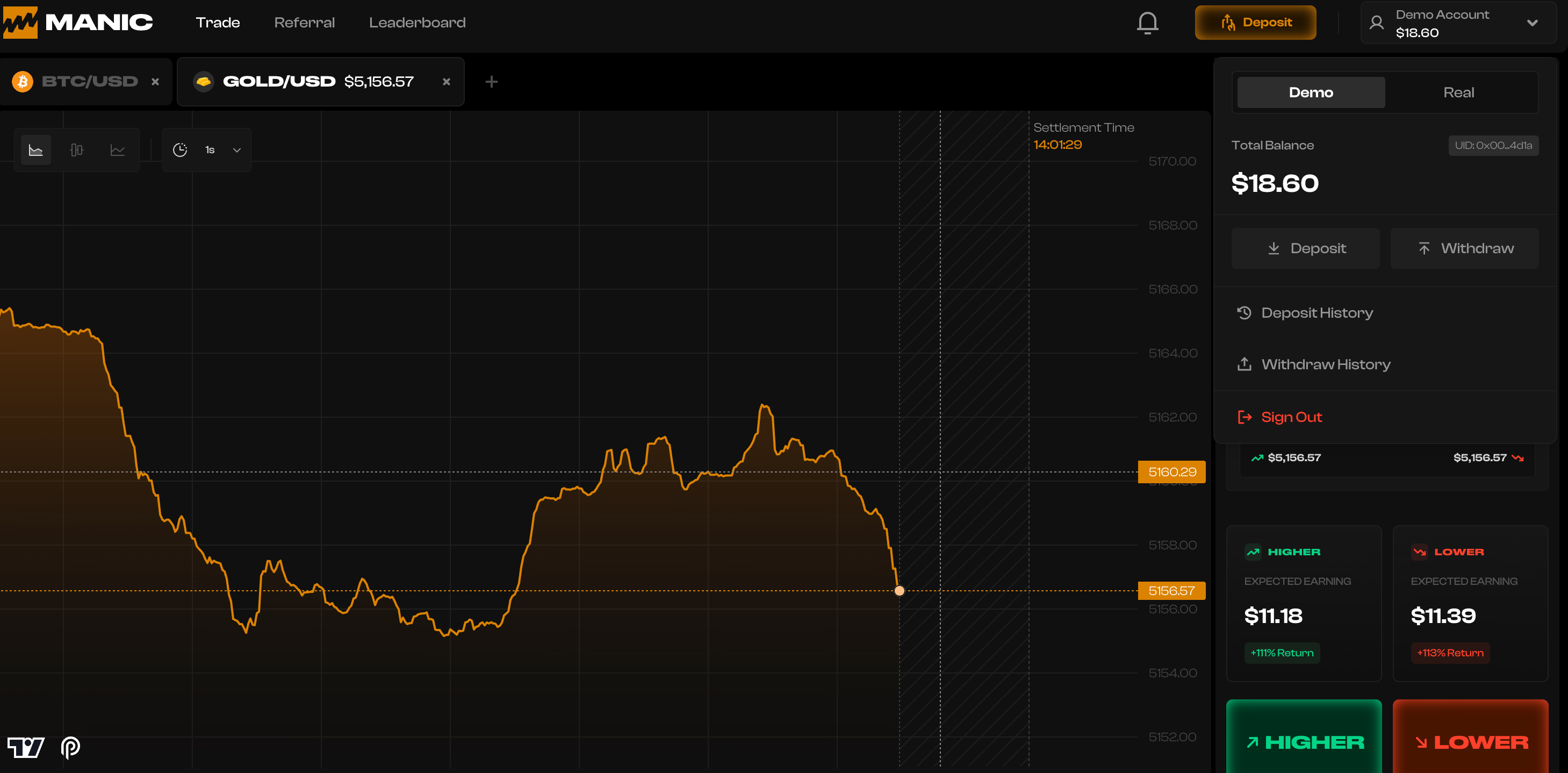
Your USDC balance appears on the platform interface. XAU/USD is visible as a tradable pair with the current Pyth Network price displayed in real-time.
Step 4: Your First XAU/USD Position
The trading interface shows:
- Current XAU/USD price (Pyth Network feed, updating every 400ms)
- Direction: Long (gold goes up) or Short (gold goes down)
- Multiplier: Classic (3x) / Pro (20x) / Manic (100x)
- Position size: Amount of USDC to allocate
For your first trade: Use Classic (3x). Allocate an amount you're comfortable losing entirely — this is your learning trade, not your strategy trade. Select a direction based on your read of current market conditions. Confirm.
The trade opens. Your USDC is committed to the position. The Pyth Network price feed updates your position P&L in real-time.
To close: Select your open position, click Close. Settlement happens on-chain in 400ms. USDC returns to your wallet — your original allocation plus or minus the trade result.
That's the complete workflow. First position to completion: under 3 minutes once setup is done.
Part 4: On-Chain vs. Broker — The Honest Comparison
No infrastructure is perfect for every trader. Here's an honest assessment of where each model has genuine advantages.
Where On-Chain Wins
Cost structure: Zero spread, zero commission on trades. The $200-$280/month savings for an active scalper is structural, not marginal.
Access: No KYC, no geographic restriction, no account approval. 30 minutes from decision to first trade.
Custody: Your funds stay in your wallet. No counterparty risk from broker operations.
Price feed integrity: Pyth Network pricing is institutional-grade and on-chain verifiable. No broker markup, no proprietary feed risk.
Transparency: Every trade settles on a public blockchain. Settlement is verifiable by any party. No black-box execution.
Where Traditional Brokers Have Advantages
Asset variety: FX brokers offer hundreds of instruments. Manic currently focuses on a defined set of assets including XAU/USD and XAG/USD. If you need simultaneous access to gold, EUR/USD, and equity indices in one interface, a multi-asset broker currently serves that need.
Leverage flexibility: Traditional FX brokers offer continuous leverage ratios (1:10, 1:50, 1:200) that allow more granular position sizing than a three-tier multiplier system. For traders with very specific risk-per-trade requirements, this granularity matters.
Familiarity: MT4/MT5 interfaces, TradingView integration, and standard chart packages are deeply familiar to experienced FX traders. The learning curve on on-chain interfaces, while short, is real.
Regulated fund protection: At properly regulated brokers (FCA, ASIC, CySEC), segregated account requirements and deposit protection schemes (FSCS up to £85,000 for FCA brokers) provide regulatory backstop that on-chain platforms don't offer. For traders who prioritize regulatory protection over cost efficiency, this matters.
The Core Trade-off, Stated Plainly
| Decision Factor | Choose Broker | Choose On-Chain |
|---|---|---|
| Execution cost is primary concern | — | ✅ |
| Need multi-asset access (forex + equities) | ✅ | — |
| Prioritize regulatory protection | ✅ | — |
| Frequent scalping (20+ trades/week) | — | ✅ |
| Geographic restrictions limit broker access | — | ✅ |
| Want custody of your own funds | — | ✅ |
| Need standard leverage ratios | ✅ | — |
| Priority: time to first trade | — | ✅ |
Part 5: Risk Architecture — What's Different On-Chain
The risk model on Manic differs from FX broker risk in ways that matter for position sizing and trade management.
Defined Maximum Loss
On Manic, your maximum loss on any trade is your position allocation. If you allocate 50 USDC to a Classic (3x) XAU/USD trade, your maximum loss is 50 USDC. The position closes automatically if it reaches maximum loss. You cannot lose more than you allocated.
This contrasts with FX broker leverage, where adverse moves beyond your margin trigger margin calls — and in fast markets, execution of those margin calls can occur at prices significantly worse than your theoretical stop, sometimes resulting in losses exceeding your account balance (negative balance events, which most regulated brokers now protect against but historically didn't).
No Stop-Loss Management Required
Because maximum loss is defined at entry (your position allocation), you don't manage stop-loss orders on Manic. The risk parameter is set when you decide how much USDC to allocate to a trade. This simplifies execution — one less decision at trade entry, one less order to manage during the trade.
For scalpers who've experienced stop-hunt wicks on FX platforms, this is a meaningful structural difference. There's no stop order in the market to hunt.
Position Duration
Manic's XAU/USD positions are structured as direction trades with defined parameters — they're not open-ended positions you hold indefinitely. This makes them more appropriate for scalping timeframes (minutes to hours) than for long-term gold positions. Traders wanting multi-day gold exposure should use traditional instruments (gold ETFs, futures, or spot accounts) for that portion of their gold market involvement.
Conclusion: The Broker Requirement Is Optional
The broker wasn't a feature. It was a constraint.
For decades, the broker was the only path to retail gold trading. That made the spread, the KYC, the custodial risk, and the onboarding delay unavoidable. You accepted them because the alternative was not trading gold at all.
Blockchain infrastructure removed that constraint. The Pyth Network provides institutional-grade XAU/USD pricing on-chain. Solana provides settlement infrastructure fast and cheap enough for retail scalping. The broker intermediary is now optional — not for everyone, not in every situation, but for active XAU/USD scalpers who prioritize cost efficiency and execution quality, it's optional.
The hierarchy for choosing your gold trading infrastructure:
- What is your primary constraint? (Cost? Access? Speed? Custody?)
- Does broker regulation matter more than spread savings? (If yes, use a regulated broker)
- Are you scalping or investing? (Scalping → cost efficiency critical; investing → broker advantages less relevant)
Next step: Audit your current gold trading costs this week.
- Spread cost — Total pips paid in spread over last 20 trades
- Good: Under 5 pips average (ECN/Raw account)
- Poor: Over 15 pips average (standard retail)
- Onboarding friction — How long did your current broker take to approve and fund?
- Good: Under 24 hours
- Poor: Over 3 days (this is time you couldn't trade)
- Custody comfort — Are you comfortable with your broker holding your capital?
- If uncertain: Non-custodial on-chain trading removes this variable
Week 1: Calculate your actual annual spread cost (pips × pip value × trade frequency × 52) Week 2: Set up Solana wallet and USDC — 30 minutes, no commitment required Week 3: Run parallel — same XAU/USD setups on both platforms, compare net P&L
For additional trading resources and XAU/USD session timing tools, visit our Trading Tools & Resources Hub.
Start Trading XAU/USD Without a Broker
The application is open. The spread is zero. The custody is yours.
Manic.Trade gives gold traders direct XAU/USD market access without the broker intermediary:
- No account application — Wallet connection replaces broker onboarding. No identity verification, no approval wait, no rejection risk.
- $0 spread on every trade — Pyth Network oracle pricing with no markup. The institutional gold price, directly.
- Non-custodial — Your USDC stays in your wallet. Manic never holds your funds. No counterparty risk.
- 30-second return setup — Once your wallet is funded, opening a gold position takes under a minute. No platform login, no order routing delay.
The difference: A broker account takes 3-7 days to open, charges 20-30 pips on every trade, and holds your capital on your behalf. A Solana wallet takes 10 minutes to create, costs nothing to trade with, and never touches your funds.
Trade XAU/USD without a broker →
FAQ
Q: Is it legal to trade gold without a broker?
In most jurisdictions, yes. Trading gold via a non-custodial on-chain platform is not regulated as brokerage activity because the platform doesn't hold your funds, doesn't provide investment advice, and doesn't act as a counterparty to your trades in the traditional sense — the smart contract does. The legal status depends on your jurisdiction: residents of the United States, for example, face specific restrictions on retail gold CFD trading regardless of platform type. Residents of the EU, UK, Australia, Southeast Asia, and most other jurisdictions face no specific restriction on using non-custodial on-chain trading platforms for commodity direction trades. If you're uncertain about your jurisdiction's rules, consulting a local financial advisor is the appropriate step. This guide doesn't constitute legal or financial advice.
Q: What happens to my USDC if Manic.Trade shuts down?
Because Manic operates on a non-custodial model, your USDC remains in your Solana wallet at all times — not on Manic's servers or in Manic's custody. If you don't have an open position, your funds are in your wallet and entirely unaffected by anything that happens to the Manic platform. If you have an open position when a platform issue occurs, the smart contract governing that position is on the Solana blockchain — not on Manic's servers. The blockchain doesn't shut down because a platform does. Your position and its settlement terms exist on-chain independently. This is the structural advantage of non-custodial on-chain trading: your funds don't live at the platform.
Q: Can I trade gold on-chain from the United States?
This is jurisdiction-specific and subject to change. US residents face specific regulatory restrictions on certain types of retail commodity derivatives trading. The CFTC's oversight of retail forex and commodity trading creates restrictions that may apply to on-chain commodity direction trading depending on how regulators classify the instrument. US residents should verify current regulatory status before trading. Manic's terms of service specify eligible jurisdictions — check these before proceeding if you're in the US or any other regulated jurisdiction with specific commodity trading rules.
Q: How much USDC do I need to start trading XAU/USD on-chain?
There's no platform minimum, but practical minimum depends on your strategy. For Classic (3x) gold direction trades targeting meaningful P&L, a starting allocation of $50-$100 USDC per trade is realistic. To run a proper scalping approach with multiple positions and risk management, $500-$2,000 USDC gives you enough capital to execute 10-20 setups without risking meaningful percentage of account on any single trade. The practical lower bound: whatever you can allocate per trade such that a loss doesn't meaningfully affect your ability to continue trading. Many traders start with $100-$200 USDC to learn the platform mechanics before scaling to their full intended position sizes.
Q: Is Pyth Network pricing accurate enough for gold scalping?
Pyth aggregates XAU/USD pricing from institutional market participants including Jump Trading and Jane Street — the same firms whose pricing underlies major exchange gold markets. The feed updates every 400ms. For gold scalping on 5-minute charts targeting 10-25 pip moves, 400ms price update frequency is well within acceptable precision — your entry timing is driven by candle closes and EMA signals, not sub-second tick data. Comparison testing between Pyth XAU/USD and CME gold futures real-time pricing shows consistent divergence under 2 pips during liquid sessions. For the scalping approach described in our gold scalping guide, Pyth pricing accuracy is more than sufficient.
Q: What's the difference between this and buying tokenized gold like PAXG?
Fundamentally different products. PAXG (Paxos Gold) and XAUt (Tether Gold) are tokenized representations of physical gold — owning them means owning a claim on actual gold held in a vault. They're investment vehicles, not trading instruments. You profit if gold goes up and lose if gold goes down, with no multiplier. Trading XAU/USD on Manic is a direction trade — you're predicting whether gold will be higher or lower over your chosen timeframe, with a multiplier that amplifies both profit and loss. Tokenized gold is for holders who want gold exposure in crypto form. Manic's XAU/USD is for traders who want to profit from gold's price movements directionally in either direction, quickly. These are different use cases, not competing products.
Q: Can I go short on gold without a broker?
Yes. Manic's XAU/USD direction trades allow both long (gold price goes up) and short (gold price goes down) positions with equal ease. This is actually an advantage over physical gold exposure and tokenized gold, both of which only allow you to profit from price increases. For scalpers who want to trade both sides of gold's intraday volatility — which, given gold's 1,000-3,000 pip daily range, offers significant opportunity in both directions — non-custodial on-chain trading gives you the same short-side access a broker would without the broker's costs and custody model.
Q: How do I get my profits out?
When you close a profitable trade, USDC settles to your Solana wallet immediately (within 400ms). From your wallet, you have several options: hold as USDC, convert to other assets on Solana DEXs (Jupiter, Raydium), or withdraw to a centralized exchange and convert to fiat. The fiat withdrawal path: Solana wallet → centralized exchange (Coinbase, Binance, Kraken) → bank account. Typical total time for the final fiat leg: 1-3 business days via bank transfer, instant via exchange debit card for amounts under withdrawal limits. There are no Manic withdrawal fees. Solana network fees for the wallet → exchange transfer run approximately $0.00025.
Q: Do I need a VPN to access Manic?
No VPN is required for general access. Whether you need a VPN depends on your jurisdiction's specific rules around on-chain trading platforms — some jurisdictions block certain financial platforms at the ISP level, others don't. Using a VPN to circumvent a geographic restriction that applies to you legally isn't a recommended approach and may create legal exposure depending on your jurisdiction. Access Manic directly and check whether the platform is accessible in your region before assuming any tools are needed.
Related Reading
Explore the Commodities Silo:
- Gold Scalping Strategy in 2026: Why Your Broker Is the Biggest Risk — The infrastructure-first framework for XAU/USD scalping
- XAU/USD on Solana vs FX Broker: The Execution Comparison — Direct data comparison of both infrastructure paths (coming soon)
- Slippage Control: The Architecture-First Approach — How execution infrastructure determines trading outcomes
- The Speed Advantage: Why Sub-Second Execution Defines Winners — The 400ms execution advantage in depth
- What Is Slippage in Crypto? — The hidden cost layer beneath broker spread
Cross-Pillar Connections:
- Momentum Trading Guide — The directional trading framework that applies to XAU/USD
- Flow State Trading: Why the Zone Is Architecture Not Attitude — Simplified execution interfaces and trading psychology
- Cognitive Load and Trading Success — Why removing broker complexity improves decision quality
- How to Control Fear and Greed in Trading — Emotional management for fast gold positions
- Trading Tools & Resources Hub — XAU/USD session timing, position sizing, and trading resources