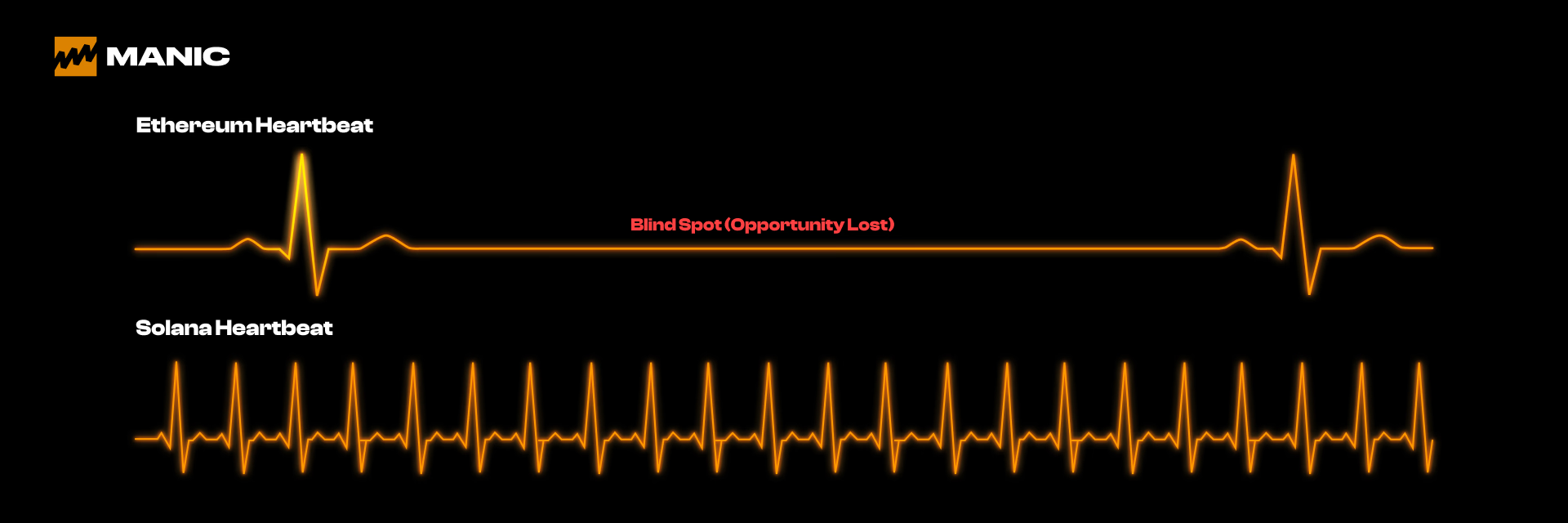
Why is Solana better for scalping than Ethereum? The answer lies in “Block Time.” Ethereum creates a new block (updates the ledger) every 12 seconds. Solana creates a block every 400 milliseconds. For a scalper, this difference is absolute. On Ethereum, you are trading with a 12-second blindfold; by the time your order is confirmed, the micro-trend has already vanished. On Solana, the ledger updates at the speed of human reaction, making real-time scalping physically possible.
We love Ethereum. It is the king of DeFi, NFTs, and secure settlement. But trying to scalp on Ethereum is like trying to play Counter-Strike via postal mail. You send your command (“Buy!”). Then you wait. And wait. 12 seconds later, the network responds: “Okay, you bought.” But the price is different now. The opportunity is gone.
Manic Trade is built exclusively on Solana. Not because we are fanboys, but because of physics. Here is why high-velocity strategies die on Layer 1 Ethereum.
1. The 12-Second Blindfold
Blockchain trading is not continuous; it is discrete. It moves in “chunks” called blocks. Between Block A and Block B, nothing happens. The network is frozen in time until the next block is mined.
- Ethereum Block Time: ~12 Seconds.
- Solana Block Time: ~0.4 Seconds (400ms).
Imagine you are trying to fade a “Wick” (as we taught in [The “Wick” Betrayal]). You see the price spike. You want to short the top. On Ethereum, even if you click instantly, your transaction sits in the “Mempool” (waiting room) for the next 12-second bus. By the time the bus leaves, the wick has already collapsed. You missed the entry. Worse, you might get filled after the collapse, meaning you just shorted the bottom.
In scalping, a 12-second delay is not “lag.” It is a different era.
2. The “Tick Rate” Analogy (For Gamers)
If you are a gamer, you understand Tick Rate.
- Ethereum = 10 Tick Server. (Update rate is slow. You shoot, but the bullet doesn’t register).
- Solana = 128 Tick Server. (Update rate is instant. What you see is what you get).
To trade Micro-Trends effectively, the network’s update speed must match your brain’s processing speed. Solana’s 400ms block time is faster than the average human conscious reaction time. This means the blockchain feels “live.” It feels liquid. It allows for the “0.5 Second Rule” we discussed previously — where execution feels instantaneous.
Contextual Link: Speed isn’t just about the blockchain; it’s about your UI too. See how we optimize the interface layer in [The 0.5 Second Rule].
3. The Cost of Friction (Gas Fees)
Speed is useless if it costs $50 to pull the trigger. On Ethereum, a fast swap can cost anywhere from $5 to $50 depending on congestion. If you are scalping for a $20 profit, you cannot pay a $10 fee. The math doesn’t work.
- Ethereum Fee: $5.00+
- Solana Fee: $0.00025
On Solana, the fee is mathematically negligible. You can take a trade for a $2 profit and still be net positive. This allows for “High-Volume, Low-Margin” strategies — the bread and butter of professional market makers and scalpers.
4. Why Layer 2s (L2) Are Not the Answer (Yet)
“But what about Arbitrum? What about Base?” Layer 2s are faster than Ethereum Mainnet, yes. But they still rely on a “Sequencer” and eventual settlement to the slow main chain. More importantly, the liquidity on L2s is fragmented. Solana is a Monolithic Chain. All the liquidity, all the traders, and all the volume are on one single high-speed layer. For a scalper, unified liquidity means less slippage and better fills.
Conclusion: The Right Tool for the Job
You wouldn’t drive a tractor on a Formula 1 track. Ethereum is a tractor — powerful, robust, heavy. It pulls the economy of DeFi. Solana is an F1 car — light, dangerous, fast. It is built for racing.
At Manic Trade, we are racers. We don’t care about “Store of Value.” We care about Price Action. And for Price Action, there is only one chain that keeps up.
Welcome to the fast lane.
Ready to trade at 400ms? Ditch the lag. Switch to Solana. Trade on Manic.
🌐 Official Website: Manic.Trade
🐦 X (Twitter): @ManicTrade
🎮 Discord: Join the Server
✈️ Telegram: Official Channel
🤖 Glossary: Terms You Need to Know
Block Time
- Plain English: The heartbeat of a blockchain. It is how often the network updates its ledger and confirms new transactions.
- Stat: Ethereum = ~12s. Solana = ~0.4s.
Mempool (Memory Pool)
- Plain English: The “waiting room” where your transaction sits before a miner picks it up and puts it into a block.
- Context: In high-speed trading, getting stuck in the mempool means missing the trade.
Tick Rate
- Plain English: A gaming term referring to how many times per second a server updates the game state. Higher tick rate = smoother, more accurate gameplay.
- Analogy: Solana is a high-tick-rate server for finance.
Monolithic Chain
- Plain English: A blockchain where execution, settlement, and data availability all happen on the same layer (like Solana). This often results in lower latency compared to modular setups (like ETH + L2s).
Related Reading
This article is part of our comprehensive guide: The Speed Advantage: Why Sub-Second Execution Defines Modern Crypto Trading as well
Discover the three layers of execution speed (hardware 15%, UI 50%, blockchain 35%), why Solana's 400ms confirmation beats Ethereum's 12 seconds, and how infrastructure advantage captures 3-5x more profit than skill alone.