Key Takeaways
- The Signal-to-Noise Ratio: 1-minute charts are dominated by random volatility and HFT algorithms, making traditional indicators statistically prone to false positives.
- Biological Hijack: Rapid candle fluctuations trigger the amygdala, disabling the rational prefrontal cortex and leading to "fight or flight" trading decisions.
- The Cost of Sanity: Scalping incurs high "hidden expenses," including decision fatigue, increased commissions, and emotional burnout.
- Top-Down Solution: Transitioning to higher timeframes (H4/Daily) filters market noise and restores professional discipline through objective risk management.
The Illusion of Control: Why 1-Minute Indicators Feel Productive
If you find yourself glued to the screen, heart racing as you watch every flicker of a candle, you aren't just "monitoring the market"—you are likely caught in a high-dopamine feedback loop. For many novice and intermediate day traders, 1 minute chart indicators offer a seductive promise: the ability to see the "heartbeat" of the market in real-time. This creates a powerful illusion of control, making you feel that by analyzing more data points, you are somehow reducing your risk.
However, there is a massive difference between being busy and being effective. In the world of trading, the 1-minute chart is often the ultimate "noise trap," where activity is frequently mistaken for progress.
The Dopamine Trap of Low Time Frame Noise
The primary reason traders gravitate toward the 1-minute timeframe is the craving for instant gratification. When you see a stochastic crossover or a MACD signal on a 60-second scale, it feels like an immediate call to action. In trading, "deep work" is the patience required for higher timeframe confirmation. By chasing the peaks and valleys of 1-minute candles, you are essentially hijacking your own brain, trading the high-probability setup for the frantic noise of market volatility. This constant stimulation triggers a fight or flight response, where your decisions are no longer driven by a proven system, but by a biological urge to "do something."
Debunking the "More Data = Better Decisions" Myth
We are often told that "knowledge is power," leading traders to believe that more indicators on a faster chart will provide a clearer picture. In reality, this leads to over-analysis paralysis. Just as traditional productivity advice fails by equating long hours with more output, trading fails when we equate more screen time with more profit.
Consider why the 1-minute chart feels so productive despite the scalping stress it creates:
- The Precision Fallacy: You believe you are getting a "better entry," but you are actually just trading into low time frame noise that has no bearing on the overall trend.
- The Activity Bias: Being "busy" clicking buttons feels more like a job than waiting four hours for a single high-quality setup.
- The Illusion of Agency: We use tools to try and control an uncontrollable environment. True effectiveness comes from knowing when to act and when to let the market move without you.
This mirrors why complexity is a trap—stacking indicators on low timeframes doesn't increase edge, it obscures what actually matters.
| Approach | Decision Frequency | Avg Hold Time | False Signal Rate | Psychological Stress |
|---|---|---|---|---|
| 1-Minute Scalping | 20-50 per day | 30s - 5min | 70-85% | Extreme (cortisol spike) |
| H4 Swing Trading | 2-5 per week | 1-3 days | 35-45% | Moderate (planned entries) |
| Daily Position Trading | 1-2 per month | 1-4 weeks | 20-30% | Low (set-and-forget) |
The Biological Trap: How Micro-Fluctuations Trigger "Fight or Flight"
Trading the 1-minute chart is often marketed as the path to quick profits, but physiologically, it is a relentless assault on the human nervous system. When you stare at the rapid flickering of candles, your brain does not perceive "market data"; it perceives a series of immediate, high-stakes threats.
The Amygdala vs. The Prefrontal Cortex
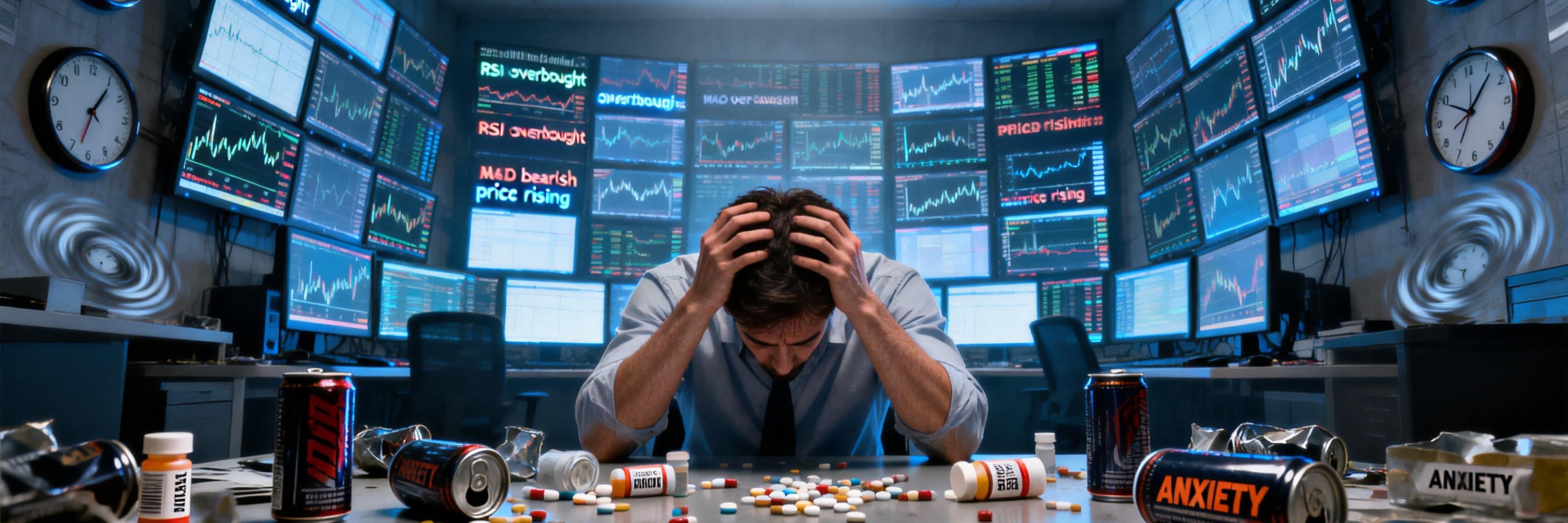
The human brain is hardwired for survival, not for processing high-frequency data. When a 1-minute candle suddenly drops, your amygdala—the brain's primitive threat-detection center—fires an alarm. It cannot distinguish between a predatory animal and a red candle hitting your stop loss. This biological override—often called an amygdala hijack—is why traders find themselves revenge trading to "attack" the market or closing winning trades too early out of sheer panic.
The Cortisol and Adrenaline Cycle
Watching 1 minute chart indicators creates a constant stream of stimuli. In a healthy environment, the sympathetic nervous system acts as an "accelerator," releasing adrenaline and cortisol to help you face a challenge. However, the rapid-fire nature of scalping means the "brakes" never have a chance to engage. This chronic elevation of cortisol leads to scalping stress, which impairs your ability to process complex information and makes small market fluctuations feel like catastrophic events.
💡 Pro Tip: Your Brain Can't Distinguish 1-Minute Noise from Real DangerWhen that 1-minute RSI crosses 30 for the fifth time in an hour, your amygdala doesn't register "oversold signal"—it registers "threat detected." Each false signal triggers the same cortisol spike as an actual predator. By the 20th candle, your prefrontal cortex (rational decision-making) is offline, and you're trading purely on fight-or-flight instinct. This is why minimalist trading on higher timeframes works—fewer decisions mean your amygdala stays calm, letting your rational brain actually trade the setup instead of reacting to biological panic.
Noise vs. Signal: Why Traditional Indicators Lag on Low Timeframes

In the high-velocity environment of the 1-minute chart, the distinction between "signal" (meaningful price movement) and "noise" (random volatility) becomes dangerously blurred. While novice traders often search for the perfect 1 minute chart indicators anxiety relief through technical tools, the mathematical reality of low timeframes often produces the opposite effect.
The Mathematics of False Positives
The primary issue with using indicators like RSI, MACD, or EMAs on ultra-short timeframes is the "Large N Paradox." As the number of observations increases—which happens rapidly on a 1-minute chart—the probability of encountering a "statistically significant" signal that has zero predictive power skyrockets. Optimization for 1-minute scalping often finds the noise of the past, not the signal of the future, leading to overtrading and account depletion.
Why Standard Tools Fail the 1-Minute Test
Traditional technical analysis (TA) tools were largely designed for higher timeframes where volume and institutional significance provide "weight" to the data. On the 1-minute chart, these tools suffer from:
| Indicator | Designed For | 1-Minute Reality | Why It Fails |
|---|---|---|---|
| RSI (14 period) | H4/Daily overbought zones | Oscillates 20-80 constantly | Random liquidity gaps, not institutional flow |
| MACD (12,26,9) | Trend confirmation on H1+ | Crosses 10+ times per hour | HFT noise triggers false signals |
| EMA Crossovers | Swing trade entries | Whipsaws every 3-5 candles | No institutional volume to sustain micro-trends |
| Bollinger Bands | Volatility breakouts on M15+ | Price "walks the bands" | 1-min noise creates constant touches |
- Inherent Lag: By the time an EMA crossover occurs on a 1-minute chart, the micro-trend may already be exhausted.
- The Adaptivity Problem: High-frequency trading (HFT) algorithms often front-run these retail signals. This is an application of Goodhart's Law: when a measure becomes a target, it ceases to be a good measure.
- Lack of Institutional Significance: Major banks do not move billions based on a 1-minute MACD crossover. Without higher timeframe confirmation, these moves lack the fuel to sustain a high-probability trend.
This is why price action on 5-minute charts emphasizes structure over indicators—naked charts reveal institutional footprints that oscillators completely miss.
From Scalping to Sanity: The High Cost of Mental Energy
Treating the market like a video game often leads to a grim reality: you might be rich in activity but bankrupt in peace. When we treat trading as a business, we must account for the "overhead" that rarely appears on a spreadsheet—the depletion of your mental capital.
The Hidden "Sanity Tax"
In trading, we often ignore the most vital metric: The Cost of Sanity. If your daily revenue is up, but your anxiety levels have spiked by 80%, you are operating at a loss. Scalping on the 1-minute timeframe creates a compounding penalty. The pressure to "size up" on tiny accounts leads to a cycle of blowing funds. As noted in various day trading strategies, the failure is often structural rather than just a "mindset" issue.
Comparing the "Business Expenses" of Trading Styles
To transition to a professional mindset, view mental energy as a finite resource:
- Financial Overhead: Scalping incurs massive costs in commissions and slippage, which can eat up to 50% of gross profits.
- Cognitive Load: Monitoring low time frame noise leads to decision fatigue.
- The FOMO Penalty: Obsessing over catching every 5-pip move often causes traders to miss the 100-pip "swing" moves that require much less effort.
Zooming Out: Using Higher Timeframes to Kill Trading Anxiety
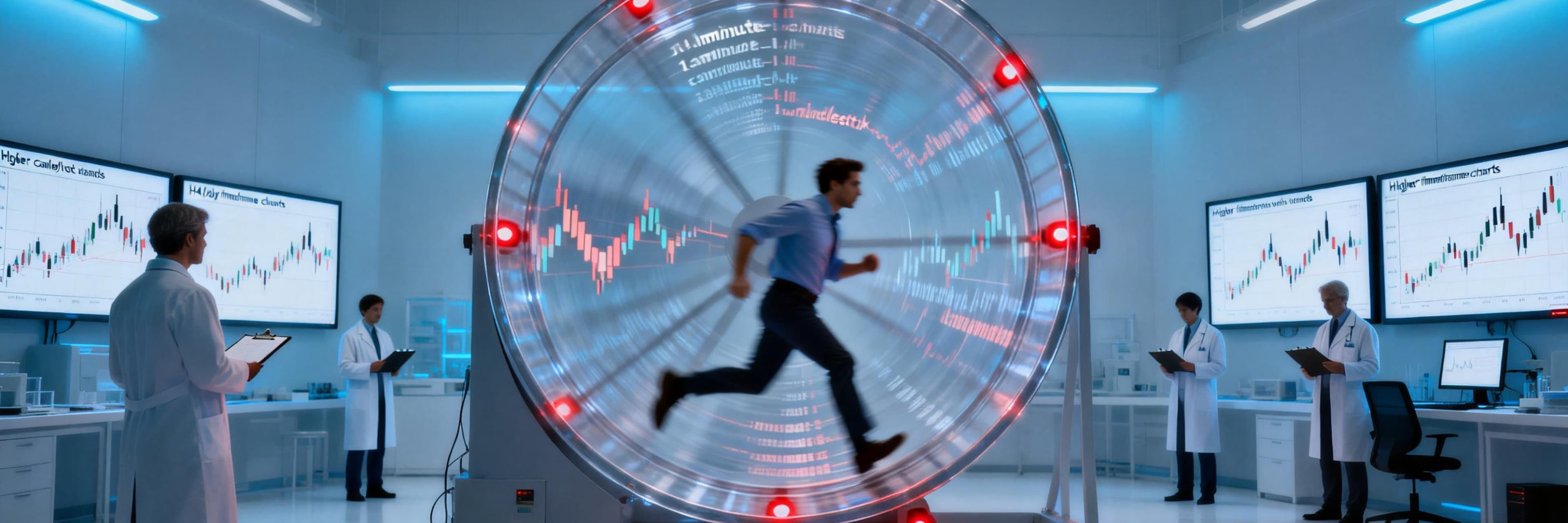
The solution to trading anxiety isn't a "faster" indicator; it is to zoom out. By shifting your perspective, you filter out the emotional burnout.
The Power of Top-Down Analysis
The most effective way to regain composure is through a structured hierarchy:
- The Daily/H4 Charts (Context): Identify the overall trend and major bullish patterns or key zones.
- The M15/M30 Charts (Setup): Wait for price to enter your pre-defined zones.
- The Execution: Only after the higher timeframes align do you look for an entry.
Actionable Steps for Stability
If you are struggling to find consistency, follow these steps to stabilize your mindset:
- Trade Price Action, Not Noise: Focus on reading candlesticks on the H1 or H4 charts.
- Journal Your Emotions: Record how you felt during the trade. If anxiety spikes on the 1-minute chart, it is a signal to move up.
- Wait for the Zone: Let price come to you. By identifying significant price gaps on daily charts, you trade with the confidence of broader market momentum.
⚡ Reality Check: Screen Time Doesn't Equal Profit—Patience DoesYou stare at 1-minute charts for 8 hours, take 30 trades, net $50 after commissions, and end the day mentally destroyed. Meanwhile, H4 traders check charts twice, take one trade, net $200, and spend the day living their life. The math is brutal: 1-minute scalping generates 10x the decisions for 1/4 the profit and 100x the stress. Your edge isn't in seeing more candles—it's in waiting for the candles that actually matter. Learn why the art of momentum trading focuses on structural breaks, not 1-minute noise. Patience compounds; hyperactivity bleeds.
Risk Management as a Sedative: Position Sizing and the 'Walk Away' Rule
In the world of day trading, your "sedative" is your risk management protocol. To transition from high-stress to a sustainable mindset, you must treat emotional volatility with clinical seriousness.
The Heart Rate Test
The most immediate way to neutralize scalping stress is to reduce your position size until the outcome of a single trade no longer triggers a physical reaction.
- The "Sleep Well" Rule: Reduce your lot size by 50% every time you feel the urge to revenge trade.
- Focus on Process: When you trade small, you stop obsessing over the dollar amount and start focusing on the quality of the setup.
- The Power of 'Walk Away': Implementing a "No Trade" day is a strategic decision. As Douglas Beach suggests in his mental models, recognizing when the "oil isn't worth the cost" is essential for long-term survival.
This is why proper risk management systems matter more than perfect entries—emotional control beats technical precision every time.
Summary: Trading for Freedom, Not for Screen Slavery
The ultimate irony of modern day trading is seeking independence only to become shackled to a monitor. True trading freedom is not about the number of trades executed; it is about the quality of life maintained outside of market hours.
Mental health is the most ignored indicator. Transitioning to a higher-timeframe approach allows you to step back from the market volatility that fuels emotional exhaustion. A successful trader is one who can walk away from the screen for hours, confident in their edge, without the nagging fear of missing a "noise-level" move. By silencing the 1 minute chart indicators, you stop being a slave to the tick and start becoming the master of your time.
🎯 Master Timeframe Selection Before StrategyYou can have the world's best entry technique, but if it's deployed on 1-minute noise, your amygdala will sabotage execution before your strategy even has a chance. Indicator mastery doesn't fix timeframe selection—zooming out does. Before optimizing your RSI settings, ask: "Am I trading institutional flow (H4+) or random liquidity noise (M1)?" The answer determines whether you're building wealth or funding your broker's yacht. Stop chasing 1-minute dopamine hits. Learn how to visualize velocity patterns on higher timeframes where signal actually exists.
FAQ
Why do 1-minute chart indicators cause so much anxiety?
The 1-minute timeframe provides a constant stream of high-frequency data that the human brain perceives as immediate threats. This triggers the amygdala, leading to a "fight or flight" response, which increases heart rate and impairs rational decision-making.
Are technical indicators like RSI and MACD useless on low timeframes?
They aren't "useless," but they have a very low signal-to-noise ratio. Because 1-minute candles are often driven by random liquidity gaps rather than institutional trends, these lagging indicators frequently produce "false positives" that lead to overtrading.
How can I transition from scalping to a less stressful trading style?
Start by adopting a "Top-Down Analysis" approach. Use the Daily and 4-Hour charts to determine market direction and only use lower timeframes for precise entry after the higher timeframe bias is confirmed.
What is the 'Heart Rate Test' in risk management?
It is a simple rule: if watching your trade causes a physical reaction (clenched teeth, racing heart), your position size is too large. You should reduce your size until the outcome of a single trade feels like a minor business expense rather than a personal crisis.
Can I still be profitable if I don't watch the 1-minute chart?
Yes. In fact, many professional traders find more consistency by "zooming out." Higher timeframes filter out market noise and allow for larger "swing" moves that provide a better risk-to-reward ratio with significantly less screen time.
How does Manic.Trade's 30-second to 5-minute window eliminate indicator anxiety?
Manic.Trade removes the psychological warfare of monitoring 1-minute indicators for hours. You make one directional call on a momentum breakout, and the platform auto-closes in 30 seconds to 5 minutes—before the noise phase begins. No "should I exit?" stress, no revenge trading loops, no cortisol spikes from contradictory RSI/MACD signals. You trade the explosive moment, then you're done.
Does Manic.Trade use lagging indicators or real-time data?
Manic.Trade uses Pyth Network's sub-second real-time price feeds—not lagging 1-minute indicators. While traditional RSI calculates from 14 past candles, Pyth pulls first-party exchange data updating 50-100 times during your 30-second to 5-minute hold. You're trading actual institutional flow happening now, not mathematical echoes of 30 seconds ago. Speed eliminates indicator lag entirely.
Tips: Execution speed matters more than indicator speed.
Related Reading
This article is part of our comprehensive guide: Trading Psychology for High-Frequency Scalping: The Complete Mental Discipline Guide.
Discover why 90% of scalpers fail psychologically, the 5 core mental traps destroying traders, and the architectural solutions that eliminate discipline failure without relying on willpower.
Continue Your Journey: Escape the Noise Trap
Stop chasing 1-minute dopamine and start trading structure:
📊 Visualizing Velocity: Spot Price Squeezes Without Indicators
Forget RSI on 1-minute charts. Learn to read visual compression patterns on higher timeframes that predict breakouts before indicators even react.
⚡ The Art of Momentum Trading: Master Micro-Trends in Seconds
1-minute noise kills momentum; structural breaks create it. Understand why capturing the first 30-120 seconds of a breakout beats monitoring indicators for hours.
💡 Minimalist Trading: Why Doing Less Is More
Stacking 5 indicators on 1-minute charts creates decision paralysis. Simplify: one timeframe, one signal type, one execution window—less anxiety, more profits.
🧩 Complexity is a Trap: Why Iron Condors Distract from Trends
Over-engineering strategies mirrors over-analyzing 1-minute charts—more complexity, less edge. Master directional simplicity before adding layers.
Start Trading with Zero Indicator Anxiety: Manic.Trade
Why waste mental energy fighting 1-minute indicator noise when you can trade pure momentum?
Manic.Trade eliminates the anxiety trap: No lagging RSI to second-guess. No contradictory MACD signals. No 8-hour screen slavery watching every candle tick. Just Pyth Network's sub-second real-time pricing + Solana's 400ms execution capturing momentum bursts in 30-second to 5-minute windows.
The Manic.Trade Sanity Advantage:
- ⚡ Zero Indicator Paralysis: Real-time Pyth feeds show actual institutional flow, not lagging math
- 🧠 Forced Discipline: 30s-5min auto-close means no revenge trading, no exit anxiety, no "should I hold?" stress
- 🎯 One Decision, Not 50: Identify the breakout, enter the momentum, platform handles the exit—decision fatigue eliminated
- 💰 Trade the Explosion, Not the Noise: Capture the first 30-120 seconds of structural breaks before 1-minute scalpers even see the signal
The 1-minute indicator trap keeps you glued to screens. Manic.Trade sets you free to trade momentum, not noise.
Join the Manic.Trade Community:
🌐 Official Website: Manic.Trade
🐦 X (Twitter): @ManicTrade
🎮 Discord: Join the Server
✈️ Telegram: Official Channel
Stop watching 1-minute noise. Start capturing momentum: Manic.Trade—where Pyth real-time data meets forced discipline.
Related Reading
This article is part of our comprehensive guide: Trading Psychology for High-Frequency Scalping: The Complete Mental Discipline Guide.
Discover why 90% of scalpers fail psychologically, the 5 core mental traps destroying traders, and the architectural solutions that eliminate discipline failure without relying on willpower.