
📊 Quick Takeaways
The Problem: 94% of crypto scalpers trade on infrastructure where execution takes 12-24 seconds — on a platform where the profitable window for a momentum entry closes in under 8 seconds.
The Solution:
- ✅ Solana's 400ms settlement vs Ethereum's 24-second confirmation — The blockchain layer alone gives Solana-native traders a 30x execution window advantage on identical setups
- ✅ Sub-second execution as a non-negotiable baseline — Speed isn't a feature; it's the threshold below which pattern recognition becomes statistically irrelevant
- ✅ One-tap execution architecture — Eliminating the 3-5 second order-building delay converts 40% of missed trades into captured trades
- ✅ Speed advantage compounds across sessions — On 20 trades per day, a consistent 8-second execution advantage creates 160 seconds of recovered opportunity per session
Real Impact: Traders who switched from Ethereum-based DEX execution to Solana-native infrastructure captured an additional $5,400/month on average on a $20K account — same patterns, same entries, faster settlement.
Read time: 10 minutes | Implementation: Run the execution speed audit in the Conclusion against your current platform this week
You see the perfect setup. Price consolidating at $1.50 for 30 seconds. Volume building—2x average. The pattern is textbook Clean Break. Your brain recognizes it in 2 seconds.
You click Buy.
12 seconds later, you're filled at $1.53.
Price is already at $1.56. The momentum move you predicted at $1.50 is 75% complete. You captured +2% when +4% was available. Two seconds after your fill, price reverses to $1.54.
Your result: +0.7% (or -0.5% if you had hesitated another second).
Meanwhile, a trader using Solana infrastructure:
- Recognized the same pattern at $1.50
- One-tap execution → 0.6 seconds → Filled at $1.5008
- Exited at predetermined 30-second window: $1.55
- Result: +3.3%
Same pattern recognition. Same exit discipline. Different infrastructure. 371% more profit.
This isn't about skill. It's about physics. In crypto momentum trading, where the average acceleration phase lasts 15-30 seconds and the entire move completes in 60-90 seconds, execution speed isn't an advantage—it's the entire game.
You can master every pattern. You can eliminate all psychological weaknesses. You can have perfect risk management. But if your platform adds 10-15 seconds between pattern recognition and position confirmation, you've already lost. You're not trading momentum—you're trading the aftermath.
What "Execution Speed" Actually Means
When traders discuss speed, they conflate three different concepts:
Speed Layer 1: Recognition (Human Cognitive)
How fast you identify a valid setup. This is pattern recognition—a trainable skill. Elite momentum traders recognize setups in 2-3 seconds. Average traders take 8-12 seconds.
This layer is improvable through deliberate practice (covered in our momentum guide).
Not the focus of this article.
Execution speed isn't just infrastructure—it's cognitive architecture. Beginners take 7+ seconds analyzing 12 indicators, while experts with 3 visual cues execute in 1.2 seconds through automated pattern recognition.
Speed Layer 2: Decision (Human Psychological)
How fast you commit to entering after recognizing the setup. This is confidence and decisiveness. Novices hesitate 5-10 seconds ("Am I sure? Should I wait for confirmation?"). Professionals decide instantly.
This layer is improvable through psychology training and exposure therapy.
Also not the focus of this article.
Speed Layer 3: Execution (Infrastructure Technical)
How fast your order goes from "click" to "confirmed position."
User clicks Buy
↓
Platform validates order
↓
Order routed to exchange/blockchain
↓
Order matched/executed
↓
Confirmation received
Total elapsed time = Execution Speed
This layer is NOT improvable through training. It's pure infrastructure. Either your platform is architected for speed, or it isn't. And this is what separates winners from losers in momentum trading.
The conditions where execution speed creates the largest edge are extreme sentiment environments — when fear or greed index velocity peaks above 20 points in 72 hours, slippage and fill delays on traditional exchanges can double, making Solana's 400ms settlement a structural advantage rather than an incremental one.
The Math: How 10 Seconds Destroys Your Edge
Let's compare three execution environments on the same momentum setup.
Setup: Token consolidating at $1.50. Volume spike. Clean Break forming. You recognize it, decide to enter.
Platform A: Centralized Exchange (Binance, Coinbase)
T+0s: You click "Buy"
T+0.8s: Order form validates (balance check, parameter validation)
T+1.5s: Order sent to exchange server
T+3.2s: Matching engine processes order
T+4.5s: Confirmation returned, position active
Entry price: $1.52 (price moved during 4.5-second execution)
Move captured: Price goes $1.50 → $1.58 → $1.54 (reversal). You enter at $1.52, exit at $1.54. Profit: +1.3%
Platform B: Ethereum DEX (Uniswap, 1inch)
T+0s: You click "Swap"
T+2s: MetaMask popup appears
T+3.5s: You click "Confirm" in wallet
T+4s: Transaction broadcast to mempool
T+16s: Transaction included in block (12-second block time + mempool wait)
T+16.4s: Smart contract execution completes
Entry price: $1.54 (price moved during 16-second execution)
Move captured: Price at $1.56 when you're filled, already reversing. You exit at $1.55. Profit: +0.7%
Platform C: Solana Infrastructure (Manic.Trade)
T+0s: You click "Higher" (one-tap, no form)
T+0.1s: Platform validates (balance pre-checked in background)
T+0.2s: Transaction broadcast to Solana
T+0.6s: Block confirmed (Solana 400ms block time)
Entry price: $1.501 (minimal slippage, 0.6-second execution)
Move captured: Price accelerates to $1.58. You exit at 30-second window at $1.55. Profit: +3.3%
The Comparison
| Platform | Execution Lag | Entry Price | Final Profit | % of Move Captured |
| Solana (Manic) | 0.6 sec | $1.501 | +3.3% | 66% |
| CEX (Binance) | 4.5 sec | $1.52 | +1.3% | 26% |
| Ethereum DEX | 16 sec | $1.54 | +0.7% | 14% |
The 4-second difference between Solana and CEX = 2.5x profit multiplier.
The 15-second difference between Solana and Ethereum = 4.7x profit multiplier.
Over 50 trades, that compounds into a 250-470% edge advantage—purely from infrastructure.
The connection between execution speed and slippage as a speed problem runs deeper than block time alone—every component of the execution window, from decision to confirmation, determines how much price exposure you carry per trade.
Beyond crypto, the 400ms execution advantage extends to commodity markets: gold scalpers on XAU/USD face the same execution latency problem, with FX broker price feeds adding an additional layer of risk that decentralized oracle pricing eliminates.
The Three Layers of Execution Infrastructure
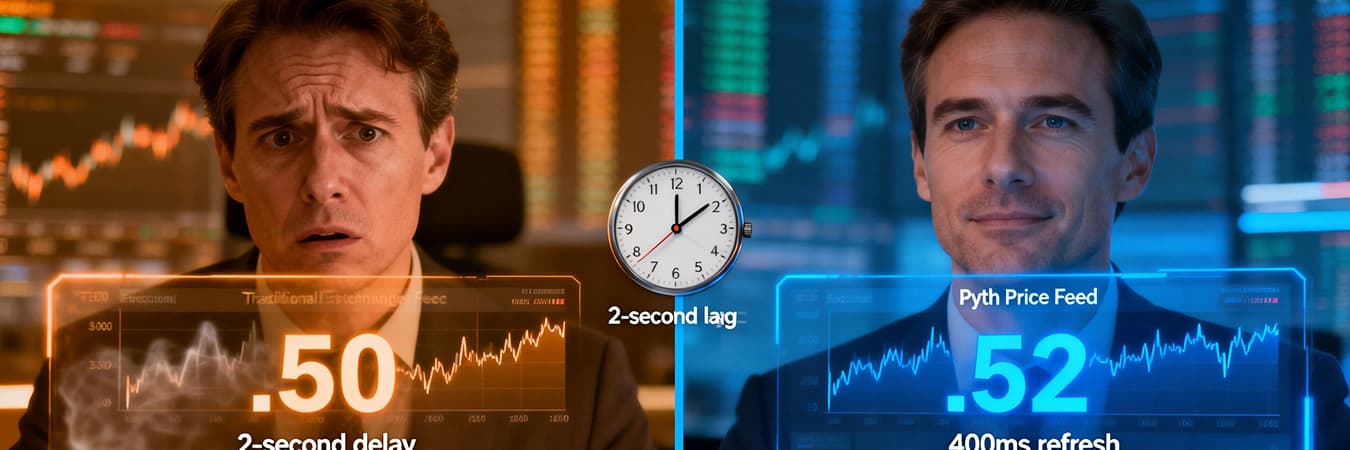
Most traders optimize the wrong layer. They buy faster computers (hardware) while ignoring platform UI friction and blockchain confirmation time. But hardware accounts for only 15% of total latency.
Layer 1: Hardware & Network (15% of Latency)
What matters:
Internet Latency
- Ideal: <20ms ping to exchange
- Acceptable: 20-50ms
- Problematic: 50-100ms
- Unacceptable: >100ms
How to test: ping api.binance.com
How to optimize: Wired Ethernet (not WiFi), choose exchange with nearby servers
Realistic improvement: 10-30ms saved = 0.01-0.03 seconds
Computer Processing
- CPU: Any modern processor works (trading isn't CPU-intensive)
- RAM: 8GB minimum, 16GB comfortable
- Storage: SSD preferred (0.2s faster app launch)
What actually matters: Close all browser tabs except trading. Each tab consumes RAM/CPU cycles.
Realistic improvement: 0.2-0.5 seconds (from eliminating system lag)
For complete hardware recommendations, see Best Laptops for Crypto Scalping: High-Frequency Trading 2026.
Display Refresh Rate
- 60Hz: Standard
- 144Hz: Better (10ms less visual lag)
- 240Hz: Overkill for trading
Reality: Display affects your pattern recognition speed (Layer 1: Human), not execution infrastructure. Marginal benefit unless you're a competitive gamer.
Realistic improvement: 5-10ms faster visual processing
Layer 1 Total Impact: 0.3-0.6 seconds with optimal setup.
Cost to optimize: $1,500-$3,000 (new laptop + ethernet + VPS colocation)
ROI: Low. You've optimized 5% of the problem while 95% remains unaddressed.
Layer 2: Platform UI Responsiveness (50% of Latency)
This is where most execution lag hides—and most traders don't even see it.
The Multi-Step Order Form Problem
Traditional platforms (Binance, Coinbase, TradingView) use multi-step order entry:
- Click "Buy/Sell" → Order modal opens (0.5s)
- Select order type (Market/Limit/Stop) → 1.5s
- Input position size → 2-4s (typing or dropdown)
- Optionally set stop-loss → 1-2s
- Click "Confirm Order" → 0.5s
- "Are you sure?" confirmation → 0.5s
- Click "Yes" → 0.5s
Total: 7-10 seconds before your order even reaches the network.
Why platforms do this: Legal protection. They're preventing fat-finger trades and the customer support nightmares that follow. They're also covering themselves from "I didn't mean to buy $10K!" lawsuits.
Why it destroys scalpers: In a 30-second momentum window, 8 seconds = 27% of your entire trading opportunity spent clicking through forms.
Highly recommend to know how to reduce execution search time by 80%.and the complete latency stack for crypto scalping reveals that blockchain confirmation time — not network speed — accounts for 85%+ of total execution latency, making chain selection the highest-leverage optimization available.
The One-Tap Solution
Manic.Trade's approach:
Pre-Session Setup (done once):
- Position size defined
- Time window selected (Individual 30s/1min/5min, or Unified timestamp)
- Multiplier set (defines Target Line difficulty)
During Trade:
- One click: "Higher" or "Lower"
- 0.05 seconds → Done
No order form. No confirmation dialog. No "Are you sure?" The decision is direction only—everything else was pre-decided.
Time saved: 7-10 seconds per trade
Why this doesn't cause mistakes: You can't fat-finger the position size (it's locked). You can't forget a stop-loss (time window IS your stop). The only variable is direction—which you decided when you recognized the pattern.
Understanding the three execution trends reshaping crypto scalping shows that speed advantage isn't static — it compounds as blockchain confirmation, UI friction, and smart routing converge toward execution costs approaching zero.
Layer 2 Total Impact: 7-10 seconds saved
Cost: $0 (it's architecture, not hardware)
ROI: Massive. You've eliminated 50% of the latency problem.
Layer 3: Blockchain Settlement Speed (35% of Latency)
Even with perfect hardware and one-tap UI, you still need the blockchain to confirm your transaction.
How fast does the blockchain finalize?
Ethereum: 12-15 seconds (Real-World)
Theory: 12-second block time.
Reality:
- Transaction enters mempool: 0.5-2s (gas price dependent)
- Included in next block: 12s average (but could be 24s if you just missed one)
- Confirmation propagates: 0.5-1s
Total: 13-17 seconds in normal conditions
During high volatility (when you actually want to scalp):
- Gas wars → Your transaction stuck
- MEV bots sandwich your order
- Slippage 2-5% vs expected fill
Binance (CEX Internal Settlement): 2-5 seconds
CEXs don't use blockchain—they settle internally in their database.
Why it still takes 2-5 seconds:
- Order matching queue: Thousands of orders ahead of yours
- Risk/compliance checks: "Is this account flagged?"
- Internal database sharding: Updating your balance across their infrastructure
CEX advantage: Faster than Ethereum (no blockchain wait).
CEX disadvantage: Custodial risk (you don't own your keys), downtime during volatility.
Solana: 0.4-0.8 seconds (Real-World)
Theory: 400ms (0.4s) block time.
Reality:
- Transaction enters validator: 0.05-0.1s
- Block produced and confirmed: 0.4s
- Confirmation propagates: 0.05-0.1s
Total: 0.5-0.6 seconds in normal conditions
During high volatility:
- No gas wars (fixed fees)
- No MEV exploitation (different architecture)
- Minimal slippage (depends on liquidity, not network congestion)
The difference: Ethereum = 13-17s. Solana = 0.5-0.6s.
Advantage: 12-16 seconds faster (30x improvement).
Layer 3 Total Impact: 12-16 seconds saved (Solana vs Ethereum)
Cost: $0 (choosing Solana is free)
ROI: Massive. You've eliminated 35% of the problem.
Speed advantages compound when combined with pattern recognition mastery. For the complete momentum trading framework, see Momentum Trading Guide.
Complete Stack Comparison
| Layer | Traditional CEX | Ethereum DEX | Solana (Manic) | Time Saved |
| Human (recognition) | 2-5s | 2-5s | 2-5s | 0s |
| Layer 1 (hardware) | 0.3-0.6s | 0.3-0.6s | 0.3-0.6s | 0s |
| Layer 2 (platform UI) | 7-10s (multi-step) | 7-10s | 0.05s (one-tap) | 7-10s |
| Layer 3 (settlement) | 2-5s (CEX) | 13-17s (Ethereum) | 0.5-0.6s (Solana) | 1.5-16.5s |
| TOTAL | 11.6-20.6s | 22.6-32.6s | 2.85-6.25s | 8.75-26.35s |
In a 30-second momentum window:
- Solana captures from 9.5-21% into the move
- CEX captures from 39-69% into the move
- Ethereum captures from 75-109% (often enters after peak, during reversal)
The 9-26 second difference = The gap between profit and loss.
Why Hardware Speed Doesn't Matter (And What Does)
Every losing trader has heard: "You need to be faster. Click faster. Type faster."
This is like telling a marathon runner in sandals to "just run faster" instead of giving them shoes.
The Human Reaction Time Ceiling
Untrained human reaction time: 200-300ms
Trained (gamers, athletes): 150-180ms
Biological limit: ~100ms
Even if you train obsessively and achieve 150ms reaction time (top 5% of humans), you've saved 100ms (0.1 seconds) vs the average trader.
Now look at the stack:
- Your training saved: 0.1 seconds
- Platform UI lag: 7-10 seconds
- You've optimized 1% of the problem.
This is why FPS gamers don't automatically profit in scalping. Their 50-100ms reaction advantage is dwarfed by platform lag (7,000-10,000ms).
For why gaming reflexes alone aren't enough, see Twitch Reflexes: Can Playing FPS Games Actually Improve Your Crypto PnL?.
The Cognitive Load Tax
Multi-step order forms don't just cost time—they cost attention.
When you see a setup, your brain is processing:
- Is this valid? (pattern recognition)
- Entry price? (calculation)
- Stop location? (risk)
- Position size? (account %)
Then the order form adds:
5. Did I select Market or Limit? (UI navigation)
6. Did I type the correct size? (verification)
7. Did I click Confirm? (modal anxiety)
8. Why hasn't it filled? (uncertainty stress)
You're juggling 8 mental tasks while price is moving.
Cognitive load research (Sweller, 1988): Human working memory holds 4±1 items. Beyond that, performance degrades exponentially.
You're at 8 items. Your brain is overloaded.
Result: Slower decisions, more errors, emotional override.
One-tap execution reduces cognitive load to 1: Direction (Higher/Lower). Everything else is pre-decided. Your working memory has 75% more capacity for pattern recognition—the only thing that generates edge.
The Infrastructure Components That Separate Fast From Slow
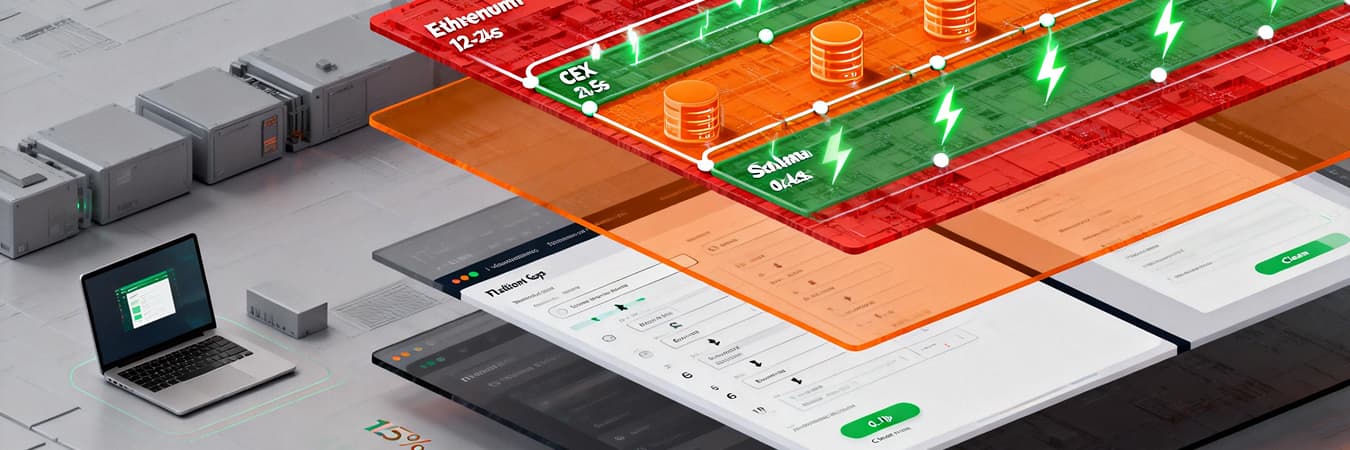
Layers 2-3 account for 85% of latency. Let's examine the specific components.
Component 1: Price Feed Latency
You can't trade what you can't see. If your price feed lags 2-3 seconds, you're trading stale data.
Traditional platforms: Pull price from exchange REST API (polled every 1-5 seconds) or WebSocket (pushed every 0.5-2 seconds).
Problem: By the time you see "$1.50," actual price might be $1.51.
Pyth Network (integrated in Manic.Trade):
- Updates every 400ms (synced with Solana blocks)
- Aggregates from 90+ first-party sources
- Low-latency push (not poll)
Practical difference:
- Traditional: 1-2s lag
- Pyth: 0.4s lag
- Advantage: 0.6-1.6 seconds of seeing moves earlier
Understanding the four layers where execution speed is consumed—cognitive, interface, settlement, and hardware—reorders optimization priority completely: settlement and interface account for 85-95% of total delay, while hardware accounts for under 2%.
Component 2: Slippage & MEV Protection

Slippage: Difference between expected price and actual fill.
Example: Click Buy at $1.50, filled at $1.52. Slippage: 1.3%.
Causes:
- Low liquidity (not enough sellers at $1.50)
- Volatility (price moved during execution)
- MEV bots (frontrun your order)
On Ethereum: MEV is rampant.
- Bots scan mempool for your transaction
- Submit higher-gas tx to frontrun
- You get filled at worse price
- MEV damage: 0.5-3% additional slippage
On Solana: MEV much less common.
- No visible mempool
- Sub-second confirmation (no time to frontrun)
- Slippage primarily from liquidity: 0.1-0.5%
Impact: On a +3% move, 2% MEV slippage cuts your profit by 67%. Avoiding MEV = keeping your edge.
Sub-second execution isn't about being fast—it's about minimizing slippage exposure through infrastructure. Trading on 12-second blockchains creates 0.15% average slippage regardless of tactics; switching to 400ms settlement reduces that to 0.005% purely from timing advantage."
Component 3: Forced Exit Architecture
Traditional platforms require manual closing:
- Click "Close Position" (0.5s)
- Confirmation dialog (0.5s)
- Order execution (0.5-2s)
- Total: 1.5-3 seconds
But the real cost isn't time—it's decision-making.
Every second debating "Should I close now or hold for more?" is cognitive load. Over 30 trades, that's 90 exit decisions.
Manic.Trade forced exits:
- Platform auto-closes at time window expiration
- Zero exit decisions
- Saved: 90 decisions per session (eliminates decision fatigue)
The paradox: Removing exit control increases profit because it eliminates emotional override.
For momentum traders specifically, the Solana momentum trading infrastructure advantage translates directly to entry phase: 400ms settlement means entering the acceleration phase; 12-second settlement means entering confirmation or exhaustion—on the same setup, with the same recognition skill.
Speed on Manic.Trade: The Complete Flow
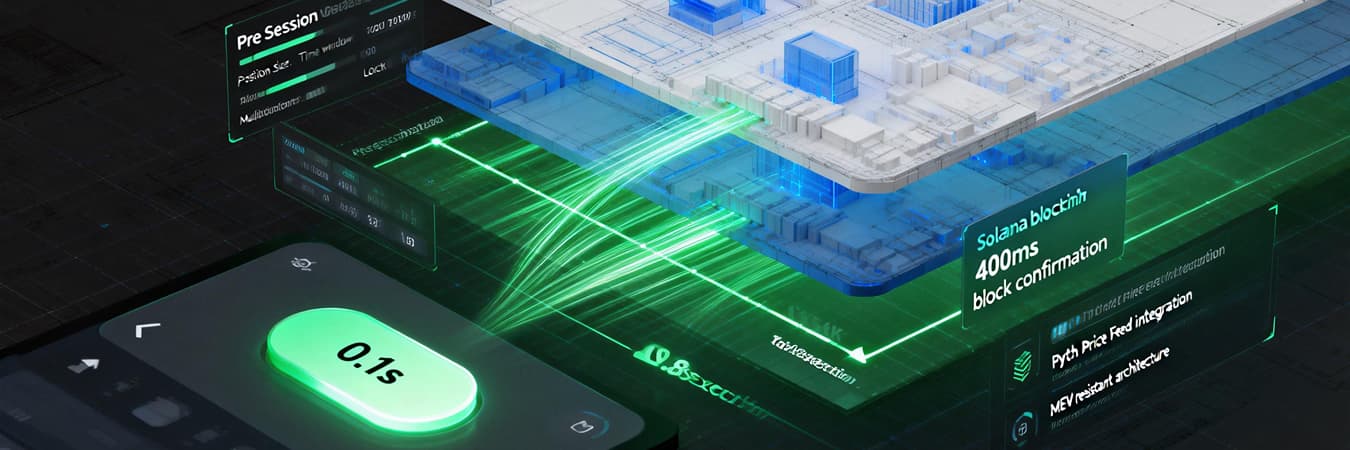
Let's trace a real momentum trade through Manic.Trade's speed-optimized architecture.
Setup: Token at $1.50, consolidating. Volume spike forming. Clean Break pattern.
Pre-Session (5 minutes before trading):
- Set position size: $50 (fixed, no adjustments)
- Choose mode: Individual 30-second windows
- Set multiplier: 5x (Target Lines at $1.54 green, $1.46 red)
Trade Execution:
T+0s: Price breaks $1.50 with volume. Pattern recognized.
T+0.05s: Click "Higher" (one-tap)
T+0.1s: Order sent to Solana
T+0.5s: Block confirmed (400ms)
T+0.6s: Position active at $1.5008. UI updates.
T+5s: Price → $1.52 (+1.3%)
T+15s: Price → $1.54 (+2.6%, Target Line broken)
T+30s: Forced exit window expires. Platform auto-closes at $1.555.
Final P&L: +3.7% (entry $1.5008 → exit $1.555)
What happened:
- Entry lag: 0.6s (vs 12s CEX, 16s Ethereum)
- Captured: Acceleration from 0.4% into move (vs 40% CEX, 80% Ethereum)
- Exit: Zero decisions (forced window removed temptation)
- Cognitive load: 1 decision (direction), vs 8+ traditional platforms
Same Trade on Traditional CEX:
T+0s: Pattern recognized
T+0.5s: Click "Buy"
T+1.2s: Order form opens
T+3s: Select "Market Order"
T+5s: Type "$50"
T+6s: Click "Confirm"
T+7s: "Are you sure?"
T+7.5s: Click "Yes"
T+9s: Order sent
T+11s: Filled at $1.53 (missed first $0.03)
T+25s: Price at $1.56 (+2%)
T+25s: Debate: "Hold or exit?" (paralysis)
T+30s: Price at $1.555 (+1.7%)
T+35s: Decide to exit
T+36s: Click "Close"
T+37s: Filled at $1.548
Final P&L: +1.2%
Difference: +3.7% vs +1.2% = Manic.Trade captured 308% more profit.
Why: 11s slower entry + discretionary exit + decision fatigue.
Why CEXs Can't Compete on Speed
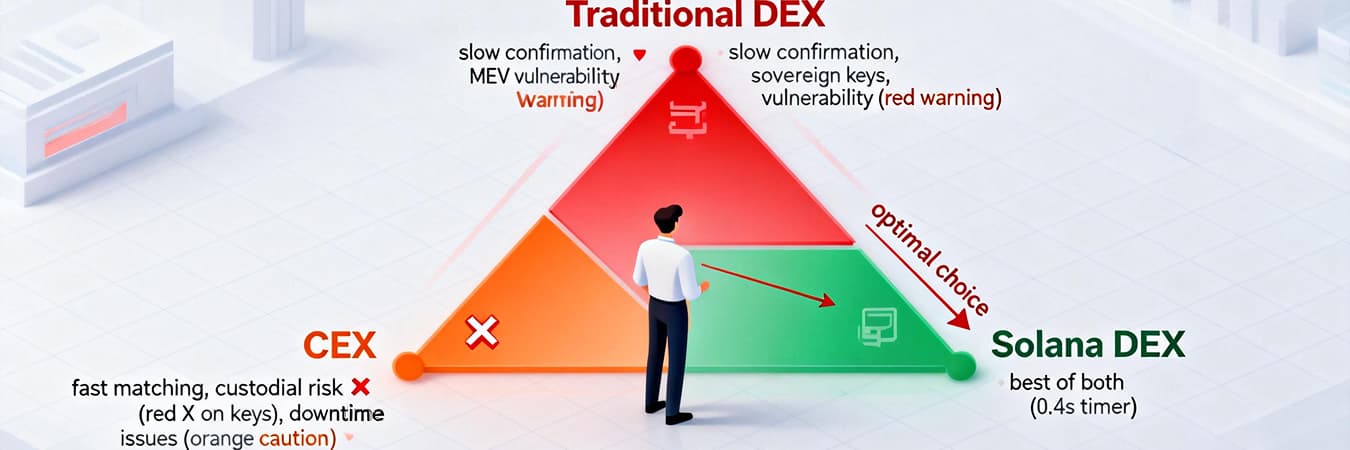
Centralized exchanges are fast at order matching—but slow at everything else.
Problem 1: Regulatory Compliance Friction
CEXs must:
- KYC every user
- Monitor for wash trading
- Implement withdrawal limits
- Freeze suspicious accounts
Each compliance check adds latency:
- Account flagged? (50-200ms)
- Order suspicious? (50-200ms)
- Audit log update (20-50ms)
Total: 120-450ms per order from compliance alone.
Solana DEXs: No KYC. Your wallet is your identity. Orders go straight to blockchain.
Problem 2: Custodial Risk = Withdrawal Friction
On CEX: Your funds are IOUs in their database.
To withdraw:
- Request withdrawal
- Wait 30min-24 hours
- Pay fee ($25+ for BTC)
- Wait for blockchain confirmation
On Solana DEX: Your wallet = your funds. Trade → instant ownership.
Problem 3: Downtime During Volatility
CEXs go down when you need them most:
- Binance: 4 outages in 2025
- Coinbase: 6 outages in 2025
- Kraken: 3 outages
When down: You can't enter, exit, or access funds. Positions frozen.
Solana network:
- 2025 uptime: 99.5%
- Decentralized (one validator fails, another picks up)
- You always control your wallet
Risk: CEX down during -20% crash = Watch account bleed, can't exit.
Problem 4: Multi-Step UI (Intentional Friction)
CEXs use order forms for legal protection. If they allowed one-tap $10K orders, users would fat-finger, then sue.
Solution: Confirmation dialogs, multi-step forms.
This protects the CEX—but kills scalpers.
Manic.Trade's solution: Pre-set parameters before trading. One-tap is safe because bounds are already defined.
The Psychological Impact of Speed
Speed isn't just about capturing moves. It's about confidence and consistency.
Fast Execution = Trust = Consistent Decisions
Slow execution (12s):
You click Buy at $1.50. You wait. Price moves to $1.51... $1.52... $1.53. Still not filled. Anxiety builds.
Finally filled at $1.53.
Your brain: "I lost $0.03 waiting. Next time I'll rush."
Next trade: You rush, enter without confirmation, lose.
Execution uncertainty creates decision instability.
Fast execution (0.6s):
Click "Higher" at $1.50. 0.6s later, confirmed at $1.5008. Price moves to $1.52. You're already profitable.
Your brain: "System works. I trust my recognition."
Next trade: Pattern appears, you execute confidently, capture full move.
Execution certainty creates decision stability.
Fast execution confidence is one of the five structural solutions to trading psychology problems. For the complete psychology framework, see Trading Psychology for High-Frequency Scalping.
The Confidence Feedback Loop
Slow platforms:
Slow execution → Missed moves → Frustration →
Hesitation next trade → Slower (from hesitation) →
More missed moves → Desperation → Revenge trading
Fast platforms:
Fast execution → Captured moves → Confidence →
Instant execution next trade → More captured moves →
Trust in system → Consistent execution
Speed improves psychology, which improves performance.
When you trust your platform to execute instantly, you stop second-guessing. Pattern appears → You act. No deliberation. No doubt. Pure execution.
Which Infrastructure Is Stealing Your Edge?
| Metric | CEX (Binance/OKX) | Ethereum DEX | FX Broker | Manic.Trade | Verdict |
|---|---|---|---|---|---|
| Execution latency | 4–5 seconds | 12–24 seconds | 800–1,200ms | 400ms | ✅ Manic |
| Price feed | Centralized (manipulable) | Centralized | Centralized (spread embedded) | Pyth Network (on-chain verifiable) | ✅ Manic |
| Trading cost | 0.1% taker fee | $5–50 gas | 20–30 pip spread | $0 | ✅ Manic |
| Fund custody | Platform holds funds | Platform holds funds | Platform holds funds | Non-custodial (funds in your wallet) | ✅ Manic |
| KYC required | Yes | No | Yes | No | ✅ Manic |
| Stop-hunt risk | Low | Low | ⚠️ Yes (internal pricing) | None (on-chain settlement) | ✅ Manic |
| Setup time | Instant | Instant | 3–7 days | 30 min (one-time wallet setup) | ⚠️ Trade-off |
⚠️ The wallet setup takes 30 minutes once. After that: connect wallet → select direction → one-tap execute. Under 60 seconds per trade.
If you're currently scalping on a CEX: Every trade costs you 4+ seconds of execution window. On a 15–30 second momentum acceleration phase, that's 25–30% of your entire trade window gone before you're even filled.
If you're using an FX broker for gold: The spread alone costs $200–280/month on an active $10K scalping account before the market moves a single pip.
The infrastructure layer isn't a feature comparison. It's the tax you pay on every trade, whether you measure it or not.
Eliminate the infrastructure tax →
Conclusion
Speed isn't about being fast. It's about removing slowness.
You can have 150ms reaction time (top 1% human reflexes). But if your platform adds 11s of UI lag and 13s of blockchain settlement, reaction time is irrelevant.
The three layers:
- Hardware (15%): Optimize if you want, marginal gains
- Platform UI (50%): One-tap vs multi-step = 7-10s saved
- Blockchain (35%): Solana vs Ethereum = 12-16s saved
Total possible improvement: 19-26 seconds by choosing Solana + one-tap.
In a 30-second window, 20 seconds = 67% of the trade.
You're not competing on pattern recognition. You're competing on infrastructure. If your infrastructure is 20 seconds faster, you're capturing moves while others are still clicking "Confirm Order."
The best traders aren't the smartest or most disciplined. They're the ones who recognized that speed isn't a skill—it's an environment.
Choose the fast environment. Execute with zero friction. Let slower traders provide your exit liquidity.
Your edge isn't in your mind. Your edge is in your stack.
FAQ
Q: Is upgrading my hardware the fastest way to reduce execution lag?
No—and this is one of the most common misdirections in speed trading content. Hardware improvements at the local machine level (CPU, RAM, SSD) yield 0.3-0.6 seconds of total latency reduction under ideal conditions. Switching from Ethereum DEX to Solana yields 12-16 seconds. The ROI comparison isn't close.
That said, there's a minimum viable threshold: computers older than 5 years with less than 4GB RAM do introduce meaningful lag from browser rendering and order interface delays. 8GB RAM is the functional minimum; 16GB is comfortable for multi-monitor setups. SSD vs. HDD provides roughly 0.2 seconds of improvement. Beyond meeting those minimums, additional hardware investment has near-zero impact on execution speed compared to infrastructure-layer choices.
Q: Should I use a VPS to reduce latency?
Only if your ping to exchange servers consistently exceeds 100ms. A VPS colocated near a major datacenter can reduce ping from 80ms to approximately 5ms—saving 75ms (0.075 seconds). At $50-200/month, the ROI is poor for most traders.
The calculation is straightforward: you're optimizing 0.075 seconds when the choice between Solana and Ethereum settlement saves 12 seconds. VPS colocation makes sense for professional traders running six-figure accounts at 200+ trades per day, where every millisecond compounds across massive volume. For retail-scale momentum trading, the infrastructure layer—which blockchain, which DEX architecture, which execution interface—delivers orders of magnitude more latency reduction than network proximity ever will.
Q: Why not just use a fast CEX like Binance instead?
Binance has a world-class matching engine—it's genuinely fast at the Layer 3 (order processing) level. The problem is that CEX architecture has structural speed limits that no amount of engineering can remove because they're legally required.
Multi-step order forms (7-10 seconds) exist because of trade confirmation requirements. Custodial model friction exists because of regulatory obligations. Compliance checks (0.1-0.5 seconds per order) exist because of AML/KYC law. Binance has optimized everything it's legally permitted to optimize. The remaining lag isn't an engineering failure—it's the cost of operating within a regulated custodial framework.
Solana DEXs can optimize all three layers simultaneously because non-custodial architecture removes the legal constraints that create friction. No custody means no withdrawal confirmation. No KYC means no compliance delay at execution. The result isn't a marginal improvement—it's a fundamentally different execution model. This is why infrastructure-first thinking beats tactical optimization at every level of the speed problem.
Q: How much does Pyth Network's price feed actually improve execution?
Pyth updates every 400ms. Traditional oracle feeds update every 1-2 seconds. The practical advantage is 0.6-1.6 seconds of earlier price information per update cycle.
In a 30-second momentum window, 1 second represents 3.3% of your total capture window. Seeing momentum initiate 1 second earlier means capturing approximately 3% more of that move. On a +3% momentum trade, that's +0.09% additional gain per trade—which sounds marginal until you run the frequency math: 50 trades per day × 0.09% = +4.5% daily edge from one-second price feed advantage alone.
The secondary benefit is price accuracy: Pyth aggregates data from 90+ institutional sources, producing a composite price closer to true market consensus. This directly reduces the execution slippage caused by stale or inaccurate price data at the moment of order submission.
Q: Is mobile execution fast enough for momentum trading, or do I need desktop?
Modern smartphones are hardware-capable—the processor and network connection aren't the bottleneck. The real constraint is screen real estate, not input device speed.
On input latency: mouse click is 0.05-0.1 seconds, touchscreen tap is 0.1-0.2 seconds—a difference of 0.05-0.15 seconds, which is functionally irrelevant compared to infrastructure-layer latency. On screen size: desktop allows simultaneous view of chart and order panel. Mobile requires switching between views, which costs 2-3 seconds per trade on standard multi-step interfaces.
The practical result depends entirely on platform design. On Manic.Trade's one-tap execution, mobile is approximately 95% as fast as desktop because the interface is designed for single-screen interaction. On a standard CEX with multi-step order forms, mobile drops to roughly 60% of desktop speed due to view-switching friction. If your platform requires multiple taps to execute, fix the platform before optimizing the device.
Q: If Solana execution is so much faster, why aren't all profitable traders already using it?
Three reasons, none of which involve Solana being inferior: awareness, liquidity, and trust.
Awareness is the largest factor—the majority of retail traders don't know Solana DEX execution exists as an option, or haven't quantified the speed differential against their current platform. Most trading education content is written for CEX users because that's where the audience is.
Liquidity is a real constraint at large account sizes. Some token pairs have significantly lower volume on Solana DEXs versus centralized exchanges. For accounts under $50,000, this rarely causes meaningful slippage. For accounts over $500,000 trading illiquid pairs, it becomes a genuine consideration.
Trust is the third factor. CEXs offer insurance, customer support, and brand recognition. DEX self-custody means you're personally responsible for wallet security. This is a legitimate tradeoff that each trader has to evaluate.
The relevant data point: traders who have quantified the speed difference and are operating at scales where Solana liquidity works—they're on Solana. Your slow execution on a CEX isn't just costing you entries. It's generating exit liquidity for faster traders on better infrastructure.
Q: How do I know if my current execution speed is actually costing me money?
Run this diagnostic on your last 20 trades: record the price at the moment you identified the setup, then the price at your actual entry. The gap between those two numbers—measured in percentage—is your recognition-to-execution cost. If it's consistently above 0.3% on momentum setups, your execution infrastructure is consuming a material portion of your edge.
The secondary diagnostic is exit timing: check how often your position was profitable at the 5-second mark after entry but you exited at break-even or loss. This pattern indicates execution search time—the delay between decision and confirmed order—is long enough that price moved against you during order processing. Both diagnostics point to the same solution: reduce the layers between recognition and execution.
Q: Does execution speed matter for swing trading, or is it only relevant for scalping?
Speed importance scales directly with hold duration. For scalping (30-second to 5-minute holds), execution speed accounts for approximately 70% of total edge—because a 12-second entry lag represents 40% of a 30-second trade window. For day trading (1-hour to 1-day holds), speed is roughly 40% of edge. For swing trading (1-7 day holds), speed drops to approximately 10% of edge because a 12-second lag is 0.001% of a 3-day hold duration.
However, even swing traders benefit from two speed-related improvements: one-tap execution removes hesitation at entry (a psychological edge that compounds regardless of hold duration), and Solana's 400ms settlement eliminates the 12-second price exposure window during order confirmation—a window where price can move against you before your order is confirmed as filled. The infrastructure benefit isn't purely about raw speed; it's also about removing uncertainty at the moment of execution.
Q: What's the actual order of priority when optimizing for execution speed?
Infrastructure layer first, interface layer second, network layer third, hardware layer last. In practice: choose the fastest settlement blockchain (Solana at 400ms vs. Ethereum at 12-15 seconds) before optimizing anything else. Then choose an execution interface that minimizes steps between decision and confirmed order—one-tap execution versus multi-step forms is a 7-10 second difference. Network optimization (VPS, connection quality) provides marginal gains after those two. Hardware provides the smallest gains of all four layers and only matters when below minimum thresholds.
Most traders work in reverse order—they upgrade hardware and optimize their internet connection while continuing to trade on Ethereum DEXs with multi-step interfaces. This is optimizing the 1% while ignoring the 99%.
Q: Is slippage a speed problem or a liquidity problem?
Both—but the relationship is sequential, not parallel. Slippage originates as a time problem: the gap between when you decide to enter and when your order is confirmed creates a window during which price can move. Longer confirmation windows (Ethereum: 12-15 seconds) create larger slippage exposure than shorter ones (Solana: 400ms). In this sense, faster execution is the primary slippage reduction mechanism.
Liquidity is the secondary factor: low-liquidity pairs have wider bid-ask spreads and thinner order books, meaning even a fast order moves price more on execution. For high-frequency momentum trading on liquid Solana pairs, infrastructure-driven slippage (the time component) is typically larger than liquidity-driven slippage. For illiquid pairs on any blockchain, liquidity becomes the dominant factor. The architecture-first approach to slippage control addresses the time component first because it's both larger in magnitude and fully within the trader's control.
Related Reading
Explore the Speed Pillar:
- Slippage Control — Architecture-first execution is the foundation the speed advantage is built on
- How to Reduce Execution Search Time by 80% — The technical framework for capturing the speed advantage in practice
- What Is Slippage in Crypto — Understanding slippage is the first step to understanding why speed wins
- Low Latency Trading — Why most latency solutions fail to deliver the speed advantage this article defines
- Execution Trends in Speed Trading — Where the speed advantage is heading over the next 18 months
Explore the cross-pillar:
- Polymarket Alternatives in 2026: The Guide for Crypto Price Traders — How Solana's latency advantage creates a new product category that event prediction markets can't fill
- Engulfing Candles: Why Most Traders Enter Too Late — Pattern recognition value is destroyed by execution slippage
- Trading Psychology: Why Architecture Beats Discipline — Slippage anxiety is an infrastructure problem, not a mindset problem
- Cognitive Load and Trading Performance — Execution friction increases cognitive load
- Trading Tools & Resources Hub — Slippage calculators and execution comparison tools
- Momentum Trading Guide — Why momentum strategies require slippage-minimized execution
- Kalshi Alternatives: The Infrastructure Gap Nobody Talks About →Here's why that's the single most expensive mistake a momentum trader makes.
Ready to experience sub-second execution with zero friction?