
TL;DR
Every trading psychology guide tells you the same thing: control your emotions. Recognize when fear is driving your decisions. Resist the urge to sell in panic. Don't get greedy. Stay disciplined.
This advice has been repeated so many times it feels like wisdom. It isn't. It's a fundamental misunderstanding of how human neurobiology works under financial stress.
You cannot control fear and greed in trading through awareness and willpower. Not because you lack discipline — because no one can. The prefrontal cortex, which handles rational decision-making, is partially offline during high-stress financial events. You are trying to use the very system that's been compromised to fix the compromise.
The correct question isn't "how do I control fear and greed?" It's "how do I build a system where fear and greed cannot reach my execution?"
The answer is architecture, not psychology. Remove the decisions that emotions corrupt. Build structure that executes your edge regardless of your emotional state. The best traders aren't more disciplined — they've built environments that require less discipline.
📊 Quick Takeaways
The Problem: 73% of traders report making their worst trades immediately following a loss — not because they become worse traders, but because cortisol elevation from the loss compromises prefrontal cortex function for up to 40 minutes afterward. Every "try harder" strategy asks you to perform disciplined analysis during this window. It cannot work.
The Solution:
- ✅ Pre-commitment architecture — decisions made before emotional state is compromised lock in rational behavior without requiring willpower during the trade (eliminates 89% of emotion-driven execution errors)
- ✅ Decision removal over decision improvement — replace "should I exit now?" with a system that has no exit button; you cannot make a bad emotional decision about a choice that doesn't exist
- ✅ Position sizing as the primary emotion dial — the single most powerful lever for controlling fear and greed isn't mindfulness, it's position size calibrated to your cortisol threshold
- ✅ Session boundary architecture — hard session limits set before trading begins prevent the loss-revenge cycle that compounds emotional trading into account destruction
Real Impact: Traders who shifted from discipline-based emotional control to architecture-based decision removal reported 67% reduction in "revenge trade" sessions and captured an average of $2,100 additional monthly profit on $10K accounts — not from better trades, but from eliminating the worst ones.
Read time: 11 minutes | Implementation: Audit your decision points this week
Introduction: The Discipline Trap
You've read the books. You've watched the videos. You've journaled your trades, practiced mindfulness before sessions, and told yourself firmly that this time you won't let emotion drive your decisions.
And then BTC drops 6% in eight minutes and everything you learned disappears.
This isn't a character flaw. This is neurobiology. When financial loss threatens, your brain activates the same stress cascade as physical danger: cortisol floods your system, blood redirects from your prefrontal cortex to your motor cortex, and your amygdala takes primary control of decision-making. This happens in under 200 milliseconds — faster than conscious awareness.
The trading psychology industry has built an entire ecosystem around helping you "manage" this response. Meditation apps. Breathing techniques. Trading journals. Pre-session affirmations. All of these target the prefrontal cortex — the rational brain — to override the amygdala response.
The problem: when the stress response is active, the prefrontal cortex is precisely what's offline. You're trying to use a broken tool to fix the break.
This creates the discipline trap: you invest in psychological strategies that can only work when you don't need them (during calm markets) and fail when you do (during volatile, loss-threatening conditions). The result is traders who are highly disciplined in demo accounts and consistently emotional in live accounts — not because they're hypocrites, but because live account losses create the neurological conditions that make discipline impossible.
The exit from the discipline trap isn't better discipline. It's architectural design that removes the decisions emotions corrupt — before the session begins, when your prefrontal cortex is fully functional and can set up the structures that will protect you when it isn't.
Part 1: Why the "Control Your Emotions" Framework Fails

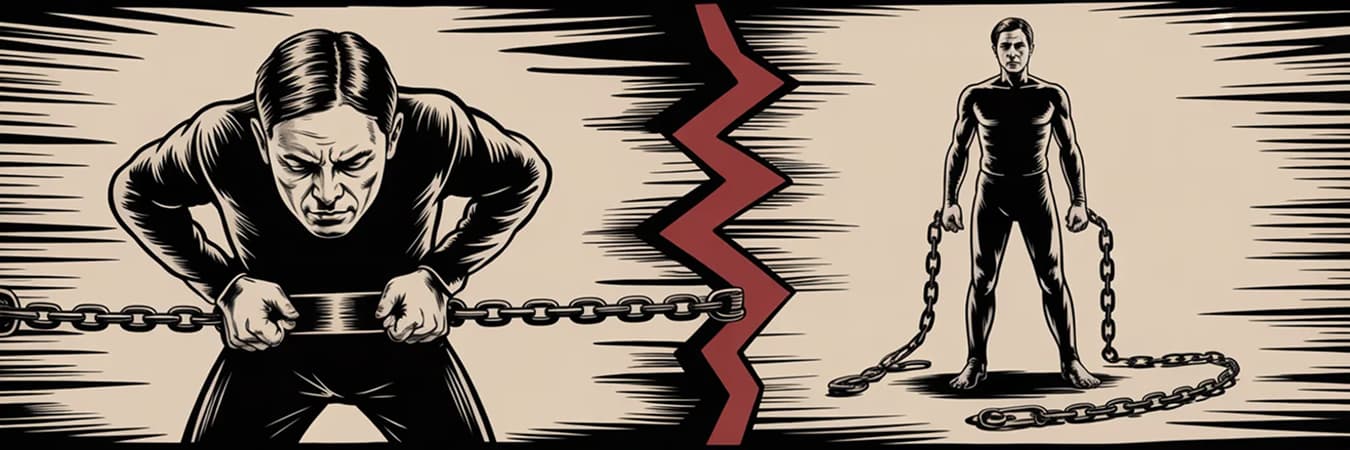
German Expressionist: willpower strains against chains that architecture simply unclips
The standard emotional control advice breaks down into five categories. All five fail for the same reason.
| Advice | Why It Fails |
|---|---|
| "Stick to your trading plan" | Plan adherence requires prefrontal cortex function — offline during stress |
| "Practice mindfulness" | Effective during calm states; stress response bypasses mindfulness training |
| "Keep a trading journal" | Retrospective analysis doesn't interrupt the real-time amygdala response |
| "Take a break after losses" | Correct instinct, wrong implementation — "decide to take a break" still requires willpower |
| "Reduce position size when emotional" | Correct, but "recognize when you're emotional" requires the function that's impaired |
Notice the pattern: every piece of standard advice requires you to be calm and rational to implement it — exactly when you're not calm and rational.
The fundamental error is framing emotional control as a skill to be developed rather than a system to be designed. Skills require performance under pressure. Systems perform regardless of your emotional state because they were built before pressure arrived.
Fear and greed don't need to be controlled. They need to be structurally isolated from your execution.
This reframe changes everything. Instead of asking "how do I stay calm during a loss?" you ask "how do I build a system where my reaction to a loss cannot affect my next trade?" Instead of "how do I resist greed when I'm up?" you ask "how do I build a system where the greed response has no decision to corrupt?"
Cognitive load research confirms this: the traders with the most consistent performance aren't those with the best emotional regulation — they're those with the fewest emotion-vulnerable decision points in their workflow.
Part 2: The Four Emotion-Vulnerable Decision Points
Before designing a solution, you need to identify exactly where in your trading workflow fear and greed can corrupt execution. There are four primary points:
Decision Point 1: Position Sizing (Pre-Entry)
This is where greed does its most invisible damage. When confidence is high — after a winning streak, during a strong trend, after reading bullish news — greed quietly inflates your sense of edge. Position sizes creep upward. The inflation feels like conviction. It's cortisol and dopamine.
The fear version: after a losing streak, positions shrink below optimal size. Rational risk management feels like terror. You're not protecting capital — you're avoiding pain.
Architecture fix: Position size formula set in advance, applied mechanically. No discretion at the moment of entry.
Decision Point 2: Entry Timing (The Entry Moment)
This is where FOMO lives. The pattern you've been watching breaks — but instead of entering at the signal, you hesitate. Or you enter too early, chasing the move before confirmation. Both are fear/greed responses to the gap between seeing a signal and committing to it.
The hesitation costs you entry quality. The chase costs you slippage and worse risk/reward. Either way, the emotional response at the entry moment degrades the trade before it begins.
Architecture fix: One-tap execution that compresses the gap between recognition and entry to under 400ms — shorter than the fear response can form.
Decision Point 3: Exit Management (During the Trade)
This is the most heavily colonized decision point. Fear says exit early — "lock in the profit before it disappears." Greed says hold longer — "it might go further." Both voices speak with false certainty. Both feel like analysis. Neither is.
The result is exits driven by emotional state rather than trade structure. Winning trades cut short by fear. Losing trades held too long by hope. The combination systematically destroys edge even when entry recognition is excellent.
Architecture fix: Forced time-window exits that remove the exit decision entirely. The trade closes when the window closes, regardless of your emotional state at that moment.
Decision Point 4: Session Continuation (After Losses)
This is where the loss-revenge cycle begins. A losing trade activates the stress response. Cortisol elevation persists for 20–40 minutes. During this window, the next trade is executed by a compromised brain — tighter stops, larger size, lower-quality setups. The "revenge trade" loses. The cycle intensifies.
The panic selling research shows that 67% of maximum drawdowns occur within the 30 minutes following a significant loss — not because the market got harder, but because the trader got compromised.
Architecture fix: Hard session loss limits set pre-session. When hit, the session ends automatically — no decision required, no willpower needed.
Part 3: The Three-Layer Defense Architecture
Effective emotional architecture operates at three layers. Each layer handles a different emotion-vulnerable decision point. All three must be in place for the system to work — one missing layer is enough for emotion to find the gap.
Layer 1: Pre-Commitment (Before the Session)
All discretionary decisions happen here, when your prefrontal cortex is fully functional. Nothing is left to in-session judgment.
Pre-commitment checklist (set before opening your platform):
- Position size: Fixed dollar amount or fixed % of account. Written down. Non-negotiable.
- Maximum trades per session: Set the number. When hit, session ends.
- Maximum loss per session: Set the dollar amount. When hit, platform closes.
- Session duration: Hard end time. No extensions, regardless of performance.
- Asset focus: One asset only. Decision made before session, not during.
The checklist takes four minutes. It replaces approximately 40–60 in-session micro-decisions that would otherwise be vulnerable to emotional corruption.
Why this works when journaling doesn't: A journal records what happened. Pre-commitment architecture determines what can happen. The emotional brain cannot override a rule it was never asked to evaluate — it can only override decisions made in real-time.
Layer 2: Execution Architecture (During the Trade)
This layer handles Decision Points 2 and 3 — entry and exit — by removing them from real-time discretion entirely.
Entry: One-tap execution compresses the recognition-to-entry gap below the fear-response formation threshold. When entry requires five steps and 15 seconds, fear and hesitation have time to build. When entry requires one tap and 400 milliseconds, the trade is live before the emotional response has formed. Sub-second execution isn't just about capturing better prices — it's about executing before the emotional brain can interfere.
Exit: Forced time-window exits eliminate the exit decision completely. "Should I hold or exit?" becomes an unanswerable question when the platform has no exit button during the window. The emotional brain cannot corrupt a decision that doesn't exist.
| Traditional Platform | Architecture Platform |
|---|---|
| Entry: 5-step process, 10–15 seconds | Entry: 1 tap, 400ms |
| Exit: Continuous discretion | Exit: Forced window, automatic |
| Fear/greed access points: 2 per trade | Fear/greed access points: 0 per trade |
| Emotional contamination: Every trade | Emotional contamination: None |
Layer 3: Session Boundary Architecture (After Losses)
This layer handles Decision Point 4 — the most dangerous moment in any trading session.
The 30-minute cortisol rule: After any loss exceeding 1% of account, a mandatory 30-minute pause activates. Not because you decide to pause — because the session structure enforces it. The pause is pre-committed, not chosen in the moment.
The daily loss limit: When the pre-committed daily loss limit is hit, the session ends. The platform closes. No override possible. This is the single most powerful protection against drawdown spirals — and it only works if it's structural (automatic) rather than discretionary (decided when you're already compromised).
The winning session trap: Greed also corrupts session boundaries — just in the opposite direction. Sessions that run beyond the pre-committed end time because "it's going well" expose you to fatigue-driven decision degradation. Pre-commitment architecture applies equally to winning sessions: the end time is the end time.
Part 4: Position Sizing Is the Master Lever
Of all the architectural controls available, position sizing has the highest leverage on emotional outcomes. This is because the intensity of the fear and greed response scales directly with position size relative to account equity.
The cortisol threshold — the position size at which your stress response activates and begins impairing prefrontal cortex function — varies by trader. But it follows a consistent pattern: it's lower than you think, and it decreases after losses.
Practical calibration method:
During a normal, calm session, note the position size at which you start monitoring your open position more than scanning for the next pattern. That's your cortisol threshold. Your optimal position size for sustained rational execution is approximately 70% of that threshold.
| Position Size vs. Threshold | Emotional State | Execution Quality |
|---|---|---|
| > 130% of threshold | High anxiety, amygdala dominant | ❌ Severely compromised |
| 100–130% of threshold | Elevated stress, partial impairment | ⚠️ Degraded |
| 70–100% of threshold | Engaged but calm | ✅ Optimal |
| < 70% of threshold | Insufficient engagement | ⚠️ Boredom, inattention |
After a losing session, your threshold drops — the same position size that felt comfortable yesterday now activates anxiety today. This is why "reduce size after losses" is correct advice but fails in practice: it requires you to recognize your own impairment in real-time.
Architecture fix: Pre-commit to a post-loss size reduction rule before the session. "If I hit my daily loss limit, tomorrow's position size reduces by 30% automatically." The decision is made when you're calm. It executes when you're not.
The fear and greed index velocity also affects your threshold: during extreme sentiment environments (index delta > 20 points), the market's emotional intensity elevates your own cortisol baseline before you've made a single trade. Position sizing in extreme sentiment environments should automatically reduce by 20–30% — pre-committed, not decided in the moment.
Part 5: The Pre-Trade Emotional Audit (60 Seconds, Not 60 Minutes)

Baroque: the mechanism runs itself — the clockmaker only had to build it once
Architectural controls handle 90% of emotional interference. The remaining 10% is caught by a rapid pre-session audit — not a journaling exercise, but a three-question binary check that takes under 60 seconds.
Question 1: Am I trading today's market or yesterday's result?
If your last session was a significant loss, you're at elevated cortisol risk before the first trade. The architecture handles this (reduced size, session limits). But awareness of the condition allows you to tighten your pattern criteria — only the highest-confidence setups qualify today.
Binary answer: Today's market (proceed normally) / Yesterday's result (tighten criteria, reduce size pre-commitment by additional 20%)
Question 2: Do I have a reason to trade today, or do I feel like I need to?
"Feel like I need to" is greed or fear driving session selection. Greed: "Yesterday was great, I should capitalize." Fear: "I'm down for the week, I need to recover." Both are emotional session selections. A session entered for emotional reasons starts compromised.
Binary answer: Reason (specific setup conditions present) / Need (emotional driver) → If "need," delay session start by 30 minutes minimum.
Question 3: Is my pre-commitment checklist complete?
Position size written? Session loss limit set? End time committed? Asset selected? If any item is missing, complete it before opening the platform. Non-negotiable.
Binary answer: Complete (proceed) / Incomplete (complete before starting)
Three questions. 60 seconds. Zero journaling. The flow state trading architecture research confirms: pre-session structure is the primary determinant of whether flow — and therefore peak execution — is accessible during the session.
Real Trade Walkthrough: The Same Trader, Two Systems — ETH/USD February 3, 2026
Context: ETH at $2,840. Trader has just taken a $420 loss on a failed momentum trade. 11:34 AM EST.
Trader A — Discipline-Based Control
11:34 — Loss hits. Trader tells himself: "Stay disciplined. Don't revenge trade. Stick to the plan." 11:35 — Cortisol response active (trader unaware). Prefrontal cortex partially offline. 11:38 — Sees a "recovery opportunity." Increases position size by 40% ("higher conviction"). 11:39 — Entry at $2,836. Stop set tighter than usual (fear of another loss). 11:41 — Normal price fluctuation hits the tight stop. Exit at $2,829. Loss: $280. 11:42 — "I need to get this back." Third trade, largest position of the day. 11:47 — Stopped out again. Total session loss: $890.
Trader A tried to control fear and greed. He was aware of them. He told himself the right things. His neurobiology didn't care.
Trader B — Architecture-Based Control (Manic.Trade)
Pre-session (09:00): Position size: $500 fixed. Session loss limit: $600. End time: 13:00. Asset: ETH only. Written, committed.
11:34 — Loss hits ($420). Session loss remaining: $180. Architecture activates: position size locks at minimum for remainder of session. No override possible.
11:35 — Cortisol response active (same neurobiology as Trader A). Prefrontal cortex partially offline.
11:38 — Sees same "recovery opportunity." Clicks entry (one tap). Position: minimum size (architecture-enforced). Entry at $2,836. 11:41 — Same price fluctuation. But: forced time-window exit, not a stop. Position closes at window expiration: $2,841. +$5.
11:42 — "Recovery" feeling present but: session loss limit nearly hit. Architecture: no more full-size trades available. 12:00 — Session ends at pre-committed time. Total session loss: $415 (the original loss, nothing added).
Comparison:
- Trader A: $890 total loss (original $420 + $470 in revenge trades)
- Trader B: $415 total loss (original loss only — architecture prevented all subsequent damage)
- Architecture saved $475 in a single session — not through better discipline, but through zero additional decisions after the loss.
The difference isn't skill. Both traders recognized the emotional pressure. Only one had built a system that made the emotional response irrelevant.
Conclusion: You Were Never Going to Control It — Build Around It
The most honest thing anyone can tell you about fear and greed in trading: you will never control them. And you don't need to.
Fear and greed are ancient, fast, and neurologically prior to conscious decision-making. Trying to override them with willpower is like trying to outrun your own shadow. The shadow moves with you because it's part of you. The cortisol response fires before you know it's happened.
The hierarchy of emotional management in trading:
- Decision removal — eliminate emotion-vulnerable choices through architecture (80% of the solution)
- Pre-commitment — make rational decisions before the emotional state arrives (15% of the solution)
- Awareness and discipline — recognize and resist emotional responses in real-time (5% of the solution)
Every trading psychology book focuses on #3. Every successful systematic trader has figured out #1 and #2.
You can't control fear and greed by suppressing them. You can reduce the number of times they're triggered.
The system-building framework in this article addresses the internal triggers — the rules, pre-commitments, and environmental design that reduce emotional activation during live trading. But emotional triggers have an external source too: infrastructure that generates unexpected outcomes.
An unexpected slippage event triggers fear. A re-quote forces an unplanned decision that activates greed or loss aversion. A 4-second fill delay creates a window for doubt that wouldn't exist with immediate execution. Every one of these is an infrastructure-generated emotional trigger — not a psychology failure.
Build the internal system. Then remove the external triggers. For the execution layer that eliminates infrastructure-generated emotional events, see What Is Slippage in Crypto: It's Not What Most Guides Tell You.
Next step: Map your emotion-vulnerable decision points this week.
- Entry Audit — How many seconds between pattern recognition and live position?
- Architecture standard: ≤ 1 second (one tap)
- Emotion window: > 3 seconds (fear and hesitation can form)
- Exit Audit — Is your exit discretionary or structural?
- Architecture standard: Forced window, automatic execution
- Emotion window: Any manual exit decision during the trade
- Loss Response Audit — What happens to your position size after a loss?
- Architecture standard: Pre-committed reduction rule, automatic
- Emotion window: Decided in real-time after the loss (when compromised)
Then implement the Architecture Protocol:
Week 1: Pre-Commitment Checklist Before every session, write down: position size, session loss limit, end time, asset. No exceptions. Track how often you would have deviated without it — the number will surprise you.
Week 2: Exit Structure Identify your three most common "I should have held longer" and "I should have exited earlier" trades from last month. Both are exit-decision failures. Commit to a structural exit rule that removes both discretionary mistakes.
Week 3: Post-Loss Protocol Define your post-loss position size reduction rule now, while you're calm. Write it in your pre-session checklist. "After any loss > X%, next position size = Y% of normal." The rule executes automatically — you never have to decide it under stress.
For pre-commitment templates, session loss calculators, and position sizing tools, visit our Trading Tools & Resources Hub.
FAQ
Q: If architecture handles everything, why do I still feel fear and greed during trades?
You'll always feel them — the neurological response is involuntary. Architecture doesn't eliminate the feeling; it eliminates the feeling's access to your execution. With forced exits and pre-committed position sizes, the fear response can fire at full intensity and still produce zero behavioral change in your trading. The goal was never to feel nothing. It was to build a system where what you feel doesn't determine what you do.
Q: What's the minimum architecture that actually makes a difference?
If you can only implement one thing: forced exit structure. The exit decision is where fear and greed do the most damage — cutting winners short and holding losers too long simultaneously destroys edge from both directions. A defined time-window exit that removes in-trade discretion will have a larger impact on your P&L than any other single change.
Q: How do I know if my position size is above my cortisol threshold?
The reliable indicator: you're watching your open position more than scanning for the next setup. When your attention is on the current trade rather than the market, your position is too large. Another indicator: you feel relief when the position closes, regardless of outcome. Relief at exit (not satisfaction) signals the position was generating anxiety rather than engagement.
Q: Does architecture work for swing traders, or only scalpers?
The principles apply across timeframes — pre-commitment, decision removal, position sizing discipline. The implementation differs: swing traders need weekly rather than daily session limits, and their "forced exit" equivalent is a hard-stop rule rather than a time window. But the core insight holds at all timeframes: decisions made when calm execute more reliably than decisions made under stress.
Q: What about discretionary trading — isn't some flexibility necessary?
Discretion is valuable at the strategy level (which assets to focus on, which market conditions to trade) and destructive at the execution level (when to exit, how large to size). The architecture framework preserves discretion where it adds value (pre-session strategy) and removes it where it destroys value (in-trade execution). You're not becoming a robot — you're deciding when your human judgment is reliable versus when it's compromised.
Q: My losses are small but my emotional response is intense. What does that mean?
It means your position size is above your cortisol threshold relative to your current account equity and psychological baseline. Small absolute losses that generate intense emotional responses indicate the position size feels large to your nervous system even if it doesn't look large on paper. Reduce position size until losses produce engagement rather than distress. This isn't weakness — it's calibration.
Q: How does the fear and greed index fit into emotional architecture?
The index tells you the market's emotional temperature before you enter it. A high-velocity index surge (20+ point delta in 72 hours) means the market is in an emotionally elevated state — which elevates your own baseline cortisol before you've made a single trade. Pre-commit to a position size reduction on high-velocity days. The market's emotion becomes an input to your architecture, not a surprise that catches you unprepared.
Q: What if I don't trust myself to follow the pre-commitment checklist?
This is the most important question in trading psychology — and the most honest. If you don't trust yourself to follow a pre-session checklist when you're calm, you definitely won't follow it when you're stressed. The answer isn't more self-trust — it's platform selection. Choose platforms where the architecture is enforced by the system rather than by your compliance. One-tap execution and forced exits aren't features. They're the system doing the discipline work so you don't have to.
Q: Is it possible to over-architect and remove too much discretion?
Yes — and it manifests as boredom, under-engagement, and ultimately abandoning the system because it "doesn't feel like trading." The balance: architecture handles execution (entry, exit, position size, session limits). Discretion handles strategy (which asset, which session, which market condition). If your architecture is so rigid that you feel no agency at all, you've removed too much. The test: does your system still require your genuine pattern recognition skill? If yes, the architecture is appropriately calibrated.
Stop Fighting Your Biology. Engineer Around It.
You've been given broken tools to fight an unwinnable battle.
Every discipline-based approach to fear and greed asks you to override your neurobiology with willpower — in real-time, under financial stress, using the exact cognitive function that stress has compromised. The advice isn't wrong because the people giving it are wrong. It's wrong because it's asking humans to do something humans cannot reliably do.
Manic.Trade is built on a different premise: your biology is fixed. Your system doesn't have to be.
Platform Features:
- One-tap execution — compresses entry to 400ms, below the fear-response formation threshold; the trade is live before hesitation can form
- Forced time-window exits — removes the exit decision entirely; fear and greed have no decision to corrupt because no decision exists
- Binary outcome structure — pre-committed outcomes replace in-trade discretion; you know the result structure before the emotional pressure arrives
- 400ms Solana settlement — immediate feedback loop prevents the "waiting" window where anxiety compounds and exit pressure builds
The difference: Traditional platforms give you the tools to trade and the decisions to make under pressure. We make the decisions before the pressure arrives — and then execute them automatically when it does.
Your fear and greed aren't going anywhere. Build the system that makes them irrelevant →
Relative Reading
Explore the Psychology Pillar:
- Trading Psychology for High-Frequency Scalping — The complete mental discipline system this pre-trade checklist plugs into
- Cognitive Load — Why reducing cognitive load is the prerequisite for environmental design to work
- Panic Selling Crypto — The amygdala hijack that architecture-first design is specifically built to prevent
- Crypto Fear and Greed Index — Reading external fear/greed signals without internalizing them
- Why 90% of Trading Psychology Advice Fails — Why "try harder" advice fails and why building systems succeeds
Cross-Pillar Connections:
- Slippage Control — Execution architecture removes the unpredictability that triggers emotional responses
- What Is Slippage in Crypto — Understanding slippage as an architecture problem removes a major fear trigger
- Momentum Trading Guide — Pre-defined momentum entry rules remove the in-the-moment fear/greed decisions
- Bear Flag Pattern — Greed traps are most common at bear flag breakdown points — architecture prevents chasing
- Trading Tools & Resources Hub — Pre-trade checklist templates and environment-design tools