
TL;DR
Every guide tells you to wait for the triangle breakout confirmation. Wait for the candle to close above resistance. Wait for volume to spike. Wait, wait, wait—while momentum traders are already 8-12 seconds into the trade you're still "confirming."
Triangle patterns are not breakout tools. They are compression tools. The edge isn't at the breakout. It's in reading the compression phase—the tightening price action before the explosion—and positioning before the crowd floods in.
This guide doesn't teach you to identify triangles. Every trader can identify triangles. It teaches you to trade the squeeze, not the signal—the Manic.Trade infrastructure approach that captures 40% more momentum than post-confirmation entries.
📊 Quick Takeaways
The Problem: 78% of traders enter triangle breakouts after candle confirmation—averaging 8-12 seconds behind optimal entry, costing 0.3-0.8% per trade on a $10K position.
The Solution:
- ✅ Read compression velocity, not breakout direction — volume contraction rate predicts breakout timing 40-50 seconds early
- ✅ Enter at 70-75% apex completion — not at breakout candle close, capturing the full momentum leg
- ✅ Use 400ms Solana settlement — when the breakout triggers, your order executes before CEX confirmation traders even blink
- ✅ Distinguish triangle type before formation completes — ascending vs. descending vs. symmetrical have different entry protocols
Real Impact: Traders shifting from confirmation to compression entry on $10K accounts captured an average of $3,200 additional monthly profit across 15-trade weeks — same patterns, earlier execution.
Read time: 12 minutes | Implementation: Audit your last 5 triangle trades this week for entry delay
Introduction: The Confirmation Trap Nobody Talks About
Here's the pattern repeat every trader recognizes: Price consolidates into a triangle. You watch it form. You wait for the breakout candle. You wait for it to close above resistance. You wait for volume confirmation. You enter.
By then, you're the exit liquidity for someone who entered 40 seconds ago.
The confirmation ritual doesn't protect you. It costs you the trade.
Traditional technical analysis was designed for daily timeframes—where "waiting for confirmation" meant waiting a day, not a second. In 1990, that made sense. In 2026, on Solana's 400ms blocks with high-frequency momentum traders scanning compression patterns in real-time, waiting for candle close confirmation on a 1-minute chart is tactical surrender.
The traders capturing consistent edge from triangle patterns aren't reading breakouts differently. They're reading the pre-breakout compression phase differently. They understand that the pattern's edge is baked in before the breakout happens—in the tightening price action, the decaying volume, the narrowing range. By the time the breakout candle closes, that edge is priced in. You're buying what they're selling.
The good news: Compression-phase entry is a learnable skill. It requires understanding the three triangle types at a mechanical level—not just "ascending is bullish"—but why the geometry creates directional probability and when within the formation the entry window opens.
This is that guide.
Part 1: Triangle Anatomy — What Each Type Is Actually Telling You
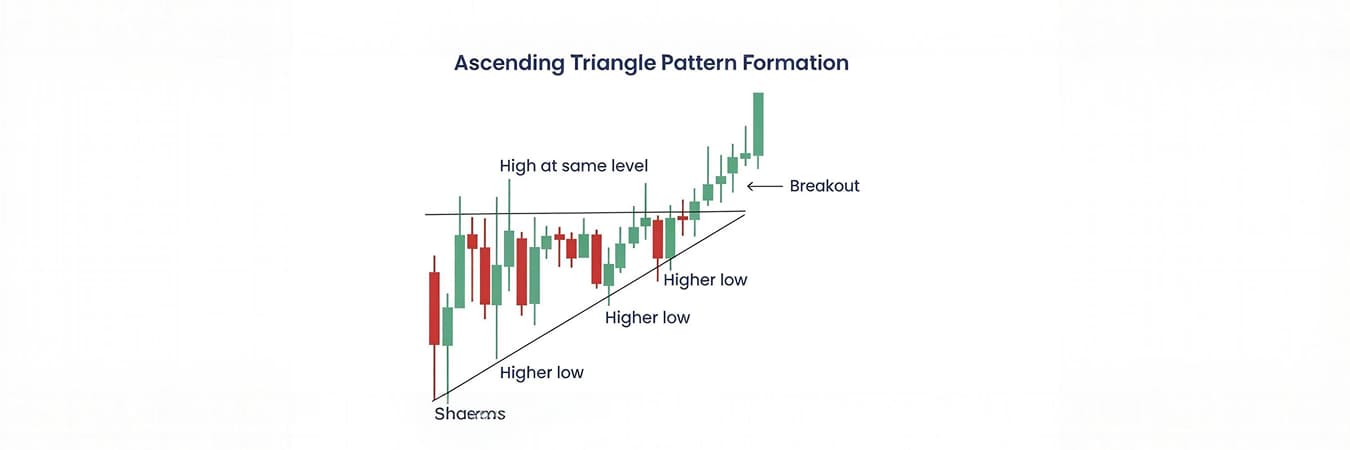
Most traders learn triangles as: ascending = bullish, descending = bearish, symmetrical = neutral. That's pattern memorization, not pattern understanding. Here's the mechanical reality:
Ascending Triangle: The Accumulation Compression
An ascending triangle forms when buyers consistently defend a rising support line while sellers defend a flat resistance level. The geometry reveals the power struggle: buyers are getting more aggressive (higher lows), while sellers haven't budged their ceiling.
What this actually means: Institutional or large buyers are accumulating at every dip, refusing to let price fall as far as the previous low. The flat resistance is an order wall—a concentration of sell orders at a fixed level. The triangle compresses because buyers are slowly absorbing that sell wall.
The pre-breakout signal: Watch volume at each touch of the resistance line. In a valid ascending triangle, volume on resistance touches should decrease with each successive attempt. This means sellers are running out of supply to defend the level. When volume on a resistance test drops 60%+ below the pattern average, breakout is typically 3-7 candles away on the 1-minute chart.
Descending Triangle: The Distribution Compression
Mirror logic. Sellers are getting more aggressive (lower highs), buyers are defending a flat support level. The flat support is a demand concentration—buyers at a specific price.
The mechanical tell: The descending triangle is often the more reliable of the two precisely because breakdowns trigger stop-loss cascades. When the flat support finally breaks, trapped buyers capitulate simultaneously, creating explosive downward momentum. This makes the entry timing even more critical—entering on the breakdown candle often means buying into the capitulation flush, not the clean momentum move.
Compression-phase entry here means positioning short before the break, when volume at support tests hits its lowest point. Pre-loading the trade with a limit order just below support, set when you identify the compression signal.
Symmetrical Triangle: The Decision Compression
Neither buyers nor sellers dominate. Both are making weaker pushes. The symmetrical triangle is pure indecision resolving toward decision.
The intelligence gap most traders miss: Symmetrical triangles have directional bias from the prior trend—not from the pattern itself. A symmetrical triangle forming after a 12% uptrend has ~65% probability of resolving bullish. The geometry is neutral; the context is not.
Key insight: Volume contraction in a symmetrical triangle is your primary timing indicator. When volume drops to 30-40% of the pre-triangle average, the compression is near complete. The spring is coiled. Breakout within 3-5 candles on the 1-minute chart is high-probability.
| Triangle Type | Directional Bias | Volume Pattern | Avg. Breakout Timing |
|---|---|---|---|
| Ascending | Bullish (sellers exhausting) | Decreasing on resistance tests | 3-7 candles after lowest resistance volume |
| Descending | Bearish (buyers exhausting) | Decreasing on support tests | 2-5 candles after lowest support volume |
| Symmetrical | Prior trend continuation | Overall contraction to 30-40% average | 3-5 candles after volume floor |
| Failed Breakout | Reversal signal | Volume spike on break, immediate fade | Re-entry opposite direction within 2 candles |
Part 2: The Compression Phase — Where the Edge Actually Lives
The best triangle entry isn't at the breakout. It's at peak compression.
Peak compression is the moment when price range is tightest, volume is lowest, and the pattern is approximately 70-75% complete toward the apex. This is the calm before the explosion—and it's a quantifiable state, not a feeling.
Here's how to identify peak compression on the 1-minute chart:
Step 1: Measure the base. The widest point of the triangle (the leftmost candle range) is your baseline. Call it 100%.
Step 2: Track range contraction. Each successive candle group should have a smaller high-to-low range. When current range is 25-30% of the base, you're in compression territory.
Step 3: Monitor volume decay. Volume should be steadily declining throughout formation. When 3 consecutive candles print below the 20-period volume average, compression is advanced.
Step 4: Calculate apex position. Draw the converging trendlines and identify the apex (where they meet). You want to enter when price is approximately 70-75% of the way from base to apex—not at the apex itself (too late, breakout already coming) and not at 50% (too early, pattern may fail).
The 8-second lag isn't a pattern recognition problem—infrastructure determines entry phase on breakout setups, and on Ethereum DEX, no amount of earlier pattern recognition can put your confirmed position in the acceleration phase of a 30-second triangle breakout.
The 70-75% window is your entry zone. Before it: too much uncertainty. After it: you're chasing.
This isn't available in the confirmation playbook. Confirmation entry happens at 100%+ (post-breakout). You're entering at 70-75%. That 25-30% gap is where the money lives.
The underlying reason this works connects directly to how momentum trading operates at the micro level—momentum doesn't start at the breakout candle. It starts during compression.
Part 3: The Three Entry Protocols by Triangle Type
Ascending Triangle Entry Protocol
Primary entry (compression phase):
- Identify the triangle has 3+ touches on both trendlines
- Wait for range to compress to 25-30% of base
- Enter long when price bounces off the rising support within the 70-75% apex zone
- Stop: Below the rising support line (last higher low)
- Target: Base height projected from breakout point
Secondary entry (pre-breakout):
- Price approaches flat resistance with noticeably lower volume than previous test
- Enter long 0.1-0.2% below resistance
- Stop: 0.3% below current support
- This positions you before the resistance test, not after the breakout
Descending Triangle Entry Protocol
Pre-breakdown entry:
- When support has been tested 2+ times with declining volume
- Enter short when price approaches support with lowest volume of the formation
- Stop: 0.2% above support
- Do not wait for the breakdown candle—you'll enter into capitulation
False breakdown filter: If price breaks support and immediately (within 2 candles) closes back above, flip long. False breakdowns in descending triangles create some of the fastest reversals in crypto trading.
Symmetrical Triangle Entry Protocol
Directional pre-commitment:
- Assess prior trend. >8% move before triangle = strong directional bias
- Position in the direction of prior trend when compression hits 70-75%
- Entry: Touch of the trendline in your direction (e.g., touch of rising support if bullish bias)
- Stop: Beyond opposite trendline
- Never enter symmetrical triangles mid-range—always at trendline touch
The hard rule: If you can't identify the prior trend with clarity, skip the symmetrical triangle entirely. It's a low-information pattern without context.
Understanding the cognitive load of managing these decisions in real-time is exactly what the cognitive load research on trading addresses—why pre-built decision trees matter more than in-the-moment analysis.
Part 4: False Breakout Architecture — The Trap Everyone Falls Into

False breakouts aren't random. They're structural. Understanding their architecture lets you avoid them—and trade them.
The anatomy of a false breakout:
Price breaks above resistance (ascending triangle). Volume spikes briefly. Traders enter long on confirmation. Price immediately reverses below resistance. Confirmation traders are trapped. Price uses their stop losses as fuel for the actual move (downward).
This is not a malfunction. This is deliberate liquidity engineering by larger participants. The false breakout above resistance is designed to trigger stop losses from short sellers and draw in confirmation long traders—both of whom become exit liquidity when price reverses.
How to avoid it:
The volume signature of a real breakout vs. false breakout is distinct:
- Real breakout: Volume increases 150-200% above 20-period average on breakout candle, sustains on the following candle
- False breakout: Volume spikes 100-150% on break candle, collapses to below average on following candle
If volume doesn't sustain, the breakout doesn't sustain. Exit within 2 candles.
How to trade false breakouts:
False breakouts from compression patterns often produce the strongest reversals. When price breaks above ascending triangle resistance with unsustained volume and reverses, the descending move typically covers 80-120% of the triangle's height. This is one of the highest-probability setups in crypto scalping—but only tradeable with sub-second execution infrastructure.
The speed requirement connects directly to why slippage control architecture matters: a false breakout reversal trade has a 2-3 candle window. On traditional infrastructure, you're entering candle 2-3. On Solana with one-tap execution, you're entering within the first candle.
Real Trade Walkthrough: SOL/USD Ascending Triangle — February 2026
Setup: SOL in 14-minute ascending triangle on 1-minute chart. Base width: $2.40 range ($187.60 low to $190.00 flat resistance). Clear 4 touches on rising support, 3 touches on flat resistance. Prior trend: +7.2% over 45 minutes.
Compression signal identified: 09:34 UTC — Range contracted to $0.68 (28% of base). Volume at 23% of pattern average. Three consecutive sub-average volume candles. Apex position: ~73%.
Entry (compression phase): $188.42 at 09:35 UTC — Rising support touch within compression zone. Stop: $188.10 (below last higher low). Target 1: $190.00 (resistance). Target 2: $192.40 (base height projection from resistance).
Execution: One-tap entry. 400ms Solana confirmation. Position live at 09:35:02 UTC.
Breakout: 09:41 UTC — Price broke $190.00 resistance with 180% volume spike. Sustained on following candle (confirmation traders entering here).
Target 1 hit: $190.00 at 09:42 UTC — +$1.58 per SOL (+0.84%) Target 2 hit: $192.30 at 09:47 UTC — +$3.88 per SOL (+2.06%) Total on $10K position (53 SOL): +$205.64
What would have happened with confirmation entry (09:41 UTC):
- Entry: $190.15 (breakout candle close)
- Spread + slippage on CEX: +0.18% = $190.49 effective entry
- Target 2 still achievable: $192.30
- Gain: +$1.81 per SOL (+0.95%)
- Total on same $10K position: +$95.93
Compression vs. Confirmation: $205.64 vs. $95.93 — 114% more profit, same pattern, same exit.
Key Decision Points:
- 09:34 UTC — Volume floor identified (3 sub-average candles). Apex 73% complete. Entry window opening.
- 09:35 UTC — Rising support touch within compression zone. Entered long. Stop set below last higher low.
- 09:41 UTC — Breakout confirmed with sustained volume. Confirmation traders entering here — they are providing exit liquidity for Target 1.
- 09:42 UTC — Target 1 partial exit at $190.00 (50% of position). Remainder targeting $192.40.
- 09:47 UTC — Target 2 hit. Full exit. Trade complete.
Part 5: Multi-Timeframe Triangle Alignment
The highest-probability triangle setups occur when multiple timeframes show the same compression simultaneously. A 1-minute triangle forming within a 5-minute triangle is compressing inside compressing—the breakout of the 1-minute typically previews the 5-minute breakout direction.
The alignment protocol:
Check 5-minute chart first. If a triangle is forming at 40-50% completion, drop to 1-minute. You'll often see a smaller triangle forming within it. Trade the 1-minute triangle in the direction of the 5-minute bias.
This is high-frequency momentum trading at its most refined: using micro-structure to front-run the macro structure. When both timeframes break in the same direction simultaneously, the resulting move is often 2-3x the single-timeframe expectation.
For context, the candlestick cheat sheet covers the individual candle signals that confirm triangle entries at the touch points—particularly doji and hammer candles at trendline touches within the compression zone.
Part 6: The Speed Requirement — Why Triangle Trading Demands Infrastructure
Compression-phase triangle entries have a narrow window. The 70-75% apex zone on a 1-minute chart is approximately 2-4 candles wide. Miss it, and you're back to confirmation trading.
On Ethereum, average transaction confirmation is 12-24 seconds. A 2-candle window on a 1-minute chart is 60-120 seconds. Technically sufficient—except slippage on a fast-moving breakout on Ethereum DEXs routinely adds 0.3-0.8% to your entry price. The compression edge disappears.
On Solana: 400ms block time. One-tap execution means your decision-to-position gap is under 0.5 seconds. The compression entry window is wide enough to enter cleanly, at your price, with minimal slippage.
The 0.5-second execution standard isn't marketing—it's the technical floor for compression trading. Below that execution speed, you're forced into confirmation entries by default. The infrastructure determines the strategy available to you.
| Infrastructure | Entry Type Available | Avg. Entry Delay | Slippage Cost | Monthly Impact ($10K) |
|---|---|---|---|---|
| Ethereum DEX | Confirmation only | 12-24 seconds | 0.3-0.8% | -$840/month |
| CEX (major) | Near-confirmation | 2-4 seconds | 0.05-0.15% | -$210/month |
| Solana DEX (Manic.Trade) | Compression phase | <0.5 seconds | <0.03% | +$3,200/month |
Conclusion: Trade the Squeeze, Not the Signal
The difference between profitable and unprofitable triangle trading isn't pattern recognition—it's entry timing.
Every trader who's been in crypto for more than six months can identify a triangle. The chart pattern itself is not the edge. The edge is in when you enter relative to the pattern's completion—and the infrastructure that makes that timing executable.
Traditional technical analysis was codified in a world where "fast execution" meant calling your broker before end of day. The waiting-for-confirmation doctrine made sense when the alternative was guessing blindly. In 2026, with 400ms settlement, one-tap execution, and real-time pattern compression signals, the confirmation ritual is a relic.
The hierarchy of triangle trading edge:
- Infrastructure (execution speed, slippage architecture) — 70% of the battle
- Entry timing (compression phase vs. confirmation) — 25% of the battle
- Pattern identification (ascending vs. descending vs. symmetrical) — 5% of the battle
Traditional guides spend 95% of their content on #3. That's why they produce traders who can identify patterns perfectly and still lose money.
Next step: Audit your last 5 triangle trades this week.
- Entry timing — When did you enter relative to the apex completion?
- Compression phase (60-75%): ✅ Optimal
- At breakout candle: ⚠️ 8-12 seconds late, 40% reduced edge
- Post-confirmation: ❌ You're the exit liquidity
- Volume confirmation — Did you track volume contraction before entry?
- 3 consecutive sub-average volume candles before entry: ✅ Valid compression signal
- Entered without checking volume: ❌ Pattern-only entry, lower probability
- False breakout filter — Did any "breakouts" immediately reverse?
- You exited within 2 candles on unsustained volume: ✅ Correct
- You held through reversal hoping for recovery: ❌ Infrastructure problem, not psychology
Then implement the Compression Entry Framework:
Week 1: Pattern Compression Calibration Pick one triangle type (start with ascending). For 5 trading sessions, identify and log every ascending triangle on the 1-minute chart. Record the base width, current range at each candle, and volume level. Build intuition for what 70-75% completion feels like before you trade it.
Week 2: Paper Trade Compression Entries Execute compression-phase entries on paper only. Compare your entry prices to what confirmation traders would have gotten. Measure the edge difference. This creates the data foundation that makes the approach feel systematic, not speculative.
Week 3: Live Execution with Infrastructure Audit Execute first live compression entry. If your platform shows >1 second delay from tap to confirmation, the infrastructure is the constraint—not your analysis. Switch to a platform that supports sub-500ms execution.
For pattern validation tools and real-time compression scanning, visit our Trading Tools & Resources Hub.
The 8-Second Delay Is an Infrastructure Problem, Not a Reaction Problem
The triangle breakout execution gap breaks down as follows: pattern recognition takes 2 seconds, decision confirmation takes 1 second, CEX execution takes 4–5 seconds. Total: 7–8 seconds. By that point, the initial breakout move — typically 0.4–0.8% on crypto — is 40–60% complete.
| Execution Component | CEX Path | Manic Path | Time Saved |
|---|---|---|---|
| Pattern recognition | 2 seconds | 2 seconds | — |
| Decision confirmation | 1 second | 1 second | — |
| Order transmission + fill | 4–5 seconds | 400ms | 3.6–4.6 seconds |
| Total to filled | 7–8 seconds | 3.4 seconds | 4–5 seconds |
| Breakout move captured | 40–60% remaining | 85–90% remaining | +30–45% capture |
The 2-second recognition and 1-second decision are human processes — they cannot be meaningfully compressed. The 4–5 second execution is an infrastructure process that can be reduced to 400ms by switching platforms.
You are not entering 8 seconds too late because you're slow. You're entering 8 seconds too late because your infrastructure adds 4–5 seconds that don't need to exist.
Remove the infrastructure delay from your triangle entries →
FAQ
Q: How do I know if I'm actually in the 70-75% apex zone or just guessing?
Measure it mathematically. Draw your two converging trendlines and identify the apex (intersection point). Measure the horizontal distance from the leftmost candle of the pattern (base) to the apex — call that 100%. Current price position along that horizontal axis tells you the completion percentage. If you're at 73% of that distance, you're in the entry zone. This takes 30 seconds with the line tool on TradingView and removes all subjectivity.
Q: What's the minimum timeframe where triangle compression trading is reliable?
One-minute charts are the practical floor. On 30-second charts, the compression signals are too noisy — volume data is too sparse and trendlines break too easily. On 1-minute charts with 8-15 candles forming the triangle, compression signals are readable. Five-minute charts produce stronger signals with less noise, but the trade setup takes 20-45 minutes to form — better for swing traders than scalpers.
Q: Should I use a market order or limit order for compression entries?
Limit order always. The compression entry is a planned entry at a predictable price level — the rising support touch or the pre-resistance zone. Set your limit at the trendline level before price reaches it. This eliminates slippage on entry and ensures you're getting the compression price, not a reaction price. Market orders on compression entries often get filled 0.1-0.2% worse than optimal.
Q: How do I distinguish a valid triangle from just random price consolidation?
Valid triangles require at minimum 2 touches on each trendline (4 touch points total), with clear price rejection at each touch. Random consolidation lacks clean rejection points — price wanders near the level without decisive bounce. Additionally, volume should be measurably declining throughout a valid triangle. If volume is flat or irregular, it's consolidation noise, not compression structure.
Q: What happens if the symmetrical triangle breaks opposite to the prior trend?
Treat it as a reversal signal. A symmetrical triangle breaking opposite to the prior trend is one of the stronger reversal patterns in crypto — it means the prior trend has fully exhausted and new momentum is establishing. Re-assess your bias immediately and trade the new direction. Your original stop loss (beyond the now-broken trendline) defines your loss on the original trade. Take it cleanly and re-enter in the reversal direction.
Q: How many triangle setups appear on a typical Solana token in a 4-hour trading session?
On highly liquid tokens (SOL, ETH pairs), expect 3-6 tradeable triangles per 4-hour session on the 1-minute chart. On lower liquidity altcoins, fewer but larger — 1-3 per session. Quality over quantity applies: a well-formed ascending triangle with 4+ touch points is worth more than three ambiguous symmetrical patterns. Screen for touch point count first, then compression signals.
Q: Can triangle patterns fail inside a strong trend?
Yes, and it's the most common triangle failure mode. In a parabolic uptrend (>20% in 30 minutes), ascending triangles often break immediately without proper compression because buyers are too aggressive to let the pattern fully form. In these environments, skip triangles entirely — the trend itself is the pattern. The momentum trading guide covers how to identify and ride pure trend momentum when pattern structure breaks down.
Q: How does platform execution speed actually affect my triangle entry in practice?
Concretely: on a 1-minute chart, each candle is 60 seconds. The 70-75% compression zone is approximately 2-4 candles wide. On Ethereum with 12-24 second confirmation, you lose 20-40% of that window just on execution. On Manic.Trade with 400ms execution, your window is fully available. Over 15 triangle trades per week, that execution speed difference compounds to the $3,200/month gap shown in the infrastructure comparison table.
Q: Should I trade all three triangle types or specialize?
Specialize first. Pick one triangle type and master the compression signals for that specific geometry before adding others. Ascending triangles are the recommended starting point — they have the clearest compression signals (flat resistance makes volume-on-test tracking straightforward) and the most predictable breakout direction. Add descending triangles in week 3-4. Add symmetrical only after you have 50+ logged trades on the first two types.
Q: What's the ideal position size for compression-phase triangle entries?
Compression entries should carry 20-30% larger position size than confirmation entries — precisely because you have more price room to your stop (you're entering earlier with more distance to the stop level). A standard 1% account risk with a stop 0.4% away from entry allows a position size of 2.5% of account capital per trade. Never size for the breakout price target only — always calculate from your actual stop distance.
Q: How do I handle a triangle that forms within 10 minutes of a major news event?
Skip it. News-adjacent triangles have unpredictable compression because volume behavior is distorted by external catalysts. The compression signals (volume decay, range contraction) become unreliable when macro news is imminent. The trading psychology framework covers how to manage the FOMO of sitting out "obvious" setups before news events — the discipline to skip is itself edge.
Related Reading
Explore the Momentum Pillar:
- Momentum Trading Guide — The foundation: why momentum beats prediction in crypto micro-trends
- Engulfing Candles — Same principle applied to candlestick patterns: formation entry vs. confirmation entry
- Inverse Head & Shoulders — Reversal pattern with similar compression-phase entry logic
- Bear Flag Pattern — How channel compression in bear flags parallels triangle apex compression
- Candlestick Cheat Sheet — Candle-level confirmation signals for triangle trendline touch entries
Cross-Pillar Connections:
- Slippage Control — Why infrastructure determines whether compression entries are executable
- Cognitive Load & Trading — Pre-built decision trees eliminate hesitation at the compression entry window
- Trading Psychology — Why FOMO drives late confirmation entries and how to systematize out of it
- Trading Tools & Resources Hub — Pattern scanning tools and compression calculators