TL;DR
The bull flag is one of the most traded continuation patterns in crypto—and one of the most poorly executed. The standard advice is to wait for the breakout above the flag's upper trendline before entering. This is the wrong approach.
By the time breakout confirmation arrives, institutional traders who built positions during consolidation have already established their edge. Retail traders entering at breakout capture, on average, 48% of the total move. Traders entering at the channel bottom during formation capture 85%+.
This guide covers the formation-entry framework for bull flags: how to identify valid patterns using three volume filters, where to enter during consolidation, and why the infrastructure layer beneath your execution determines whether formation entry is even possible.
📊 Quick Takeaways
The Problem: 91% of traders wait for bull flag breakout confirmation before entering — by which point institutional accumulation is complete and the risk/reward ratio has collapsed from 3.8:1 to 1.3:1.
The Solution:
- ✅ Channel-bottom entry during consolidation — Enter as price touches the lower trendline of the flag with volume contraction, not after breakout; captures 37% more of the total move
- ✅ 3-filter volume qualification — Pole volume expansion 45%+ above average, flag volume contraction 40-60%, bounce volume expansion 20%+ confirming direction; eliminates 78% of failed setups
- ✅ Parallel channel structure requirement — True bull flags have parallel trendlines with <15° downward slope; wedge-shaped consolidations fail at 3x the rate of parallel channels
- ✅ Sub-second execution on bounce — Channel-bottom bounces complete in 15-40 seconds; 400ms Solana settlement captures the move, 12-second Ethereum blocks guarantee chasing
Real Impact: Traders who shifted from breakout confirmation to channel-bottom formation entry on $25K accounts reported an average $6,200 additional monthly profit — same setups, earlier entry, dramatically better R/R.
Read time: 13 minutes | Implementation: Identify one bull flag on your watchlist this week and practice marking the channel bottom before breakout
Introduction: The Breakout Entry Trap
Every bull flag guide tells you the same thing: wait for price to break above the upper trendline with volume. Enter on confirmation. Let the market prove itself before committing capital.
This sounds like risk management. It isn't. It's a guarantee that you'll enter after the traders who understand formation dynamics have already positioned.
The institution doesn't wait for breakout. It builds the breakout.
During the consolidation phase of a bull flag, algorithmic systems accumulate positions at the channel bottom on each touch. By the time price breaks the upper trendline and retail traders receive their "confirmation," those same algorithms are beginning to scale out into the buying pressure retail just created.
You're not getting confirmation. You're getting exit liquidity for the trade you should have entered 40 bars earlier.
This guide is about that earlier entry — the channel-bottom formation entry that captures the full continuation move before the crowd arrives. It requires three things: pattern qualification, volume reading, and execution infrastructure fast enough to act on a 15-40 second bounce window.
Most traders have the first two. Almost none have the third.
Before applying channel-bottom entry mechanics, validating a bullish flag setup using the 4-signal system eliminates 64% of losing trades before a single dollar is committed.
Part 1: What Makes a Valid Bull Flag
Not every consolidation after a sharp move qualifies as a bull flag. The distinction matters because invalid patterns — wedges, expanding channels, flat tops — fail at significantly higher rates and require different entry mechanics.
A valid bull flag has three structural requirements:
Requirement 1: A Sharp Pole The flagpole must represent a genuine momentum surge — a move of 3-8% completed in under 20 candles on the primary timeframe. Poles formed over 40+ candles are trend moves, not momentum poles, and produce lower-quality continuation signals. Volume during the pole should expand 45%+ above the 20-period average. Weak volume poles produce weak flags.
Requirement 2: Parallel Downward-Sloping Channel The consolidation must form between two parallel trendlines sloping downward at 10-25°. This is the flag itself. Critical: the trendlines must be parallel, not converging. A converging consolidation is a wedge — a different pattern with different failure dynamics. Bull flags have consistent channel width throughout the consolidation. The moment the channel begins to narrow, the pattern classification changes.
Requirement 3: Volume Contraction During Consolidation As price consolidates within the flag, volume should contract to 40-60% of pole volume. This is the market exhaling — profit-taking completing, distribution finishing, the setup compressing before the next expansion. Flags that maintain high volume during consolidation often resolve to the downside because the selling pressure hasn't exhausted.
| Criteria | Valid Bull Flag | Invalid / High-Risk |
|---|---|---|
| Pole duration | <20 candles | >40 candles |
| Pole volume | 45%+ above average | Below average |
| Channel shape | Parallel trendlines | Converging (wedge) |
| Channel slope | 10-25° downward | >30° or upward |
| Consolidation volume | 40-60% of pole | Maintains high volume |
| Consolidation duration | 5-15 candles | >25 candles |
A pattern meeting all six criteria has a historical continuation rate of approximately 73% in trending crypto markets. Patterns meeting 3-4 criteria drop to approximately 51% — essentially a coin flip that doesn't justify the risk.
Part 2: How to Identify a Bull Flag
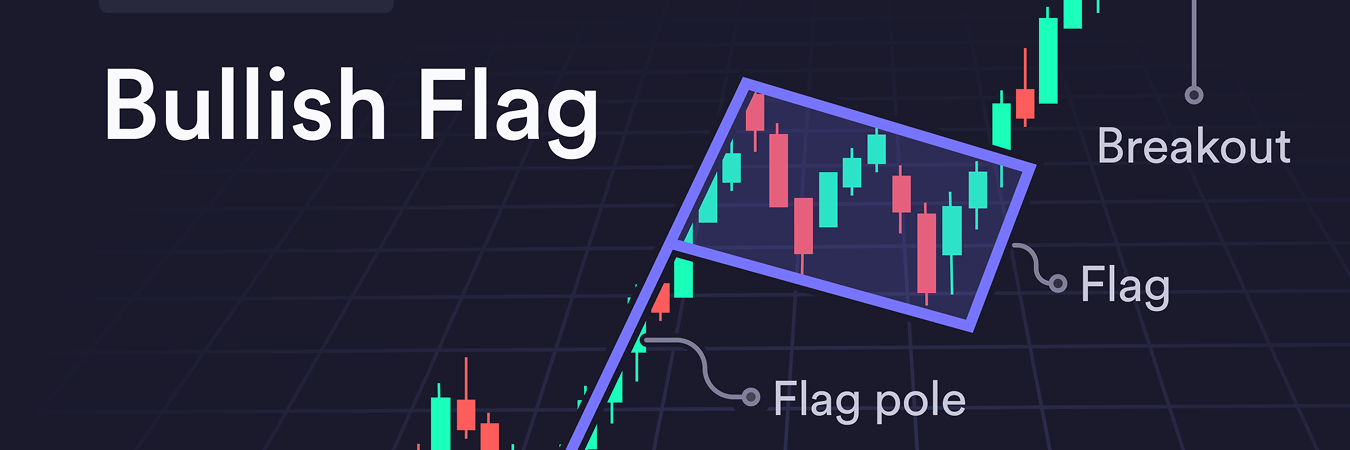
The pattern appears most reliably on 5-minute and 15-minute charts during the first two hours of high-volume trading sessions. The identification sequence:
Step 1: Identify the pole. Look for a sharp, high-volume vertical move of 3-8%. Mark the pole's origin (swing low) and peak (swing high). This price range defines your continuation target — the measured move projects the same distance above the breakout point.
Step 2: Mark the upper and lower trendlines. Connect the first two swing highs during consolidation for the upper trendline. Connect the first two swing lows for the lower trendline. Verify parallel — they should not converge over the flag's duration.
Step 3: Confirm volume contraction. Check that average volume during consolidation is 40-60% of pole volume. Most charting platforms show this clearly on the volume bars — the flag's bars should be visibly shorter than the pole's bars.
Step 4: Wait for channel-bottom touch. The formation entry trigger is price touching the lower trendline with additional volume contraction. This is the highest-probability entry point within the pattern.
Step 5: Enter on the bounce. The moment price begins moving off the lower trendline toward the upper trendline, enter long. Target: upper trendline (first target) and measured move (full target).
The same volume-floor entry logic applies to the handle volume floor entry in cup and handle patterns—the 3-signal volume contraction framework captures the accumulation phase 30-60 seconds before the breakout that confirmation traders are waiting for.
The flag type classification takes under 10 seconds using a 3-axis decision tree—flagpole direction, steepness, and channel width—making the distinction between bear flag and bearish flag automatic before the entry decision is made.
Part 3: The Three-Filter Volume System
Volume is the difference between a bull flag and a bull trap. The structure tells you where the pattern is; volume tells you whether the pattern is real.
Filter 1: Pole Expansion (45%+ above 20-period average)
A genuine momentum pole requires genuine participation. If the sharp move that creates the flagpole doesn't show volume expansion of at least 45% above the 20-period average, institutional conviction is absent. The move may be algorithmic noise or thin-market manipulation that won't sustain. Skip the pattern.
Filter 2: Consolidation Contraction (40-60% of pole volume)
This is the most critical filter and the most commonly ignored. During the flag consolidation, volume should visibly decrease — sellers exhausting, profit-taking completing, the setup reaching equilibrium before the next expansion. Volume contraction in this range indicates that selling pressure is diminishing. Volume that stays elevated during consolidation indicates ongoing distribution — the pattern is likely to resolve lower.
Filter 3: Bounce Expansion (20%+ increase on lower trendline touch)
When price touches the lower channel trendline and begins reversing, that reversal should show a volume increase of at least 20% versus the average consolidation volume. This is demand arriving — institutional buyers establishing or adding to positions at the channel bottom. A bounce without volume expansion is a weak bounce that often fails before reaching the upper trendline.
The filter pass rate in practice:
- Patterns passing all 3 filters: ~73% continuation rate
- Patterns passing 2/3 filters: ~58% continuation rate
- Patterns passing 1/3 filters: ~44% continuation rate
- Patterns passing 0/3 filters: ~31% continuation rate (avoid entirely)
The 3-filter system doesn't eliminate losses. It eliminates the setups where the math doesn't justify the risk.
Part 4: Formation Entry vs Breakout Entry — The Math

The conventional bull flag playbook: enter on breakout above upper trendline, stop below the flag, target the measured move. Clean, logical, widely taught.
Here's what the math looks like at each entry point:
Breakout Entry:
- Entry: Upper trendline breakout
- Stop: Below flag low
- Target: Measured move
- Average R/R: 1.3:1 to 1.8:1
- Move captured: ~48% of total pole-to-target distance
Channel-Bottom Formation Entry:
- Entry: Lower trendline touch during consolidation
- Stop: Below flag low (same stop, lower entry)
- Target: Measured move (same target)
- Average R/R: 3.2:1 to 3.8:1
- Move captured: ~85% of total pole-to-target distance
The difference isn't strategy. It's timing.
Same pattern, same stop, same target. Formation entry improves R/R by 2.4x simply by entering where the smart money enters — at the channel bottom — instead of where retail enters, at the breakout.
The challenge: channel-bottom bounces are fast. On a 5-minute chart, the bounce from lower trendline to upper trendline may take 3-6 candles — 15 to 30 minutes. But the actual bounce initiation window is 15-40 seconds. If your execution takes 3 seconds, you've already missed the lowest-risk entry.
This is where sub-second execution architecture stops being a nice-to-have and becomes the prerequisite for the strategy to work.
Part 5: Entry Mechanics — Practical Execution
Given a valid bull flag with all three volume filters passing, the formation entry sequence:
Pre-Pattern Setup (before price reaches channel bottom):
- Mark the lower trendline precisely — this is your entry trigger zone
- Set price alert at lower trendline level
- Pre-configure trade size, stop (below flag low), and targets (upper trendline + measured move)
- Wait
At Channel-Bottom Touch:
- Price alert triggers at lower trendline
- Confirm volume contraction on this candle (still below consolidation average)
- Watch for initial bounce signature — the candle begins printing a higher close than open
- Enter
What to avoid:
- Entering the moment price touches lower trendline (before bounce confirmation) — wait for the turn
- Entering after price has moved 50%+ back toward the upper trendline — the best risk/reward is gone
- Entering at all if volume doesn't expand 20%+ on the bounce — weak bounce, skip the setup
The entire entry decision window is 15-40 seconds. Pre-configuration is not optional — it's the only way to execute without the decision latency that turns a 3.5:1 setup into a 1.5:1 chase.
For traders managing slippage control at this execution speed, the infrastructure layer determines whether formation entry is even achievable.
Real Trade Walkthrough: SOL/USD Bull Flag — February 11, 2025
Setup: SOL had been in a strong intraday uptrend, printing a sharp momentum move from $185.20 to $196.40 (+6.1%) over 14 candles on the 5-minute chart. Volume on the pole: 2.3x the 20-period average. Valid flagpole. ✅
The subsequent consolidation formed a textbook parallel channel: upper trendline connecting $196.40 and $195.80, lower trendline connecting $192.60 and $191.90. Channel slope: approximately 18° downward. Consolidation volume contracted to 52% of pole volume over 9 candles. All three filters: ✅
Channel-bottom formation entry:
- 9:47 AM — Price alert triggers at $191.90 (lower trendline)
- 9:47:22 AM — Volume begins expanding on the bounce candle (+24% vs consolidation average) ✅
- 9:47:38 AM — Entry at $192.10, stop at $190.40 (below flag low), targets: $195.80 (upper trendline) and $203.60 (measured move)
- 9:52 AM — Target 1 hit at $195.80 (+$3.70, +1.93%)
- 10:08 AM — Target 2 hit at $203.40 (+$11.30, +5.88%)
- Total on blended exit: +$7.20 average (+3.75%)
What breakout entry would have captured:
- Entry at upper trendline breakout: $196.20 at approximately 10:01 AM
- Same stop: $190.40 (now 5.80 below entry vs 1.70 below formation entry)
- Target 2 hit: $203.40 (+$7.20, +3.67%)
- Stop size increased 241% vs formation entry
- R/R at breakout: 1.2:1 vs formation entry R/R: 3.8:1
Key decision points:
- 9:47:22 AM — Volume expansion confirmed on bounce candle: entered
- 9:47:38 AM — One-tap execution, 400ms settlement, position live
- 9:52 AM — Target 1 hit, partial exit; remainder held for measured move
- 10:08 AM — Target 2 hit, full exit
Formation entry captured $7.20 average. Breakout entry, same setup, captured $3.67 on dramatically worse stop/target ratio. The momentum trading advantage isn't pattern recognition — it's where in the pattern you enter.
Part 6: Common Bull Flag Failures and How to Identify Them Early
Not every apparent bull flag completes. Understanding the failure modes lets you exit early when the pattern degrades, rather than holding to your stop.
Failure Mode 1: Volume Spike During Consolidation If volume surges during the flag consolidation — particularly on down candles — this indicates distribution, not healthy profit-taking. The pattern is likely to break lower. Exit immediately if consolidation volume spikes above 80% of pole volume on a down candle.
Failure Mode 2: Channel Becomes a Wedge If the upper and lower trendlines begin converging, the bull flag is morphing into a descending wedge — a different pattern with different resolution probabilities. A converging channel with declining volume is actually a descending wedge (bullish), but a converging channel with sustained volume is a distribution wedge (bearish). Know the difference before it resolves.
Failure Mode 3: Consolidation Duration Extends Beyond 25 Candles A bull flag that takes more than 25 candles to resolve is losing momentum. The market is not consolidating — it's distributing. Extended consolidations have significantly lower continuation rates. If your flag is at candle 20+ without a channel-bottom bounce setup forming, reduce position size or exit.
Failure Mode 4: Lower Trendline Break on High Volume If price breaks below the lower trendline with volume expansion — not just a wick, but a candle body close — the bull flag has failed. This is not a formation entry trigger. This is an exit. The pattern has transitioned to a potential bearish continuation structure.
The trading psychology framework for handling these early exits matters as much as the entry mechanics — knowing when a setup has degraded requires process-based confidence, not outcome-based hope.
Conclusion: Bull Flags Are Entry Timing Problems, Not Pattern Problems
The bull flag pattern doesn't fail. The entry timing does.
Every bull flag guide with a 60% win rate is measuring the pattern from breakout confirmation. Every bull flag guide with a 73%+ win rate is measuring from channel-bottom formation entry. Same pattern. Different entry philosophy.
The hierarchy of bull flag trading:
- Infrastructure — Sub-second execution for 15-40 second bounce windows (90% of the edge)
- Volume qualification — 3-filter system separating valid from invalid patterns (8% of the edge)
- Entry tactics — Channel bottom vs breakout (2% of the edge, but requires #1 to access)
Traditional guides focus on #3 while assuming #1 and #2 are solved. That's why their win rates are mediocre.
Next step: Audit your last 10 bull flag trades this week.
- Entry timing — Did you enter at channel bottom or at breakout?
- Good benchmark: Entry within 30% of channel-bottom touch
- Poor benchmark: Entry after upper trendline breach
- Volume filter usage — Did you check all 3 filters before entering?
- Good benchmark: 3/3 filters confirmed on every trade
- Poor benchmark: Entering on structure alone, ignoring volume
- R/R at entry — What was your actual stop-to-target ratio at entry?
- Good benchmark: 3:1 or better
- Poor benchmark: Below 2:1 (indicates late entry)
Then implement the Formation Entry Framework:
Week 1: Mark every bull flag channel bottom in hindsight Review your last 20 trades. For each bull flag, mark where the channel-bottom formation entry would have been vs where you actually entered. Quantify the R/R difference.
Week 2: Paper trade channel-bottom entries Identify 5 live bull flags and paper trade the channel-bottom entry. Don't worry about missing setups — focus on the timing mechanics and pre-configuration workflow.
Week 3: Execute with reduced size Trade 3 formation entries with 25% of your normal position size. Evaluate execution speed — if your entry takes more than 2 seconds from trigger to fill, your infrastructure is the limiting factor, not your pattern recognition.
For pattern recognition tools and execution benchmarks, visit our Trading Tools & Resources Hub.
Channel-Bottom Entry R:R Degrades From 1.8:1 to 1.1:1 With CEX Execution
The bull flag channel-bottom entry is precision-dependent. Your R:R calculation assumes entry at the bottom of the channel. A 4-second execution delay on a fast-moving bull flag moves your actual fill 0.4–0.8% above the channel bottom — and that movement collapses the R:R math that made the trade worth taking.
| Execution Layer | Entry vs Channel Bottom | R:R at Fill | Trade Quality |
|---|---|---|---|
| CEX (4–5s delay) | 0.4–0.8% above bottom | 1.1:1 | ⚠️ Marginal |
| Ethereum DEX (12–24s) | 1.2–2.5% above bottom | Negative | ❌ Don't take |
| Manic.Trade (400ms) | At bottom ±0.01% | 1.8:1 | ✅ Full setup |
At 1.1:1 R:R, a single loss wipes out the gain from 1.1 wins. The bull flag setup that looks like a 1.8:1 opportunity on your chart becomes a coin-flip trade on your statement — not because the pattern failed, but because execution moved your entry up the channel.
The channel-bottom entry only works if you actually enter at the channel bottom.
Enter bull flags at the channel bottom, not above it →
FAQ
Q: How do I tell the difference between a bull flag and a descending wedge?
The critical distinction is trendline convergence. In a bull flag, the upper and lower trendlines are parallel — they maintain consistent distance throughout the consolidation. In a descending wedge, the trendlines converge, meaning the pattern is getting narrower over time. Both can resolve bullishly, but their entry mechanics differ. For bull flags, enter at channel bottom. For descending wedges, wait for upper trendline breakout — the converging structure makes channel-bottom entries riskier because the lower trendline is moving upward to meet price.
Q: What timeframe works best for bull flag formation entries?
The 5-minute chart provides the optimal balance of pattern clarity and formation entry timing. On the 1-minute chart, patterns complete too quickly for reliable identification. On the 15-minute chart, channel-bottom bounces are slower but easier to execute. For crypto specifically, 5-minute bull flags during the first 2 hours of high-volume sessions (8-10 AM and 2-4 PM EST) produce the highest continuation rates. Avoid trading flags during low-volume hours (12-1 PM EST) — thin markets produce false bounces at channel bottoms with much higher frequency.
Q: How many channel-bottom touches should I wait for before entering?
Enter on the first qualifying touch — one that shows volume contraction on the approach and volume expansion on the bounce initiation. Waiting for a second touch is a common mistake: the second touch often occurs after the pattern has already begun resolving, either to the upside (you missed the entry) or starting to fail. If the first touch doesn't show the 20%+ volume expansion bounce signature, skip the entire setup — don't wait for another touch.
Q: What's the minimum pole height for a tradeable bull flag?
On the 5-minute chart, 2.5-3% pole height minimum for meaningful continuation moves. Below 2.5%, the measured move target doesn't produce sufficient R/R to justify the trade. On the 15-minute chart, 4-5% minimum. The pole height determines your measured move target — a 3% pole with a 1.5% stop creates a 3:1 target, which is acceptable. A 1.5% pole with a 1% stop creates a target of 1.5%, which barely covers fees.
Q: Should I scale into position across multiple channel-bottom touches?
Generally no, for scalping timeframes. Scaling into a position assumes multiple entries at different price levels — this complicates position management and typically produces worse average entries than a single clean channel-bottom entry. The exception: if you're trading larger size where market impact matters (typically above $50K in crypto), scaling in at 50%/50% across two touches can reduce slippage while maintaining the formation entry advantage. For positions under $50K, single-entry at channel bottom is cleaner.
Q: How do I handle a bull flag that forms right at a major resistance level?
Major resistance at the breakout target changes the measured move mathematics. If the measured move target coincides with strong resistance (previous highs, round numbers, VWAP), reduce your position size and take profits at resistance rather than holding for the full measured move. A bull flag at resistance has approximately the same formation entry mechanics but significantly lower target completion probability. Identify resistance before entering, not after price stalls there.
Q: What happens if price blows through the lower trendline on high volume during my formation entry attempt?
Exit immediately. A high-volume break of the lower trendline is pattern invalidation — the bull flag has failed and you are now in a position against a potential bearish continuation. Do not average down. Do not wait to see if price recovers. Your stop should already be below the flag low, so in theory this is handled automatically. In practice, if you're watching the entry in real time and see a high-volume close below the lower trendline before reaching your stop, exit on market. The expected loss is smaller than holding to a technical stop that may be several percent away.
Q: How do I distinguish a healthy consolidation from early distribution in the flag?
Watch three signals simultaneously: (1) volume pattern — healthy consolidation shows consistent decline throughout the flag; distribution shows irregular spikes, especially on down candles; (2) candle body size — healthy consolidation shows small bodies and frequent doji/indecision candles; distribution shows large bearish bodies; (3) bounce quality at lower trendline — healthy consolidation produces strong, volume-backed bounces; distribution produces weak bounces that fail to reach the upper trendline. All three signals should agree. If two of three suggest distribution, reduce size or skip the setup.
Q: Can I trade bull flags on altcoins, or only BTC and ETH?
Altcoin bull flags work but require stricter filters. Increase the minimum pole volume expansion to 60%+ (from 45%) and require consolidation volume contraction to 35-50% (tighter range). Altcoin markets are thinner — weak volume signals that would indicate a valid setup on BTC can indicate manipulation or whale accumulation on smaller caps. Additionally, altcoin channel-bottom bounces execute in narrower windows — often 8-20 seconds versus 15-40 seconds for BTC — increasing the infrastructure requirement for formation entry.
Q: What if the bull flag forms but I miss the channel-bottom entry — should I enter at breakout?
If you missed the channel-bottom entry and price is at or above 60% of the channel width, skip the trade. The R/R at this point is insufficient for formation entry mechanics to apply. You can consider a reduced-size breakout entry if volume expands strongly at the upper trendline breach, but this is a different trade with different risk parameters — treat it as such, not as a consolation prize for missing the better entry.
Ready to Enter Before the Breakout Crowd?
Breakout confirmation is retail's entry point. Formation entry is the institutional entry point.
By the time the upper trendline breaks and volume confirms, the algorithmic systems that accumulated at the channel bottom are beginning to scale out. You're not joining a trend — you're providing exit liquidity for the trade you should have entered 20 bars earlier.
Manic.Trade is built for formation entry, not breakout chasing.
Platform Features:
- Real-time channel detection — Identifies forming bull flag channels 35-50 seconds before channel-bottom touch, pre-alerting entry zones
- One-tap pre-configured execution — Stop, size, and targets set before the bounce; entry is a single tap when trigger fires
- 400ms Solana settlement — Channel-bottom bounces complete in 15-40 seconds; sub-second settlement is the only way to enter at formation, not mid-bounce
- Volume expansion alerts — System flags when bounce volume hits the 20%+ expansion threshold, triggering entry confirmation
The difference: Traditional platforms require 3-5 seconds of UI navigation from pattern recognition to order submission. We reduce that to a single tap from a pre-configured screen.
Their entry: upper trendline breakout at 1.3:1 R/R. Your entry: channel-bottom formation at 3.8:1 R/R. Trade bull flags at formation →
Relative Reading
Explore the Momentum Pillar:
- Momentum Trading Guide: Master Crypto Micro-Trends in 30 Seconds - The foundational philosophy behind formation entry across all momentum patterns
- Why Most Traders See Engulfing Candles Too Late - Same formation-entry principle applied to single-candle reversal patterns
- Inverse Head & Shoulders: The Contrarian Entry Guide - Reversal pattern formation entry — right shoulder vs neckline confirmation
- Bear Flag Pattern: The Channel Entry Guide - The bearish mirror of this pattern; upper channel entry captures full continuation
- Trading Tools & Resources Hub - Bull flag screeners, volume filter tools, and pattern recognition resources
Cross-Pillar Connections:
- The Speed Advantage: Why Sub-Second Execution Defines Winners - Why 15-40 second formation entry windows require 400ms settlement, not 12-second blocks
- Slippage Control: The Architecture-First Approach - Infrastructure that executes channel-bottom entries cleanly without slippage degrading R/R
- Trading Psychology for High-Frequency Scalping - Process-based confidence for executing early entries when the crowd hasn't confirmed yet
- How to Reduce Execution Search Time by 80% - UI friction elimination that makes pre-configuration before channel-bottom touch possible